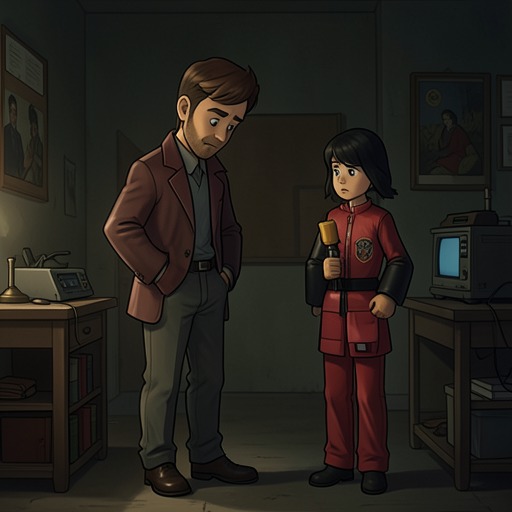
Scott Is Placed in the Dollhouse by Beth
The Shrinking ManScott Carey’s placement in the Dollhouse by Beth Carey turns a domestic gesture into a near-fatal encounter: for Beth, lifting her father is an easy way to help him, but for Scott, her hand is powerful enough to bind and nearly crush him. The episode gathers the consequences of his shrinking into one intimate scene, where love and danger coexist because the family can no longer safely share the same physical world.
The Dollhouse as a Domestic Arrangement
The Dollhouse enters Scott Carey’s life when he is ten inches tall, at a point when shrinking has also begun to silence his work. “Life in a Dollhouse” was the title of the last chapter of his book; after finishing it, he found he could write no more. A pencil, even the smallest one, was as large as a baseball bat. He considered using a tape recorder, but before he could do so, he had become unable to communicate. The dollhouse therefore arrives not simply as a toy, but as a proposed home at the edge of his diminishing ability to participate in ordinary life.
Louise Carey brings home a deluxe model, made affordable by sales and resales of Scott’s book. At first he is resting on a cushion beneath the couch, where Beth will not accidentally step on him. He crawls out to meet Louise as she kneels and brings her ear near his mouth. Although he initially means to tell her that he does not like the gift, he looks at her and says, “It’s very nice.” His response registers the care behind the offering even as the arrangement exposes how little his preference can alter the conditions imposed by his scale.
The house has a porch with a small wrought-iron railing, fluffy white curtains, hardwood floors, a window seat, candle brackets, and a fireplace made of false bricks. Scott recognizes an unsettling resemblance between standing on its porch and standing on the steps of Clarice’s trailer. Inside, however, the model’s charm is interrupted by its open side: one wall is missing, and Louise watches him through that opening. She later pushes the house against the wall behind the couch, giving him both privacy and the protection of four walls. The Dollhouse is refuge, but its visible opening and miniature construction also keep his dependence on the larger household in view.
A Home That Cannot Fully Function
By noon, the furniture has been installed, and Scott has asked Louise to provide practical adjustments. Beth is under strict orders not to approach him, while the House cat remains a danger if it gets inside. Louise adds an extension cord and a small Christmas-tree bulb for light, having initially forgotten that he would need illumination. Plumbing is impossible. These details make the home a negotiated adaptation rather than a complete solution: safety and light can be arranged, but essential conveniences cannot.
The furniture makes that limit tangible. The chairs, including those in the living room, have straight backs and no cushions; the bed has neither springs nor a mattress, so Louise sews cotton padding into a piece of sheet. More broadly, the furnishings imitate use without reliably enabling it. The piano’s keys are painted on and its interior is hollow; the refrigerator is a single solid piece; the stove knobs turn without producing heat; the sink’s faucets yield no water; and clothes placed in the washer would remain dirty and dry. Burning scraps in the fireplace would only fill the house with smoke because it has no chimney. Scott can occupy the miniature rooms, but their familiar objects mostly reproduce the appearance of domestic life rather than its functions.
Beth’s Ride and Scott’s Physical Danger
The later incident follows an earlier journey connected with the family’s move. While Marty is driving Louise and Beth to the railroad station, Beth notices a hook and thread caught on Scott’s trouser leg and plucks them free. Marty guesses that he picked them up in the cellar, then forgets the matter; Beth pockets the hook and thread and forgets them too. The forgotten objects offer a small measure of how easily Scott’s possessions and dangers can disappear from the attention of people who live at an ordinary scale.
In the ensuing encounter, Beth picks Scott up and carries him toward the Dollhouse. The movement is no harmless lift from his perspective: her hand clamps around his body from shoulder to hip, pins his arms, and squeezes out his breath as the room blurs and he begins to black out. She sets him on the porch, where he catches hold of the wrought-iron railing and finds Beth looking down at him with frightened eyes. She explains, “I gave you a ride.” Her words describe an act of help, but his body has experienced it as confinement and near suffocation.
Scott gets through the front door, shuts it, and snaps the tiny hook into its eye. He collapses inside, breathing with a dry rasp. Outside, Beth insists, “I didn’t hurt you.” Scott does not answer; he feels as though he has nearly been crushed in a vice. When Beth repeats that she did not hurt him and begins to cry, the difference between intention and consequence becomes explicit. She is not responsible for failing to understand fully what her hand can do, but Scott recognizes that he can no longer postpone asking Louise to keep her away from him.
Aftermath and Significance
After Beth goes outside, Scott retreats to the small cushions Louise has made for him and lies staring at the shadowy ceiling. The floor’s trembling and the crash of the front door mark Beth’s departure through sensations that his reduced body registers with painful force. He thinks of his lost child, and the narration turns to Beth’s birth: Louise’s long labour, Scott waiting through the night, and his attempts to rest in the car or pass the time in the hospital alcove. The recollection places the frightened child at the Dollhouse beside the daughter he had once waited to meet, intensifying the emotional cost of needing protection from her.
The episode’s reversal is not that Beth becomes cruel, but that ordinary care has become hazardous without either person intending harm. The Dollhouse protects Scott from accidental steps and offers privacy, yet Beth can cross its scale boundary with a single movement. Its porch, railing, and closing door are at once the fixtures of a miniature home and the barriers Scott must use to recover control of his body. The scene makes shrinking a practical family crisis: affection remains, but safe contact must be renegotiated because the same gesture now carries radically different consequences for father and daughter.