Scott climbs the lawn chairs to reach the bread
The Shrinking ManScott climbs the lawn chairs to reach the bread is a survival action that converts despair into a practical, precarious ascent. In Carey’s cellar, Scott Carey treats an immense lawn chair as a cliff, invents climbing equipment from pins and thread, and reaches a distant piece of bread. The food matters, but the decisive change comes earlier: after contemplating surrender, he recognizes that he is still alive and chooses to act as if continued life remains possible.
From surrender to a plan
Scott begins by circling a cement block in search of food, chewing a dirty cracker crumb after scraping its surface. The alternative is to return to the box-top shelter and sleep again; above him lies the spider’s territory. Faced with that choice, he stops, and the narrative marks a small but consequential shift in his attention: a spark of resolve replaces his near-listless uncertainty. He reasons that the cellar is his universe, and that its values and meanings need not be imposed from outside.
He acknowledges that he had planned suicide, while remaining unsure what stopped him. He can call it fear, a subconscious wish to survive, or an outside intelligence preserving him; the cause remains unresolved. What is certain is that he is alive and that he can still make decisions. He decides to act alive. A large piece of cracker behind the cement block offers an immediate, concrete reward for this decision, though it tastes horrible. He eats it and turns toward the clothing carton, aware that the undertaking ahead may end either in success or death.
Making tools for the climb
Scott enters the carton and slides down its piled clothes into the sewing box, where a heavy needle proves too difficult to carry up the cellar’s steep rise. Rather than abandon the attempt, he changes his equipment: a pin will serve better. He topples the rubber cork that holds the pins and needles, pulls out a pin, and cuts a short length of Thread climbing line by sawing through its fibers with the pin’s point. He ties the line around the pin so he can carry it across his back. The improvised sling is a practical answer to a problem of scale: a tool useful on the floor would become an impediment during the ascent if it dangled loose.
He then imagines a second pin bent into a grappling hook. A length of Thread climbing line attached to it can catch in openings in the Lawn chair, allowing him to climb one section at a time. He extracts another pin and about twenty feet of line, then drags both out of the carton. His preparations include food and water: he plans to carry cracker pieces and a fragment of Sponge soaked from the hose. By the time he reaches the foot of the chair, he has bent the second pin beneath the cement block, torn off the Sponge, collected water and food, and transported the supplies. The equipment is crude and heavy, but preparing it has already displaced his thoughts of suicide with the satisfaction of working toward a goal.
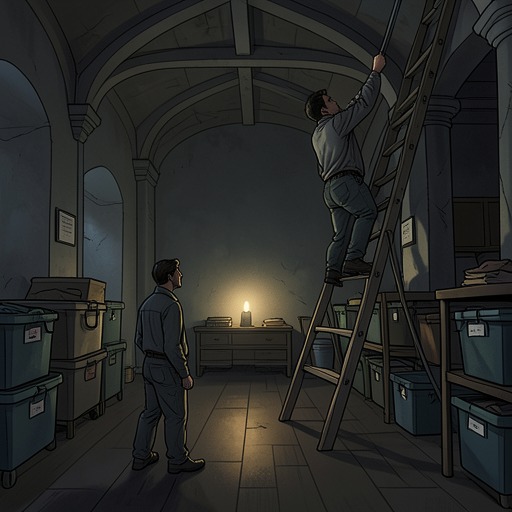
The height nearly undoes that new confidence. Looking toward the top of the chairs, he confronts the whole route at once and feels the scale of the task. He checks the panic by dividing the climb into stages: first a shelf, then the first chair’s seat, then the next chair’s arm. The segmented plan does not make the ascent safe; it makes the next step imaginable. He starts upward with the Pin hook, carrying the Pin spear, food, and water.
The ascent and its reversals
When he is next seen resting on the broad slat of the lower Lawn chair, he is chewing cracker beside the coils of Thread climbing line, the Pin hook, and the Pin spear. The climb has already cost him: one knee is swollen after striking a chair leg, and he has used only a few drops of water squeezed from the Sponge. The cellar is quiet, and the window shows a square of light. He wonders whether Louise Carey and Beth Carey are home, then deliberately turns his thoughts away from them, recognizing that they are no longer part of the life he is managing here.
The route upward is not a simple continuation from where he rests. To reach the upper chair’s arm, Scott calculates that he must gain about fifty feet, but the seat offers no suitable place to catch the hook. He therefore has to descend partway and climb along the chair’s back. The lower shelf slopes down almost to the floor; its gaps can be bridged with the hook and line, but the vertical rise to the seat has been difficult. Even after planning this detour, the roar of the oil burner catches him while he is crossing a gap. The noise shocks him into trembling, a reminder that ordinary household machinery can become a bodily threat at his scale.
A fall scrapes his hand and presses water from the Sponge onto his body. Scott tears a strip from his robe to bind the injury, tightens the knots in his sandal so it will not slip off again, and modifies his technique. He fastens the Thread climbing line to the Pin spear before throwing it across a gap; this keeps the spear from rolling away and makes the crossing work. He maneuvers across the orange chair’s sloping seat, then climbs its back by catching the hook on successive braces. The method is painstaking, but each adjustment turns a previous mistake or danger into usable knowledge.
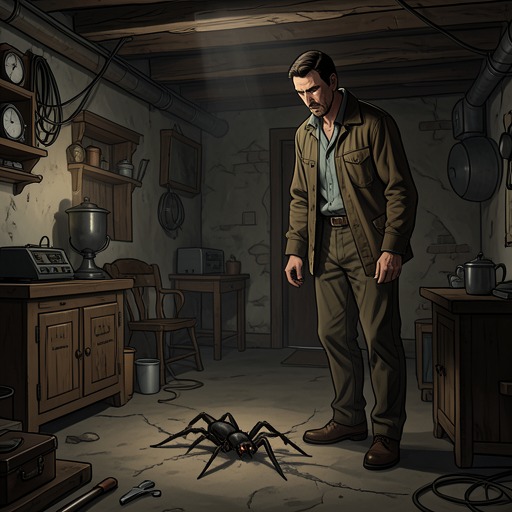
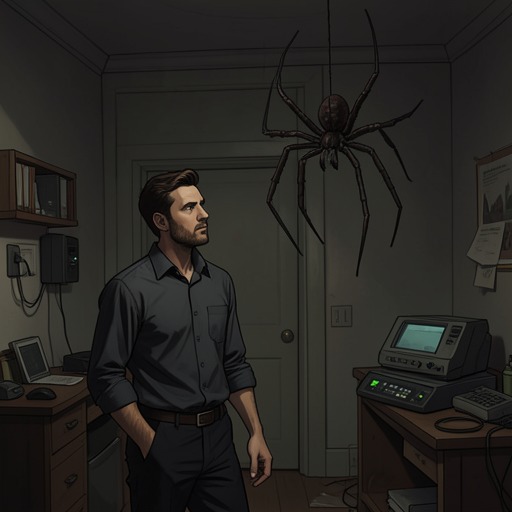
The Black widow spider remains a threat throughout, even when it is not visible. Scott has feared it as a creature that seems to sense his presence, and his imagination makes it the embodiment of anxieties and unknown dangers. During the climb he bends the Pin hook again when it begins to open under strain, unwilling to risk its failure while he hangs in space. He eventually reaches the croquet wicket and climbs its curving metal length, repeatedly losing his balance and swinging beneath it. As fatigue worsens, he pulls himself along underneath, with the line and other equipment swaying below him. At the upper chair’s shelf, his muscles cramp; he lies gasping with his forehead against rough wood and his feet projecting over a drop he estimates at seven hundred feet.
Bread, return, and the meaning of the climb
After resting, Scott looks down at the cellar. The red hose, cushion, floor opening, and box-top shelter have shrunk into distant shapes: the hose resembles a motionless serpent, and the shelter a small gray square. He gathers his strength, eats the remaining cracker, drinks from the Sponge, and reaches the top. Dropping the climbing gear and spear, he shelters behind the glass base of a large fuse and surveys a dusty, open expanse of pipes, wires, debris, paint cans, and jars. The bread lies about two hundred yards away.
Scott cannot be sure the spider is dead or gone. He scans the scraps of wood, stones, cardboard, cans, and jars, but sees nothing. Hunger nonetheless becomes stronger than caution. He drives the Pin spear into the sand, breaks off bread, and eats until his appetite returns. He finishes the water, discards the Sponge that has served its purpose, then cuts off a much larger piece of bread. Using the Pin hook, he drags it across the sand, leaving a furrow behind. At the edge, he pushes the chunk over the brink; it falls in flakes and crumbs and breaks into three pieces on the floor.
The immediate objective is achieved: Scott has made the difficult climb and obtained food. Yet his body remains tense, and the knot of distress in his stomach does not lift simply because the spider is nowhere in sight. The ascent therefore ends in a qualified victory, not security. Its central reversal is from intended self-destruction to deliberate effort: tools assembled from sewing supplies, water carried in Sponge, and a journey divided into manageable stages give Scott a way to act within an immense and hostile environment. The bread confirms that his labor can meet a need, while the unresolved danger and lingering fear keep that success provisional.