Scott decides to survive and climb the cellar cliff
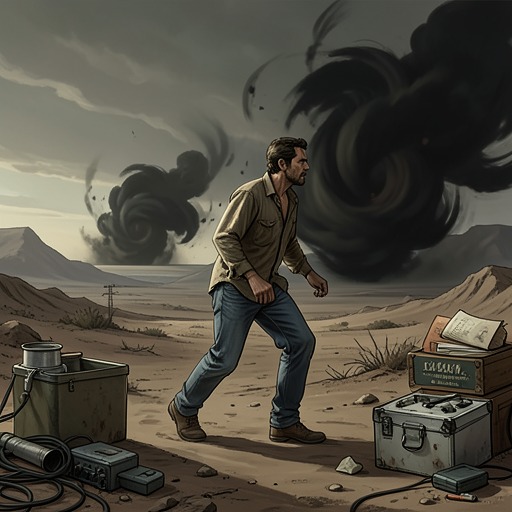
The Shrinking ManScott decides to survive and climb the cellar cliff at the moment when mere endurance begins to become deliberate action. After considering suicide while trapped beneath the box top, he wakes smaller, sick, and still alive; rather than accept either a miraculous explanation or the label of a will to live, he chooses to act as though survival remains possible. The decision turns the cellar’s ordinary debris into equipment and its furniture into a mountain route, converting despair into a hazardous, practical undertaking.
From Exhaustion to Decision
Scott lies beneath the box top, listening to a spider crawl over the cardboard. He is thirsty enough to draw his hand back from a fragment of damp cracker, and so exhausted that even memories of the failed antitoxin treatment no longer have much force. He has imagined waiting until the spider leaves and then walking over the cliff to end his life. Instead, he falls into a heavy sleep.
When he wakes, the oil burner has clicked off and the cellar is silent. His headache and fever have eased, but his body still aches, and he cannot tell himself that sleep was an act of courage or a sign of some benevolent protection. He recognizes that he had neither a will to live nor, despite his earlier plan, a will to die. The box top’s increased weight confirms what he had meant to check against the ruler: overnight, he has shrunk to two-sevenths of an inch. He struggles out from beneath the cardboard, then walks unsteadily across the cement without measuring himself. The diminished body and the passage of another night make the crisis physical as well as philosophical.
At the box top, he considers going back to sleep and surrendering again. The spider’s territory rises above him, but he makes himself look for cracker crumbs instead. Finding one dirty crumb, scraping it clean, and chewing it becomes the small action from which a larger decision develops. He asks himself whether the cellar is his universe and whether he can determine its values and meanings. Whatever kept him from suicide, he concludes, has left his existence unbroken; he can still make decisions. He tells himself to act alive, and the choice shifts his attention from the finality of his circumstances to the next task.
Turning Debris into Equipment
The change in purpose is accompanied by a concrete reward. Behind a cement block, Scott finds a large piece of cracker, cleans it, and eats it despite its bad taste. He treats it as nourishment, then heads toward the clothing carton, whose contents had already sustained earlier efforts: he had obtained thimbles and material for a robe there, as well as thread used to reach crackers. His earlier fury at the carton, which had once driven him to kick it open, has become useful in retrospect. The objects gathered during previous struggles now make a new attempt conceivable.
He first picks up a needle, but it is too heavy to carry up the cliff. He replaces it with a pin, prying one from a rubber cork after forcing the cork to topple. To keep the pin from dangling or cutting him as he climbs, he makes a sling from thread, weakening the fibers with the pin’s sharp point and tying loops around its head and near its point. The improvised carrying method is a practical response to the scale of the obstacle: even a small tool is cumbersome to a person now only two-sevenths of an inch tall.
A second pin becomes a proposed grappling hook. Reasoning from the equipment used by mountaineers, Scott rejects cleated shoes and alpenstocks as unworkable but recognizes that a bent pin attached to a long thread could catch in openings in the lawn chairs. He takes another pin and, to his scale, roughly twenty feet of thread from the carton, carries them out, and drags them across the floor. He also prepares food and water: cracker crumbs and a piece of Sponge soaked with water from the hose, carried in his robe. The pin spear, the pin hook, and the water-bearing Sponge give the climb its basic tools, though he knows that only two days remain to him regardless of what he attempts.
The Climb and Its Cost
Bending the hook by levering its point under the cement block takes tremendous effort. So do tearing off the Sponge, collecting water and crackers, and hauling everything to the foot of the lawn-chair cliff. Yet the work itself marks a decisive contrast with the night before: suicide has become a distant impossibility, and Scott is pleased simply to be alive and trying. His excitement falters when he looks up at the chairs, which rise toward the wall like Everest. The scale of the route remains daunting even after he has built equipment for it.
The route requires more than a direct ascent. Later, Scott calculates that the chair arm lies about fifty feet above his position and sees that there is nowhere for his hook to catch on the face nearest him. He must descend partway and climb around the back, where he can thread the hook through openings between the slats. The lower shelf slopes beside the seat and is comparatively manageable; the vertical rise to the seat is the hard section. As he works, the thread and hook bridge gaps that his body cannot cross unaided. The cellar’s construction dictates the route, turning slats, gaps, and chair supports into successive stages of a mountaineering problem.
At the chair’s top slat, after an hour of climbing, the pin hook is almost unbent. Scott lies down, exhausted, and looks back across the immense face he has just climbed. He remembers that his back once could have covered that whole area and that he once could have carried the chair. The comparison gives the ascent its bodily measure: the furniture has not changed, but his shrinking has transformed it into a landscape. Exhaustion briefly quiets thoughts of the spider and the past; after what seems to have been a short, dreamless sleep, he takes up his equipment and crosses the chair arm with the thread trailing behind him.
The next stages remain precarious. He hooks onto a croquet wicket and climbs its smooth, curved metal length while carrying the weight of the thread, hook, and spear. Several times he loses his balance and spins beneath the wicket, hanging there until he can recover his grip. By the time he reaches the upper chair’s shelf, his muscles are cramping, his forehead is scraped against rough wood, and his feet extend over a drop that looks seven hundred feet deep. From above, the cellar changes scale again: the red hose resembles a motionless serpent, the cushion a flowered plain, and the box top where he slept a small gray square. The ascent has made the familiar cellar appear both vast and newly legible.
Bread Reached, Danger Unresolved
From the chair, Scott reaches the clifftop and takes shelter behind the glass base of a large, bell-shaped fuse. In the shaft of light near the dusty window, he sees pipes and wires overhead, scraps scattered across the floor, and paint cans and jars looming in the distance. He looks carefully for the spider but cannot see it. Its absence does not reassure him: he believes it has sensed him before and may remember him. He plants the spear in the sand and begins eating a piece of bread, whose taste restores an appetite the crackers had not satisfied. After eating and drinking the remaining water, he throws away the Sponge that has carried it.
The bread is too large to carry intact. Scott hacks off a piece about twice his own size, catches it with the hook, and drags it back toward the cliff, cutting a road through the sand. At the edge, he props the chunk upright and pushes it over. It falls, sheds crumbs like snow, and breaks into three pieces on the cellar floor. He has completed the difficult climb and secured food, but the expected relief does not arrive: tension remains in his body, and a cold knot of distress stays in his stomach. The event therefore ends not with safety or escape but with a limited achievement. Scott’s decision has carried him from passive contemplation of death into strenuous action; it has not made the spider, the shrinking, or the precariousness of his situation disappear.