Scott discovers water in the hose
The Shrinking ManScott discovers water in the hose at the point where thirst has narrowed his attention almost entirely to the need to drink. The discovery saves him from an immediate crisis, but its relief is sharply limited: water extends his survival without changing the conditions that make survival so precarious. The scene turns on that difference between finding a resource and escaping danger, as a life-preserving answer emerges from an object he first mistakes for a wall.
Thirst and the Hole
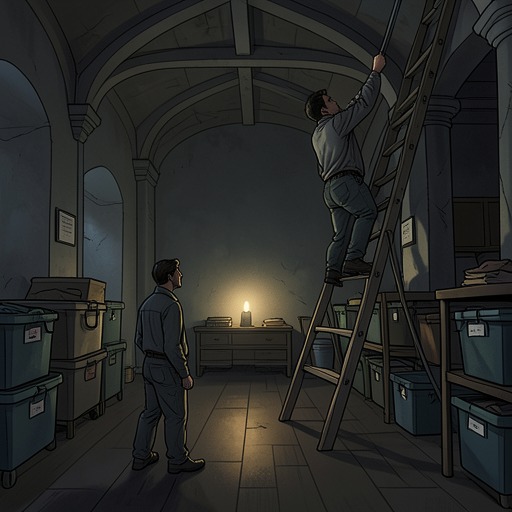
Scott Carey walks across the cellar with his mind fixed on water. He cannot reach the tank, and the drops in the Cracker box are beyond his ability to climb to; the need is immediate, while the available supplies seem inaccessible. This narrowing of attention shapes the scene before he finds anything. He walks slowly, looking down and scarcely seeing, as thirst overtakes his awareness of the space around him.
He nearly falls into a hole in the cement floor. At its edge he catches himself, kneels, and peers into a cavity that looks like a well but breaks off about fifteen feet below into darkness. Holding his breath, he distinguishes a faint sound beneath his own laboured breathing: water dripping. The hole offers evidence of water but no safe means of reaching it. Its depth turns the sound into a torment, and Scott lies on his stomach listening while thirst makes swallowing painful and his tongue strains against his dry mouth.
For a moment, he nearly dives headfirst into the opening. The impulse is not a plan but the crisis speaking through his body: he is prepared to risk death rather than endure the thirst. He turns away on rigid legs, fists clenched, still thinking of the hole as a possible entrance to another world. The possibility of such a plunge belongs to the scene's bleak irony: a descent might bring him toward water, yet could also end the life the water would preserve.
The Cellar Hose Reveals Its Use
As he walks away, Scott sees what first appears to be a red wall. When he prods it, he recognizes the Cellar hose. He circles its serpentine bulk until he reaches an end and sees a long, shadowed tunnel curving away from him. The ordinary hose has become, at his scale, both landscape and passage; what looked like a barrier can be followed into the cellar's hidden contours.
Scott recalls that water sometimes drips from a hose when it is lifted. He steps onto the metal ring at its end and stands in a groove, thinking through that practical possibility. The recognition changes the direction of his search: rather than attempting the dangerous hole or returning to an unreachable source, he follows the hose itself. He runs clumsily along its smooth interior, striking the hard walls when it twists abruptly. The route keeps turning until, after what seems to him the hundredth bend to the right, he reaches cold liquid deep enough to cover his ankles.
Relief, Not Rescue
Scott squats and lifts trembling handfuls of water to his lips. It tastes stale and hurts his throat as he swallows, but he drinks eagerly, with a gratitude that makes even the finest wine seem an inadequate comparison. The physical details keep the discovery from becoming an easy triumph: the water is cold and unpleasant, his hands shake, and swallowing hurts. It is nevertheless drinkable, and after the earlier torment of hearing unreachable drops, that difference is decisive.
His relief also revises his view of his earlier efforts. He remembers repeatedly climbing down the Thread to reach the water tank and now regards those descents as foolish, because the hose has provided another source. The thought gives the moment a flash of comic self-reproach, but the comedy does not last. On his way back through the tunnel, Scott recognizes that the gain is reactive: the water preserves his minuscule existence a little longer, not the larger future that threatens it.
A Temporary Gain
The scene therefore makes survival real without making it secure. Scott wonders whether he will remain intact long enough to see the end of his existence, and whether that would count as triumph. His question grows out of the distinction between immediate bodily relief and an unchanged ultimate danger; the drink answers thirst, not the fate that gives the episode its pressure.
When Scott emerges into the cellar, he recognizes how weak he is from sickness and, more urgently, from hunger. Rest and sleep might ease the sickness, but hunger has only one answer. His gaze shifts to the towering cliff. The movement carries the episode forward: finding water closes one immediate need while exposing the next obstacle. The hose is a genuine resource, but the scale of the cellar continues to make ordinary necessities into difficult, dangerous undertakings.