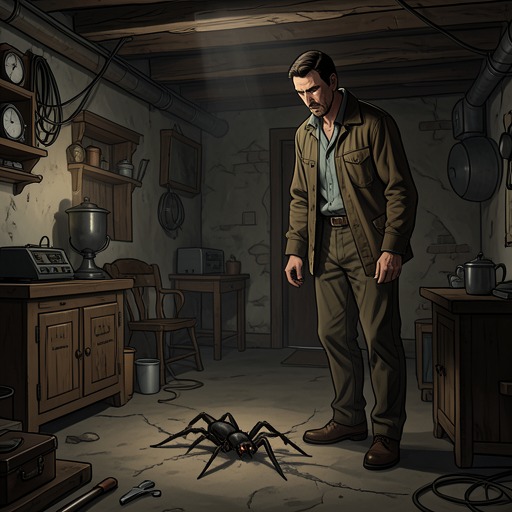
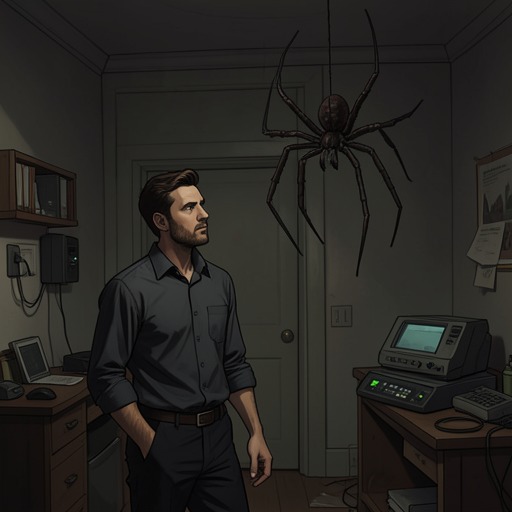
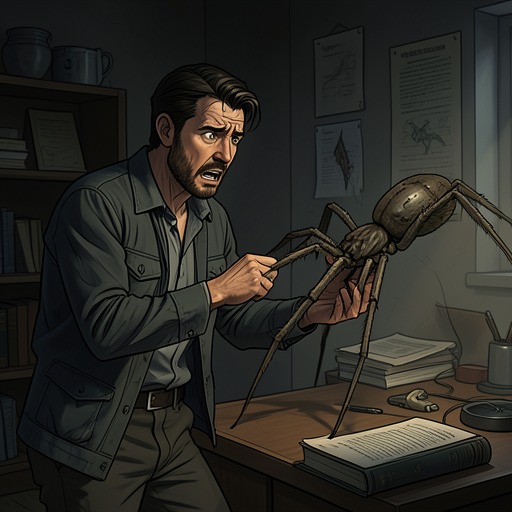
Scott hunts down the giant spider
The Shrinking ManScott hunts down the giant spider in a contest shaped as much by his shrinking scale as by his decision to stop fleeing. He understands the Black widow spider as more than an immediate predator: it has come to represent something he hates and believes he cannot coexist with. Since he expects to die eventually, he chooses to risk himself trying to destroy it. The hunt becomes a concentrated test of that choice, moving from careful preparation to a failed trap, improvisation, and finally the spider’s death. Scott survives the encounter, but it does not remove the danger of his wider predicament.
Decision and Preparation
Scott does not regard the decision as simple. He wonders whether he is acting because he cannot truly believe that he will disappear soon, just as a young, ordinarily healthy person may find death difficult to imagine. He sets that uncertainty aside: what matters, he decides, is what he does now. Rather than let fear decide for him, he commits to pursuing the spider even if the attempt costs his life. His resolve is therefore not confidence that he will win; it is a refusal to let the uncertainty of his future prevent action in the present.
His first plan borrows from the logic of hunting a larger beast. Scott will dig a pit, leave the Pin spear point-up in its base, lure the spider over it, and cover the opening after it falls. He uses the Pin spear to scrape out the sand, working for forty-five minutes before the pit is finished. The work itself creates a further hazard: without the Thread hanging down, he would be trapped in the steep-sided hole. He secures the spear point in the bottom with packed, wet sand, climbs back out by the Thread, and pulls the line after him.
The trap is designed to solve the problem of scale. Scott fears that confronting the spider directly with the Pin spear would leave him exposed to its force; from his reduced size, even its movement could knock him over. He recalls an earlier encounter in which its leg passed over him and rejects repeating that method. Yet the pit has weaknesses he cannot dismiss: the spider may climb the walls, avoid the point, or spring away before reaching it. He finds a flat piece of cardboard wide enough to cover the opening and settles on a sequence that depends on timing: the spider must fall, and Scott must close it in before it can escape. Knowing that hesitation may undo his resolve, he sets out to find it.
Baiting the Spider
Scott prepares stones as another means of provoking the spider. The oil burner roars in the distance, making the sand tremble; when it stops, he throws a stone toward the creature on its web. The first misses and tears a hole in the web. The spider moves, then becomes still again, while Scott’s own caution urges him to retreat. Instead, he continues. He throws another stone, then more, until the spider responds and comes down from the web.
The moment turns Scott from hunter into quarry. He runs across the sand toward the pit, repeatedly checking the spider’s position and struggling to keep his direction. His fear becomes acute enough that he briefly thinks he is falling, though he is still running. He cannot see the pit at first, and the spider is gaining on him. When the pit finally comes into view, he stops at its edge rather than immediately leaping away. The plan requires him to wait until the spider is almost upon him, making the trap’s success depend on holding his ground at precisely the point when flight seems most urgent.
The Trap Fails
Scott springs aside at the last moment, and the pursuing spider falls into the pit. He slides the cardboard over the opening and throws himself across it, attempting to hold it shut while the creature struggles underneath. For an instant he believes that the plan has worked. Then the cardboard tilts, and he has to leap clear as the spider forces its way out. The creature emerges with the Pin spear still impaling it, dragging the weapon behind; the intended trap has failed to contain it, and Scott is again exposed at close range.
The failure does not end the encounter. Scott turns to the Thread and a Pin hook, swinging the hook around himself before the spider runs into it. He secures the line around a heavy piece of wood, making the wood an anchor that restrains the spider’s movement. The arrangement gives him room to act, but it does not make him safe: the creature can still reach toward him, and at one point a leg catches his shoulder before he breaks free. The Pin hook, Thread, and anchor thus replace the pit as a means of controlling distance, converting items he can handle into an improvised restraint.
Killing the Spider
With the spider tethered, Scott takes up the Pin spear again. He uses it repeatedly when the creature surges toward him, keeping the point between them. As it weakens, he has the option of leaving it to die on its own. Instead, he chooses to approach and end the struggle. The decision marks a change in his attitude within the fight: the spider remains the threat he set out to destroy, but Scott also feels pity for it and does not want its suffering to continue. He enters the limited space created by the tether and meets its final lunge with the spear.
The spider falls still on the sand, and Scott collapses unconscious after the confrontation. When he comes around, he confirms that the encounter was not a dream. The spider is dead, but the result is not a complete escape or a safe ending. It is almost night, and Scott still needs the Pin hook; more immediately, he has to get down the cliff before darkness makes the descent impossible. The killing therefore resolves the immediate predator-prey conflict while leaving the practical danger of the landscape and the approaching night in place.
Significance of the Encounter
The hunt is organized around a reversal of scale. Scott cannot meet the spider on equal physical terms, so he builds a pit, uses a cardboard cover, and turns the Thread, Pin hook, wood, and Pin spear into a sequence of devices for managing distance. Each plan is vulnerable to failure, and the fight advances through improvisation rather than mastery. The pit does not hold; the tether does not remove danger; survival depends on Scott adapting while the spider remains capable of reaching him.
His motive also exceeds simple self-preservation. Scott recognizes the Black widow spider as a symbol of something he despises and cannot accept living alongside, yet he does not claim certainty about what the hunt will accomplish or whether he will live. By acting despite that uncertainty, he makes the present struggle more important than speculation about tomorrow. The final choice to end the spider’s suffering complicates the initial resolve to destroy it: Scott’s resistance is fierce, but it does not erase his capacity for pity. The event closes with a hard-won victory that brings neither restoration nor repose, only a dead predator, a recovered consciousness, and the next urgent task of descending before night.