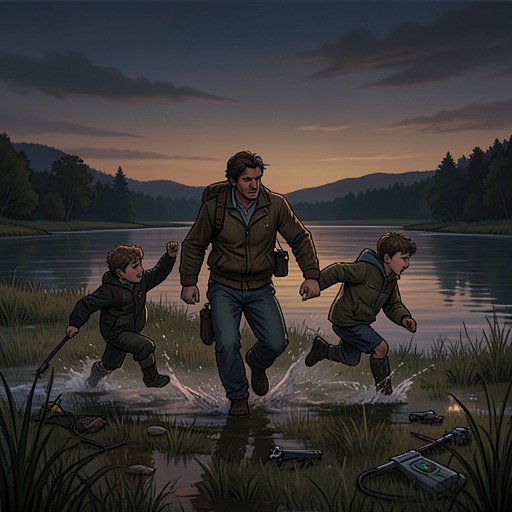
Scott is assaulted by three teenage boys
The Shrinking ManScott is assaulted by three teenage boys in an encounter that turns his reduced size from a private physical condition into a source of immediate danger. The boys first treat him as a child to be mocked and controlled; when they recognize him as the shrinking man, their curiosity becomes more threatening. Scott escapes, but the pursuit ends not in safety so much as exhaustion, fear, and a silence he carries home to Louise Carey.
Encounter and Pursuit
The episode begins with Scott sitting alone on a bench as three youthful figures pass nearby, singing. Their ordinary ease sharpens his sense of difference: he watches them with envy, conscious that they can grow up without treating their bodies as a public problem. When he hears their laughter and realizes they may be talking about him, he leaves the bench and heads toward the sidewalk. Rather than run from three boys, he keeps walking, even as they follow and close the distance.
They catch him before he reaches the sidewalk. One seizes his arm and addresses him with false friendliness, asking where he is going. Scott demands to be released. The boys continue their mockery, and one blows cigarette smoke toward him, provoking a cough that becomes another occasion for ridicule. When Scott tries to push past them, they shove him back and warn him not to try again. Their performance of concern makes the threat more humiliating: they present their aggression as if it were restraint on behalf of a helpless child.
The encounter also exposes how little control Scott has over the terms on which others see him. He is an adult, but the boys speak to him as a small child and turn his size into permission to taunt him. Their attention shifts from teasing to insulting remarks about his family. Scott lunges between two of them, and the boy in the cap grabs him and strikes him. Scott retaliates with a blow to the boy’s stomach, but the others seize his arms and the leader hits him again. The brief exchange shows that Scott can resist physically, yet his strength cannot reliably overcome the advantage of three larger attackers.
Recognition and Reversal
The boys’ view of Scott changes when one lights a match and examines his face. He recognizes that Scott is not an ordinary child but the shrinking man, and the others confirm that they have seen his picture on television. Recognition does not bring help or respect. Instead, the boys interpret Scott’s attempt to pass as deception, and their taunting takes on the added force of public exposure. The man who had hoped to move through the street unnoticed has been identified through the publicity attached to his condition.
For Scott, this discovery brings a sharp emotional reversal. Before the boys recognize him, he is angry at their treatment and tries to resist it; once he understands that they know his identity, despair overtakes that anger. He fears they can reveal who he is and connect him to the place where he lives. The matchlight, held close as they inspect him, makes recognition a face-to-face confrontation rather than a distant piece of gossip. His smallness is no longer merely visible; it has become an identity the boys believe they can use against him.
Escape from the Boys
When the boys restrain him, Scott kicks free and runs up the broken incline toward the sidewalk. He nearly loses his footing at the edge, but catches himself and continues despite the effort of running. He sees his house ahead and immediately rejects the apparent refuge: if the boys follow him there, they may learn where the shrinking man lives. He turns into a dark alley instead, trying to put distance between himself and the pursuers without leading them home.
The alley offers no secure hiding place. Scott runs around the back of a darkened house and across its yard, then reaches a fence that blocks his route. He scrambles up, slips, and tries again. One of the boys catches his foot and drags him downward. Scott kicks the boy in the face, breaks free, and gets over the fence, but continues with a limp. The reversal is limited but decisive: he cannot overpower the group in a direct contest, yet quick resistance creates the opening he needs to escape.
At the next street Scott finds a cellar door standing open. He half slips, half jumps down the steps and pulls the heavy door shut. Its movement knocks him off balance, and he ends up on the cellar floor. There, the chase finally stops. He is left unable to rise at once, breathing hard and shivering in the cold, damp space. The cellar functions as immediate cover, not as a planned refuge: his route has been dictated by pursuit, and the open door offers the first concealment he can reach.
Aftermath and Significance
Once the danger has passed, Scott begins to cry. The narration frames the breakdown as the despair of a frightened little boy rather than as an adult’s composed response to a street assault. That contrast does not erase his adult identity; it shows how the boys’ treatment, his physical vulnerability, and the sudden loss of anonymity have left him overwhelmed. He has fought back and escaped, but survival in the moment does not restore a sense of safety.
Later, when it is safe, Scott limps home, chilled and shaken. Louise is frightened and repeatedly asks what happened. He does not answer; he only shakes his head on the pillow. His silence leaves the assault undisclosed between them, even as her fear makes clear that she recognizes something is wrong. The event thus extends beyond the boys’ attack: Scott returns home alive, but does not turn the experience into a story he can share.
The episode links physical scale to social power without treating Scott’s smallness as a simple metaphor. The boys can restrain him, pursue him, and make his home seem unsafe, while his adult judgment remains active in his decision to flee, conceal his destination, and fight for an opening. Their recognition of him from television also gives publicity a double edge: it has made him recognizable, but recognition offers no protection from cruelty. The cellar refuge and the silence at home close the sequence on a narrow victory—Scott gets away, yet remains isolated with what happened.