Scott kills the cellar spider
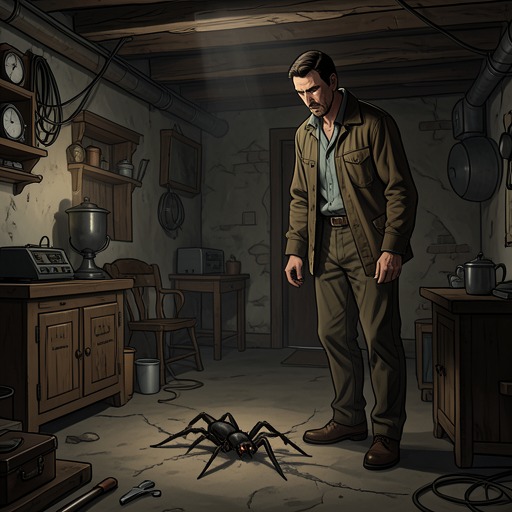
The Shrinking ManScott kills the cellar spider in a contest that turns his shrinking body into a tactical disadvantage and makes survival depend on planning, adaptation, and resolve. He begins by setting a trap, but when the spider escapes it, he must face the creature directly. The victory ends a sustained source of fear, yet it is neither easy nor certain: each plan leaves him exposed, and the failed trap makes the final outcome depend on his ability to respond under pressure.
Decision and Preparation
Scott’s decision to fight is personal as well as practical. The spider has come to represent something he hates and cannot coexist with, so he chooses to risk attacking it even though he expects his own life to be finite. He also recognizes that this resolve is not entirely settled: the prospect of disappearing tomorrow feels unreal, as death can seem unreal to the young and apparently normal. Rather than resolve that uncertainty, he narrows his attention to the present and decides that the spider should die too. The decision gives him an immediate objective without making the future more comprehensible.
The size of the opponent dictates the method. The spider is four times Scott Carey’s size, and his small pin would be a poor weapon in a direct encounter. He therefore thinks like a hunter and chooses a pit: if the spider falls into it, the pin can stand upright as a spike. Using the pin to scrape the sand, he digs for forty-five minutes. The labor leaves him exhausted, but the trap also risks trapping him; he relies on the thread hanging into the pit to climb back out.
After resting, Scott plants the spear-pointed pin at an angle, secures it with damp sand, climbs out on the thread, and retrieves the line. He considers the weaknesses in his plan. The spider might climb the pit wall, miss the pin, or leap clear. He rejects trying to hold the pin out himself because the impact could knock him down, and he remembers how vulnerable he was when a spider’s leg swept over him before. He also needs a cover for the pit: burying the spider would take too long, so he finds a flat piece of cardboard wide enough to cover the opening. His plan is to lure the spider into the pit, cover it, and hold the cardboard down until the spider is dead.
Luring the Spider
Scott does not wait for his fear to subside. He knows that delay could undo his resolve, so he sets off across the sand to find the spider. He gathers ten stones and places them before him. When the distant oil burner roars, the sand trembles; after it clicks off, he throws the first stone at the spider. It misses and tears through the web. The spider moves, but remains there, leaving Scott to decide whether to continue provoking it.
He throws another stone, then a third. That one strikes the spider, which jumps onto the web and moves across it. Scott continues throwing stones, damaging the web and keeping the encounter in motion. He shouts for the spider to come, then turns and runs. The challenge that was meant to draw it out has worked: the spider leaves the web and pursues him across the sand.
The chase makes the prepared trap difficult to locate. Scott glances back and sees the spider closing the distance, but looking behind him interrupts his search and intensifies his panic. He cannot find the pit at first. Still running, he jumps to look over the sand, lands heavily, and keeps searching. When he finally spots the raised edge of the pit ahead and to his right, the spider is nine yards behind. Scott changes direction and races toward it, then stops at the edge. The trap will work only if he waits there long enough for the spider to approach.
The Trap Fails
Scott holds his position as the spider bears down on him. At the last moment, he springs aside. The pursuing spider falls into the pit, and Scott moves quickly to slide the cardboard over the opening. He throws himself across the cover to keep it in place. The spider’s movement beneath the cardboard makes clear that the pit has contained it, but not that it has killed it. When the cover begins to lift, Scott is forced off it and jumps clear.
The spider climbs out with the pin still lodged in its body. The trap has wounded and delayed it, but failed in its decisive purpose. Scott backs away, then notices the pin hook in his hands. He runs with it while uncoiling the remaining thread, turning equipment already at hand into a second plan. He swings the hook at the end of the line, and the spider runs into it. Scott loops the thread around a heavy scrap of wood to hold the spider at a distance. When it charges, he flees; the taut line checks its advance, but one of its legs reaches him before he can get free. The improvised tether creates a moment of separation, not safety.
Killing the Spider and Aftermath
The pin hook is slick, and Scott throws sand over it before taking it up again. He braces his spear against his hip and uses it to keep the spider back. As it repeatedly leaps toward him, the spear strikes it again and again, weakening it until its attempts to advance become slower. Scott could leave it to die, but instead chooses to end the encounter himself. He moves within the space allowed by the binding, and when the spider makes one final leap, the spear brings it down. The spider is dead, and Scott collapses unconscious from the ordeal.
When he wakes, Scott confirms that the spider is no longer moving. It is almost night, and he still has to descend the cliff before dark. He approaches the body because he needs to recover the hook, then drags the hook across the sand to clean it. The task is finished, but its consequence is more than the removal of an immediate danger: Scott can now sleep without the box-top shelter and feels at peace. His victory does not erase the dangers of his reduced scale; it ends this particular period of fear and gives him a temporary freedom from guarding himself against the spider.