Scott meets Clarice and spends the night with her
The Shrinking ManScott meets Clarice and spends the night with her during a carnival visit that briefly turns shrinking from a condition of isolation into the basis for recognition and intimacy. Drawn by Clarice’s singing to a trailer whose furnishings fit his diminished body, Scott finds a place where he can sit, reach, and be held without the daily reminders of his lost scale. Their closeness offers a reprieve, but it cannot erase his marriage to Louise Carey or Clarice’s obligations as a performer; the encounter ends not with a settled future but with a promise to wait and Scott’s return to Clarice after Louise leaves.
Leaving the Car
Before he meets Clarice, Scott watches the carnival rides as if they belong to another world. Their movement recalls his own childhood visits, when he rode the Ferris wheel and Loop-the-Loop at ordinary human scale. The contrast makes the fair both familiar and estranging: the same kinds of attractions remain, but Scott now observes them from outside the life he once inhabited.
His decision to get out of the car begins in anger at confinement. He cannot lift the door handles, so he pushes a front seat forward, climbs over it, and struggles repeatedly with the door. He kicks it and strikes it with his shoulder before rolling down the window. From the narrow ledge he lowers himself toward the outside handle, slips, and falls against the car. The fall frightens him briefly because he realizes he cannot climb back in, but he recovers and walks away, expecting Louise to return eventually. The episode turns a frustrated attempt at escape into a deliberate movement into public space, despite the risks of being seen and the difficulty of navigating a world built at a different scale.
When a man appears near a tent, Scott runs for cover behind a trailer wheel. After the man leaves, a woman’s singing overhead arrests him. Scott moves out from beneath the trailer and looks toward a lighted, white-curtained window. The cries from the Loop-the-Loop interrupt his listening, but he returns and waits until the song ends. He then circles the trailer, looking up at its windows, unable to explain why the voice has drawn him there.
A World at His Scale
The trailer steps are just the right height for Scott. He climbs them and approaches a door he can reach, feeling an unfamiliar physical excitement as he recognizes what lies inside. The furniture is not merely smaller than the furniture that surrounds him elsewhere: it is usable. He can sit on the chairs and couch without being engulfed, stand beside tables and reach across them, and operate lamps instead of standing beneath them helplessly. For once, the room does not require him to adapt himself to objects made for much larger bodies.
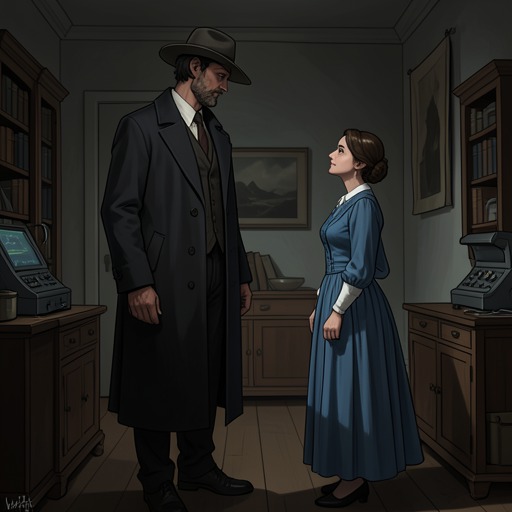
Clarice comes into the room and finds him there. She first asks who he is in a frightened whisper; Scott, absorbed by her face, tells her that he heard her singing. After a moment of nervous hesitation, she invites him inside. The words Mrs. Tom Thumb on the door identify the trailer as a performer’s space, but for Scott its importance is more immediate: it makes ordinary domestic actions possible again. His response is not simply curiosity about Clarice. The room offers a temporary reversal of his usual experience, in which chairs, tables, and lamps loom beyond his reach.
Recognition and Intimacy
Scott’s attraction to Clarice becomes explicit as the two speak and move closer. He tells her he wishes he could express what he feels; she steps toward him and rests her cheek against his. They hold each other in silence, both crying, and Clarice addresses him with tenderness. The scene gives physical form to their recognition: neither has to bridge the vast disparity of scale that defines Scott’s encounters elsewhere, and their embrace is possible without the furniture or another person’s assistance.
Their closeness also exposes Scott’s grief. He tells Clarice that he longs to be a man again so he can hold her as he wants to. The desire is not presented as an abstract wish to recover size; it surfaces in the immediate act of embracing her, where his body’s limits become painfully legible. Clarice asks how he came to the trailer, and he explains. When she wonders whether his wife will be frightened, Scott pleads with her not to make him leave. Clarice draws him closer, then remembers that she must give another show in ten minutes.
Clarice is troubled by what their attraction might mean. She insists that she has lived decently and struggles to explain why she feels so strongly toward him. Her reasoning rests on their unusual isolation: they are not simply two people among many others alike, and she believes they could travel a thousand miles without finding another person like either of them. That shared difference gives their attachment a force beyond the brief novelty of meeting, while leaving unresolved the moral and emotional complication of Scott’s existing marriage.
The Promise to Wait
A man knocks and calls from outside that Clarice’s time is nearly up. The interruption makes her public role concrete: she has another show to give, and the private room cannot protect them from the schedule governing her work. She breaks away to answer the knock, then tells Scott that Louise would be frightened. Scott responds by insisting that he will tell Louise and will not leave Clarice. Clarice says she was unfair to him, but he asks her to wait. At first she avoids his gaze; then she looks directly at him and agrees.
Clarice runs down the trailer steps, leaving Scott alone among the small furnishings. He walks around the room touching them, then goes into the other room and sits on her bed. He picks up her yellow silk robe and presses his face into its folds, breathing in its scent. The gesture shows how sharply her departure changes the room: the furniture that had seemed to restore a world within his reach now surrounds him with reminders of the person who has left it. Clarice’s promise gives him a future to hold onto, but it does not resolve how that future can coexist with Louise and his family.
Return to Clarice
Louise later finds Scott and breaks down in tears. She tells him it would be pointless and cruel to stop him, acknowledging that there is nothing she can do. She says she will come back in the morning, then drives away. Scott remains in the wind-swept street until the taillights disappear. He feels ill and miserable and recognizes that the situation is no longer the same as before; his return is not a simple continuation of his earlier escape from the car.
Yet when he sees Clarice’s trailer again, its lit window and accessible steps draw him back into the refuge he found there. The contrast is decisive: Louise’s departure intensifies his distress, while the familiar path to Clarice restores the pull of the other world. He runs to her. The encounter therefore offers neither a cure for Scott’s shrinking nor a resolution of his family ties. Its significance lies in the brief possibility it creates: at Clarice’s scale, Scott can enter a room, touch its furnishings, and share an embrace without being reduced to an object of pity or spectacle.