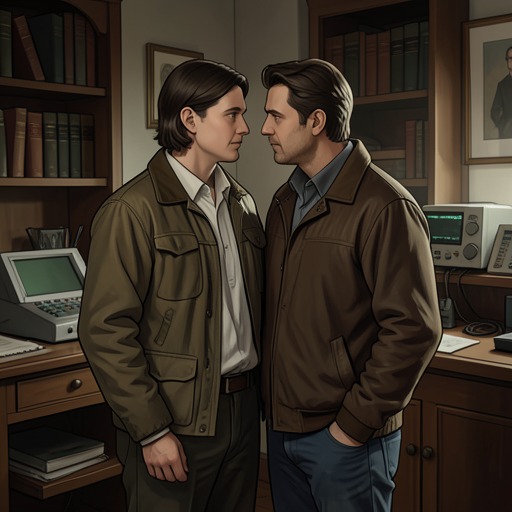
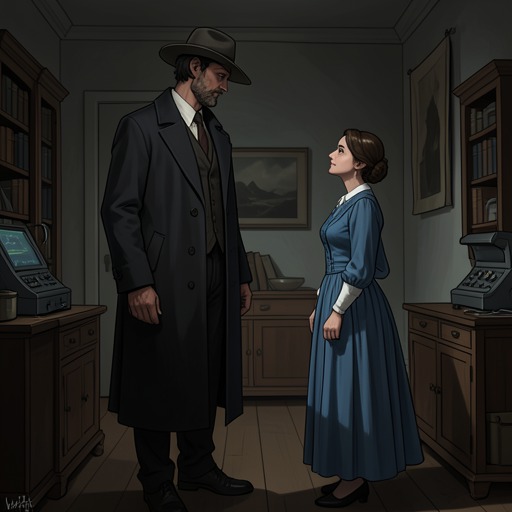
Scott meets Clarice at the carnival
The Shrinking ManScott Carey meets Clarice at the Carnival Grounds after slipping out of the car where he has been waiting for Louise Carey. The meeting is decisive because, amid a place that has become impossibly large around him, he finds a room arranged at his scale and a person who recognizes that she may be like him. His escape begins in frustration and exposure; it ends at the threshold of an unexpected human connection.
Leaving the Car and Entering the Carnival
The carnival first reaches Scott as a spectacle he can watch but no longer inhabit. The Ferris wheel’s small seats rock above the ground, the Loop-the-Loop’s arms flash past one another, and the merry-go-round turns to the distant grind and thump of its machinery. Those rides recall the boy he used to be: gripping a Ferris wheel safety bar, steering toy cars, and enduring the delighted dizziness of the Loop-the-Loop. The remembered carnival was a place of abundance and exhilaration; this one is another world, observed from a radically altered scale.
Scott’s decision to leave the car collides with the practical limits of his size. He cannot raise the door handles. After jerking at them, kicking the door, and pushing a front seat forward so he can climb over it, he rolls down the window and lowers himself onto its narrow ledge. He reaches for the exterior handle and swings down, but his fingers slip from the chrome and he falls against the car. The fall briefly makes him fear he cannot get back in; he presses on because Louise will return soon and because he has already decided not to remain inside.
Outside, ordinary distances become hazards. Scott jumps from the curb and crosses a street only after a car roars past; although it is several feet away, its engine and tires sound overwhelming at his scale. He darts behind a tent, then moves along its dark canvas wall, listening to the carnival. When a man rounds the tent and walks past without seeing him, Scott understands how readily people overlook anything below their ordinary field of attention. He threads his way beneath the tent ropes, using the gaps they make against the ground as passageways.
The Voice and the Trailer
A man’s approach sends Scott running for cover behind a trailer parked beyond the tent. From behind one of its thick tires, he watches the man search the area and then leave. Only after the immediate danger has passed does another sound redirect him: someone singing overhead. Scott recognizes the voice as coming from a lit window with a white curtain. The song leaves him restless; the screams from the Loop-the-Loop briefly break his absorption, but he returns to the trailer and waits until the singing ends.
The steps to the trailer door are the right height for him. Scott climbs them slowly, holding the railing, and approaches a room that appears to answer the scale of his changed life. Its chairs and couch are things he can sit on without being engulfed; its tables are within reach rather than towering structures he must pass beneath; its lamps can be switched on and off. Against the outsized machinery and furniture of the carnival, this interior offers not merely shelter but the possibility of ordinary use. The sign beneath the window identifies the trailer as Mrs. Tom Thumb’s, linking its miniature setting to the public world of the carnival while Scott experiences it as a rare space suited to him.
Recognition Between Scott and Clarice
A woman enters the little room and sees Scott standing there. When she opens the door, he nearly slips from the step and catches himself against the railing. She asks who he is in a frightened whisper. He gives his name, Scott Carey, but she does not recognize it. Her next question is whether he is like her. Shivering, he answers that he is. The exchange establishes their connection through what each can perceive in the other, not through reputation or an explanation of how their circumstances came about.
Scott tells her that he heard her singing, and she invites him inside. He accepts without hesitation, experiencing the welcome as if he had known her for a long time and returned from a long journey. Once indoors, he admits that he is the shrinking man. Clarice is silent for a moment; Scott cannot tell whether her response carries disappointment, pity, or emptiness. The uncertainty matters: recognition does not instantly dissolve his exposure or settle what she thinks of him. Yet they continue to look at one another, and when Clarice gives her name, their small hands clasp and remain together.
Significance of the Encounter
The meeting turns on a sharp contrast between being unseen and being recognized. Outside, the passing man fails to notice Scott because he does not look down; inside the trailer, Clarice sees him, asks whether they share something, and gives him her name. Scott’s scale has made familiar places and objects inaccessible, but here it also becomes the basis for an immediate, reciprocal recognition. The encounter does not explain Clarice’s circumstances or promise a settled future between them. It gives Scott something more limited and concrete: a person he can meet at eye level, in a room where chairs, tables, and lamps are usable rather than monumental.