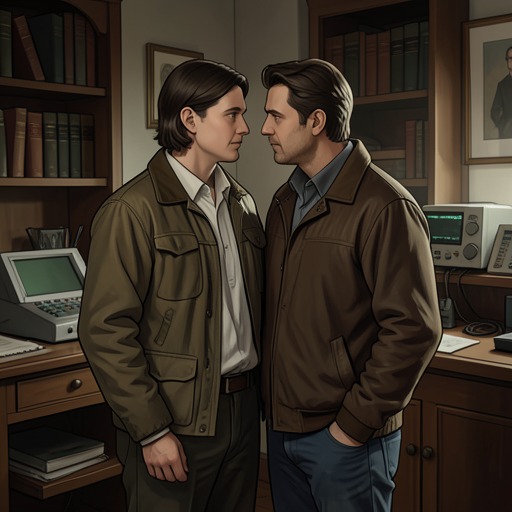
Scott spends the night with Clarice
The Shrinking ManScott spends the night with Clarice in an encounter that turns shared physical difference into intimacy and temporary refuge. The event matters not because it resolves Scott’s shrinking or repairs his marriage, but because it gives him a rare experience of being understood at his own scale. Its tenderness is inseparable from its cost: he must ask Louise Carey to accept his need for companionship, and the night offers relief without changing the future he fears.
A Meeting at Their Shared Scale
The encounter gathers force through physical gestures before either character can explain what they feel. Clarice looks at Scott for a long moment, steps close, and rests her cheek against his; he puts his arms around her. Soon she is sobbing against him, her hands catching at his back, while they cling together in silence. Their tear-wet cheeks make their recognition bodily and immediate. For Scott, whose shrinking has separated him from the ordinary proportions of the people closest to him, the embrace answers a deprivation that words alone cannot meet.
They sit together on the couch, holding tightly to each other’s hands and smiling. Clarice says that she feels close to him despite never having seen him before. Scott explains the connection through their shared pity and isolation. His wish to be a man again emerges in the same moment as his wish to hold her: the longing is not only for restored physical stature, but for the closeness and ordinary touch that shrinking has made difficult. Clarice tells him that he has been alone, while she has known others like them and has had time to adjust because she has lived this way all her life.
Clarice’s History and the Limits of the Refuge
Clarice’s account gives their connection a history beyond the immediate attraction. She tells Scott that she was once married and almost had a child. Her words reveal a life that includes relationships and possibilities Scott has lost, while her explanation that she has had time to adjust contrasts with his bewilderment at a condition he entered only after living at ordinary size. Their circumstances are alike, but their experiences are not interchangeable: Clarice has had a lifetime to inhabit her scale, whereas Scott is still grieving the family life and familiar world receding from him.
When Clarice asks how he came there, Scott tells her. She worries that his wife will be frightened if he stays away, and he urgently asks her not to make him go. Clarice draws him closer, then checks the time: she must give another show in ten minutes. The deadline places their private closeness inside Clarice’s working life, which continues even as Scott experiences the room as an escape from his other world. Her invitation to stay is offered with that obligation still pressing on the scene; it is not a promise that his larger predicament can be suspended indefinitely.
Clarice also worries about how her actions will be judged. She insists that she has lived decently and explains that the force of her feeling comes from the rarity of finding another person like them. In her view, their situation is unlike that of two people among a world of people who are all alike: they could travel a thousand miles without finding another. The claim makes their intimacy both personal and precarious. Their shared difference draws them together, but the scarcity that gives the bond its intensity also underlines how isolated they remain.
Louise Carey’s Decision
The encounter becomes a direct conflict when Scott explains his need to Louise Carey. He argues that they are no longer the same, that their lives have separated, and that she may have companionship if she wants it while he cannot. He expects her to remarry when his shrinking is over in the sense of reaching its end; for him, the prospect ahead is continued diminishment, loneliness, and eventual dissolution. Clarice, he says, offers companionship, affection, and love now. His request is specific: one night of peace, made possible in part because Clarice’s trailer has furniture suited to his size.
Scott’s plea does not conceal that his attachment has become love, but he presents the night as a brief chance to escape the loneliness of his condition, not as a cure for it. Louise Carey weeps silently as she listens. After struggling to contain her sobs, she tells him that stopping him would be pointless and cruel, and that there is nothing she can do. Her response is an act of painful permission rather than an uncomplicated endorsement. She promises to return in the morning, marking the separation as temporary while acknowledging the limits of what she can offer him.
Return and Significance
After Louise Carey drives away, Scott remains in the wind-swept street until the red taillights disappear. He then runs across the street, feeling ill and miserable, and thinks that he should not have done it and that things are not the same now. Yet seeing Clarice’s trailer, its lit window, and the small steps leading to it brings back the attraction of that refuge. Scott experiences the return as stepping into another world and leaving the sorrows of the old one behind. He whispers Clarice’s name and runs to her.
The movement from the embrace to the street and back gives the event its emotional shape: welcome is followed by hesitation, the pain of Louise Carey’s departure, and a renewed choice to seek Clarice’s company. The night does not erase Scott’s obligations or alter the course of his shrinking. Instead, it makes visible the human need those pressures have intensified. Clarice can meet him at his present scale and offer affection without asking him to become what he was; Scott, in turn, finds in her a form of companionship that the people in his former life cannot provide in the same way. The refuge is real but bounded, and the return to it is a moment of relief rather than a lasting escape.