Scott's attempt to escape during the move
The Shrinking ManScott's attempt to escape during the move is a two-part effort to prevent his family from leaving him behind: he tries to attract Marty and then devises a hook-and-thread method of being carried upstairs. The move converts the cellar's familiar obstacles into the machinery of a separation he can see but cannot explain. Scott's failure to make himself heard leaves Louise Carey believing he is dead, while his effort to follow the family ends in a fall and, later, an uneasy rescue by Beth Carey.
The move and the first appeal
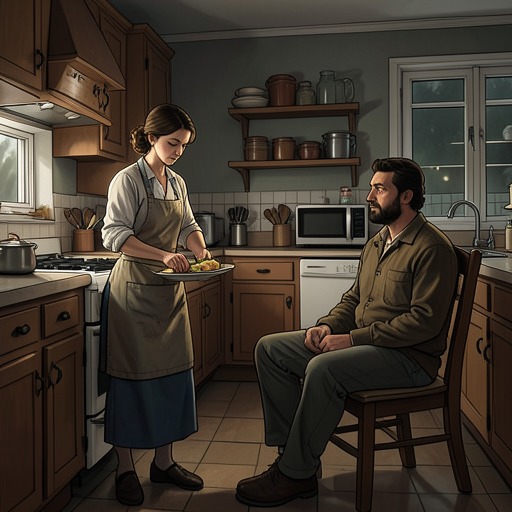
Cartons and household objects fly across Carey's cellar as Marty and Beth Carey pack. Two canvas chairs crash against the lawn chairs; a net pole, immense from Scott's perspective, drops against the cellar wall. When Marty drags a second suitcase from the table, Scott understands what the packing means: the family is moving. The sight turns household activity into an immediate threat. He runs toward his brother, calling out, but Beth crosses the floor in a few strides and bends to take the suitcase. Scott's robe catches underfoot as he tries to follow, slowing him at the moment when speed matters most.
At the steps, Marty turns, and Scott briefly believes that his cries have reached him. He waves his thin arms and calls again. But Marty turns his enormous head toward Beth and asks whether she is ready; Scott's presence remains unrecognized. Beth says there are still some things to take, and Marty says they can return. The exchange offers Scott a narrow possibility: Marty will come back down. Before that possibility can help him, Scott reaches Marty's shoe, claws at its raised sole, and beats his fists against the leather. He begs his brother, but the shoe shifts beneath him. Scott loses his grip, falls onto the cement, and watches Marty go up the steps with Louise Carey's suitcase.
The open doorway brings sunlight into the cellar, but it does not bring Scott closer to anyone. He realizes that Louise Carey is moving away and believes she is leaving because she thinks he is dead. He considers climbing the cement-block cracks as he had planned, yet the climb would require clothes, food, and water, and he cannot make himself believe he can reach the top. His immediate objective is not simply escape: he wants Louise Carey to know that he is alive. The distance between that need and his ability to communicate it gives the scene its sharpest reversal. Marty has turned, the door is open, and still Scott cannot make himself seen.
A plan built from cellar materials
Remembering that Marty said he would come back down gives Scott a reason to try again. This time he pauses to prepare rather than rushing straight at the shoe. He tears a large piece from Scott's sponge, thins it, and pulls it around himself as clothing, forcing his arms and legs through its pores. It springs open at the front, but there is no time to improve it. He breaks off bread, eats beside the hose opening, and makes small sponge pieces for his feet. The improvised footwear does not hold securely, so he needs thread to fasten it.
The thread suggests a more ambitious use. If he bends a piece of pin and ties it to a length of thread, he may be able to catch Marty's trousers and hang on until Marty carries him upstairs. Scott remembers the piece of thread he had after falling the previous night, finds that its pin is still bent enough to hook fabric, and waits on the pile of stones and wood near the bottom step. Above him, hurried footsteps continue through the rooms. He imagines Louise Carey preparing to leave and resolves to make her understand that he is alive, even if this is the last thing he does.
The plan changes when Scott recognizes that Marty will pass too quickly for him to secure a hold. He cannot wait for another chance, so he runs beneath the refrigerator and wicker table, then under the red metal table as Marty lifts a carton and heads for the steps. When Marty's shoe comes down before him, Scott throws the hook at the moving trouser leg. It catches: the thread snaps taut, and Scott is flung through the air. The device has succeeded mechanically, but it gives him no control over the force it sets in motion. He swings violently, is jerked above the first step, and loses the sponge pieces from his feet when he strikes its edge.
Failure, injury, and the consequences of being found
Torn free, Scott is carried across the floor toward the next step. He trips over a grain of concrete and falls hard enough for his skull to crack against the cement. Pain gives way to a blacking-out collapse. Louise Carey's shoe lands an inch from him and moves on without her noticing. The near miss makes the disparity of scale brutally concrete: a footstep that passes almost harmlessly through an ordinary room could crush him, while the hook that was meant to carry him toward his family has only thrown him into danger.
Later, as Marty drives the family to the railroad station, Beth Carey notices the hook and thread attached to Marty's trouser leg. She plucks them free. Marty assumes he picked them up in the cellar and forgets them; Beth puts them in her overcoat pocket and also forgets about them. The failed escape therefore leaves behind a small physical trace of Scott's attempt, but it does not communicate its meaning to either of them. The object that briefly connected him to Marty is treated as stray debris, while Scott remains unheard and left behind.
In a later encounter, Beth Carey picks Scott up and carries him to the porch of the dollhouse. He tells her to put him down; her hand binds him from shoulder to hip and squeezes his breath short. Once on the porch, he opens the tiny front door, gets inside, and secures it behind him. Beth insists that she did not hurt him, then begins to cry. Scott recognizes that he can no longer postpone asking Louise Carey to keep Beth away from him: Beth is not responsible, but her strength makes even an attempt to help feel like near-crushing force. This aftermath extends the event's central conflict beyond the departure itself. Scott's family may encounter him, yet their ordinary movements and gestures remain dangerous because they do not know his scale or his needs.