Scott’s Isolated Confinement in the Cellar
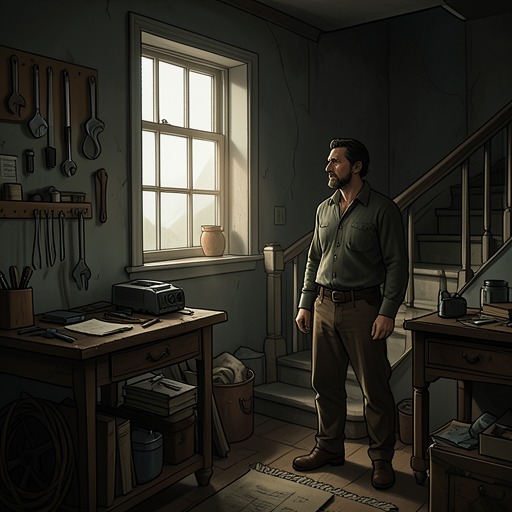
The Shrinking ManScott’s Isolated Confinement in the Cellar is not simply a locked-room predicament: it is the collision of Scott Carey’s shrinking body with a household and landscape that cannot accommodate it. In Carey's cellar, dwindling food, inaccessible water, and the sheer scale of familiar objects make survival a daily physical problem. Above him, Louise Carey’s work and the care of Beth Carey impose new routines that place Scott out of sight. The cellar is at once shelter, prison, and the only space in which the family can manage the consequences of his condition.
Material Conditions of Confinement
The cellar’s limits become most acute when Scott is ill. Shivering through alternating waves of heat and cold, he retrieves his old robe from behind a cement block and gathers the few damp cracker pieces left on the floor. He drags a box over the Sponge to make a shelter, but even these small tasks exhaust him. When he tries to squeeze moisture from the Sponge, the water tastes brackish; swallowing the remaining food hurts, and his thirst quickly returns. His supplies have narrowed to scraps beneath the box and whatever moisture he can wring out.
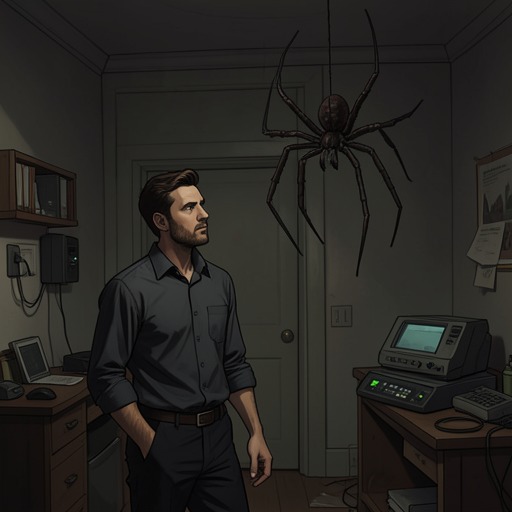
The alternatives are no better. Water lies at the bottom of a cliff he believes he no longer has the strength to climb, and he sees no way out of the cellar. Fever compounds these material dangers: the air feels heavy, heat presses on him, and he fears suffocation. He repeats that he is sick, bites into the knuckles of his left hand until the skin breaks, and falls back in exhaustion. In his feverish half-consciousness, the suspected sound of a spider walking over the box becomes a counting chant. Confinement thus magnifies ordinary needs into immediate threats, while illness weakens the strength any escape would require.
A Household Arrangement and Its Refusal
The cellar becomes part of the household’s working routine after the summer ends and the teenage girl employed at the lake grocery store returns to school. Louise, who had applied for the opening a month earlier, takes the job. She had vaguely expected Scott to look after Beth while she worked; now, with him barely reaching Beth’s chest, she recognizes that he cannot take care of their daughter and that he refuses to try. She arranges for a neighborhood girl who has left high school to watch Beth instead.
The arrangement carries a practical cost: Louise expects little money to remain after paying the caretaker. It also creates a problem of concealment. She tells Scott that he will have to stay in the cellar during the day unless he wants the girl to know who he is, since he cannot pass for a child. When Louise considers putting a lock on the door in case the girl comes downstairs, Scott refuses. His insistence that the door remain unlocked does not remove his dependence on the cellar; it marks a boundary he still tries to claim within it. The same space that keeps his condition hidden is also the space in which he resists being treated as someone who can simply be secured away.
Repeated Goodbyes and Public Disappearance
The separation takes on a predictable rhythm. Louise says goodbye, kisses Scott on the top of the head, and goes upstairs. He draws away from the kiss. Left below, he imagines the sequence repeating day after day: sandwiches and coffee, a brief farewell, Louise’s departure, the door lowering, and the lock snapping shut. When the sound of the lock comes, terror nearly makes him scream. He sees Louise’s moving legs and understands the cellar not as an abstract refuge but as the place where a prisoner is hidden from the outside world.
Afterward, he climbs onto a chair, lights a cigarette, drinks coffee, and turns through the previous evening’s New York Globe-Post. A short article on page three asks where the shrinking man is and reports that Scott Carey disappeared three months earlier, with no word received since. The contrast is sharp: the newspaper presents his absence as a public mystery, while Scott reads it from within the household that has kept him below. The cellar conceals him from view even as his disappearance continues to circulate as news.
The Open Door and the Unreachable Exit
When the family is moving away, Scott sees Louise leaving and believes that she thinks him dead. He wants to let her know he is alive, but the open door does not make escape possible. From the cellar floor, the bottom step rises too high for him to reach with the hook he might make. He considers climbing the cracks between the cement blocks, but recognizes that he would also need clothes, food, and water. The obstacle is not only the height of the step: survival outside the cellar would require provisions he cannot carry or secure.
The recognition defeats a plan he had been considering. At a rate of one-seventh of an inch of shrinking, he concludes that he will never make it to the top. The door stands open, but the scale of the house has turned an exit into an impassable face of cement. His failed attempt shows how shrinking converts ordinary architecture into a barrier without requiring anyone to lock it. Scott’s confinement is enforced both by family decisions and by a physical environment whose measurements no longer fit him.
Alone in the Empty House
After the family has gone, the thumping water pump continues in the distance before clicking off. Scott realizes that they have forgotten to turn it off and understands that the house is empty. Earlier, Louise and Beth had walked through the yard in the snow, calling his name repeatedly until darkness and continuing even afterward; now the silence confirms that they have left. Their search and their departure coexist in the same aftermath: they called for him, but he remained beyond their reach.
Scott tries to push himself up, then sinks back as pain tears through the back of his head. He finds dried blood and a lump beneath his fingertip, and lies with his forehead against the cold, rough cement. The word alone recurs as he registers the empty house and his failed efforts. Confinement has passed from a daily arrangement, maintained around work and the need to hide him, into an immediate fact of abandonment. The cellar’s silence makes visible the limits of familial care: Louise and Beth can search above, but Scott’s body, injuries, and shrinking scale leave him isolated below.