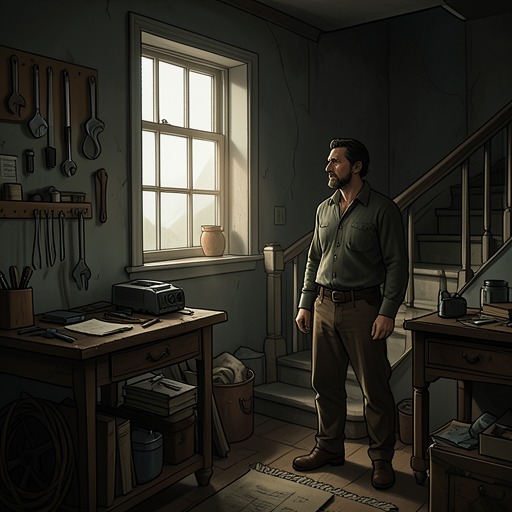
Scott’s Predicament Trapped in the Cellar
The Shrinking ManScott’s Predicament Trapped in the Cellar is more than a physical confinement: it is a steadily changing struggle to secure food and water, endure a hostile environment, and retain a sense of being a person. The cellar offers Scott Carey no reliable route out. As his body shrinks, familiar objects become immense obstacles, practical necessities grow harder to reach, and the very measure by which he understands his future begins to fail. His confinement thus makes everyday survival a test of both scale and identity.
The Cellar as an Environment
Scott has been imprisoned in the cellar long enough for bread and cold water to become his entire diet. Water remains accessible, but only through a minute leak in the tank near the electric pump: he catches its drops in a Thimble taken from a sewing box and set beneath the fuel-oil tank in a cardboard carton. The arrangement gives him a dependable supply of well water, yet its improvised smallness also marks how survival depends on adapting to objects left behind by life at ordinary scale.
Food is less secure. After five weeks, Scott finishes the last scraps of a quarter loaf of stale bread. He knows of only one remaining supply: an open box of crackers beside the cylindrical coils atop the old Refrigerator. Reaching it means confronting a sheer surface that stands between him and the food. The cellar is not empty, but its resources are no longer readily usable; the difference between having food and being able to reach it becomes a matter of life and death.
The room’s light and layout intensify that dependence. Daylight enters through grime-streaked windows overlooking the sand hills of the Black widow spider’s territory, the fuel tank, and a log pile, then falls in broad gray bars across the concrete. As evening approaches, the cellar becomes a dark pit. Scott has considered pulling the dangling bulb string to light it, but from his perspective the string hangs a hundred feet overhead and is unattainable. A small domestic fixture has become an inaccessible height, leaving him to face both the physical room and its darkness on terms set by his reduced size.
Shrinking and the Loss of Familiar Scale
The cellar’s objects do not literally transform, but Scott’s shrinking alters what they mean and what he can do with them. He experiences the illusion that the world is growing, and that objects count as ordinary only for someone of ordinary size. The oil burner becomes a towering structure with a roaring flame in its depths; the hose resembles a resting viper in scarlet coils; and a low wall presents itself as a cliff. Across the sand, the Black widow spider is no longer a small creature but a venomous monster nearly as tall as Scott.
This altered scale makes danger immediate while narrowing the possibility of action. The Refrigerator is at once a household appliance and a high wall between Scott and the crackers. The light string is present but functionally unreachable. “Reality was relative,” he recognizes, as each passing day makes the dependence of reality on bodily scale harder to ignore. His predicament is therefore not simply that he is small in a large room: the room’s ordinary arrangements have become a system of barriers that determines what he can eat, where he can go, and whether he can feel safe.
Survival Under a Shrinking Deadline
The immediate pressures accumulate rather than resolve. After driving the spider away with a pin, Scott finds that the relief cannot be trusted: the spider is still alive and may be waiting nearby. He cannot carry the pin everywhere, and he fears that soon he may be too small to carry it at all. The remaining food may last only two more days; obtaining water is becoming more difficult; and his clothes must be altered continually as his body changes. Above these practical threats hangs the continuing impossibility of escape and his dread of what will happen between Saturday night and Sunday morning.
The six-day horizon makes the crisis more than a race for the next meal. Scott imagines that reality will be blotted out not by death but by disappearance, and asks what reality could mean at zero inches. Yet he continues to act: he scans the Refrigerator’s face and considers how to reach its crackers. Persistence and despair coexist. He is still searching for food and water, but begins to question whether this struggle expresses a chosen life or only the instinctive continuation of one.
Isolation, Identity, and the Human World
Scott’s entrapment also exposes the mental flight that accompanies his physical isolation. He recognizes a pattern of running from threats—the man, the boys, the cat, the bird, and the spider—and of retreating from his problems and fears. The cellar has left him alive, but survival alone does not settle whether he remains a separate, meaningful individual or whether his existence matters. These questions arise from concrete deprivation: his world has contracted to food, water, danger, clothing, and the prospect of escape, yet he refuses to treat those necessities as a complete account of a human life.
A brief reflection on Louise Carey complicates that isolation. Scott wipes water from his face and dismisses the importance his former handsomeness once held when there is no one in the cellar to please or impress. He nevertheless recognizes that he still loves Louise. For him, the feeling retains value precisely because it offers nothing practical in return. The attachment does not free him from confinement, but it gives his dwindling world a human relation not reducible to immediate survival.
The cellar’s hold becomes visible again when a loud creak and crash send sunlight across the floor and a giant descends the steps. Scott freezes beneath the approaching figure’s plunging shoes, each raised above his head before striking the ground and shaking it. The shock is doubled: he faces an overwhelming presence and recognizes, despite his terror, that he once occupied that same scale. The scene makes his confinement’s central reversal bodily and immediate. What had been a human-sized cellar is now an immense world, and Scott’s past size survives only as the measure of how far his present life has changed.