Scott’s climb to the refrigerator crackers
The Shrinking ManScott Carey’s climb to the refrigerator crackers is a survival ordeal in which the ordinary furnishings of Carey's cellar become a landscape of cliffs, routes, and precarious footholds. Hunger forces Scott Carey to treat the enormous distance to food as a practical problem to solve, but reaching the Cracker box brings a second reversal: the crackers are water-damaged, and the prize of the ascent is only a limited supply of crumbs.
The Refrigerator as a Distant Goal
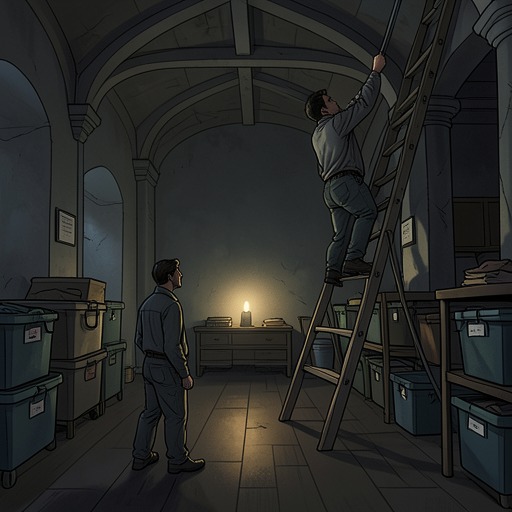
The scale of the task is established before the climb begins. Scott Carey has completed the difficult climb up to the cellar floor and now faces a quarter-mile journey to the Refrigerator. The hose’s coils are hulking obstacles, the rake handle is as thick as a tree, and the Refrigerator rises like a ten-story building. Its top seems as remote as a mountain peak. The oil burner’s irregular ignition shakes the floor beneath him, a reminder that even the ground is not reliably still.
For a long moment, Scott Carey stands indecisively, staring at the Refrigerator’s white legs. Hunger ends his paralysis: he must reach the crackers or starve. The problem is not simply distance but route. He considers several possible ascents, involving a ladder, the fuel-oil tank, boxes, Louise Carey’s suitcase, a hanging rope, or the wicker table near the Refrigerator. Each offers a different sequence of hazards. The scene turns familiar household storage into terrain to be surveyed, and eating becomes the objective of an expedition.
Building a Way Up
Scott Carey prepares a climbing aid from what is available. He draws Thread from a carton, carries it back to the wicker table, and fetches a piece of wood from a log pile, breaking off a length from one log and fastening it to the Thread. The arrangement is small and improvised, but it gives him a way to make the table’s structure serve as a climbing route.
The first throw is comparatively easy because two narrow strips twist around the table’s main leg and flare toward its first shelf. Scott Carey aims the wooden piece at the gap where one strip juts away from the leg. On his third attempt, the wood passes through the opening; he carefully draws it back until it wedges between the leg and strip. Bracing his feet against the leg, he climbs while his body swings out at the end of the taut Thread. At the first stopping point, he hauls up the line, loosens the wooden bar, and prepares to use it again. Progress depends on repeatedly placing, securing, and recovering this makeshift equipment; each object must be handled as both tool and potential support.
The ascent culminates in a leap into open space. Scott Carey presses his lips together, whispers, “So be it,” and springs for the wooden bar. His arms strike it hard enough to become almost numb, and for a moment he believes he is falling. Instead, his arms close around the wood. He hangs above a tremendous void, gasping, with his legs swinging below him. After catching his breath, he turns carefully to face the next arrangement of supports, hauls himself into a sitting position, and rests, exhausted. The last step to the tabletop remains the hardest.
The Cracker Box and Its Reversal
When Scott Carey reaches the open Cracker box, the expected reward disappears at a glance: the crackers are ruined. They are dirty, mouldy, and soaked through. He remembers the cause too late: directly overhead, the kitchen sink has a faulty drainpipe that lets water drip into the cellar whenever the sink is used. The crackers’ damage is not an abstract setback but the consequence of an unnoticed household defect, one that has turned the destination of his arduous climb into a spoiled supply.
The shock gives way to urgent salvage. Scott Carey kicks an opening through the heavy wax-paper lining and squeezes behind it, eating what he can and drinking drops of water clinging to the paper. He begins carrying dry crumbs out and piling them at the bottom of the box. To get back out, he tears handholds in the wax paper and climbs the improvised ladder, moving one or two crumbs at a time according to their size. He repeats the labor for an hour, then searches behind the lining for anything missed. The only remaining fragment is about the size of his little finger; he eats it while completing his circuit of the box.
Hunger and the Measure of Success
The episode’s outcome is neither simple triumph nor total failure. Scott Carey has overcome the distance and danger separating him from food, but the food’s condition sharply limits what the climb has won. After surveying the wreckage, he estimates that his salvage amounts to only two days’ food; by Thursday, he will have none again. He pushes the thought aside and climbs out of the box, postponing the next crisis rather than solving it.
The Refrigerator and Cracker box change in significance as Scott Carey’s scale changes. They are household objects in ordinary use, yet here their height, surfaces, contents, and defects govern whether he can eat. His improvised Thread and wooden bar make the cellar’s furnishings temporarily usable, while the leaking drainpipe reveals how an unnoticed fault can undo the value of an entire ascent. The climb therefore measures survival not by reaching a destination alone, but by what remains available after the effort: a few crumbs, a short reprieve, and another deadline already approaching.