Sewing pin
The Shrinking ManThe Sewing pin becomes a weapon because Scott Carey’s shrinking has remade the scale of ordinary objects: what he finds as a small metal pin is large enough to serve as a lance against the spider threatening him in the cellar. Its changing meaning—from an unexpected piece of metal to an instrument of defense—makes it a concrete measure of the world’s altered proportions and of his precarious ability to survive within them.
Discovery and Scale
While reaching for thread inside the ragged carton, Scott’s hand touches cold metal and jerks away. He reaches again and discovers a pin. The apparent modesty of the object collapses at once: to Scott, it is the size of a knight’s lance. That shift in scale is not merely descriptive. In a cellar where familiar materials have become immense obstacles and possible resources, a pin can occupy the place of a weapon.
Scott pulls about eight inches of thread from its barrel-sized spool, laboring for a full minute to free it by pulling, jerking, and gnawing at it with his teeth. He carries the thread back to the wicker table, then tears a piece from a log—one as long as his arm from elbow to fingertips—and fastens it to the thread. The episode places the pin among materials that Scott must handle through effort and improvisation; its later role as a spear gives the pin’s startling size a practical consequence.
The Pin as a Spear in the Spider Fight
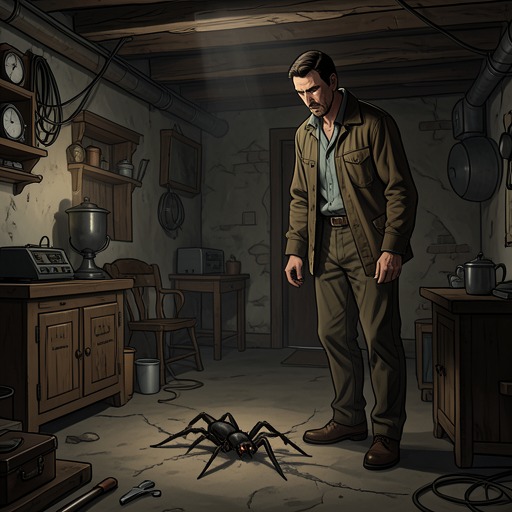
When the Black widow spider closes in, the Sewing pin becomes more than a possible tool: it is the only weapon within reach. Scott Carey falls into the open sewing box while groping for a way out, and the spider clambers over his legs. His hand closes around cold metal. He drags the pin up with both hands and, as the spider leaps, drives it toward its belly like a spear. The pin shudders under the weight of the creature only partly impaled on its point, making its size and heaviness palpable even as it gives Scott a chance to resist.
The first thrust does not finish the attack. The spider springs away, then rushes back; Scott braces himself on one knee, the pinhead against his hip, and meets it again. The spider strikes the point a second time, but one of its spiny legs rakes skin from Scott’s temple. When it leaps once more, Scott holds the pin between them. The spider recoils before reaching the point and backs away, while Scott remains crouched, arms tense, keeping the weapon aimed at it until the creature vanishes into the shadows. The pin does not kill the spider; it interrupts its assault and drives it off.
Afterward, the Sewing pin’s usefulness is inseparable from its burden. Scott circles the cellar for a long time, still gripping its weight, before understanding that the spider has gone. Relief and exhaustion make his arms give way; the pin drops and clatters against the wooden bottom of the box. He collapses beside it, recognizing it as the object that saved his life, but his safety remains temporary: the spider is alive and might be waiting outside the carton or beneath the water heater. The weapon has changed the immediate balance of power, not removed the threat.
After the Fight: Security and Its Limits
When Scott Carey wakes in the sewing box, the cellar is still, and he reasons that the spider must have left because it would have entered the carton again if it remained intent on killing him. Hunger and thirst force him to venture out regardless. He feels for the thick, icy shaft of the Sewing pin, lifts it in both hands, then carries it at his right side as he climbs over the shifting clothes toward the carton opening. Its weight drags at his arm muscles; he is astonished that he handled it so effectively during the fight and attributes that strength, probably, to fear. Ready to seize it with both hands if the spider appears, he finds in the weapon the first definite sense of physical security he has had in weeks.
Scott looks cautiously out of the carton, slides the Sewing pin through the opening, lets it dangle, then drops it to the floor before following it down. The water pump’s sudden wheeze makes him jump back to the pin and raise it as if to ward off an attack; when none comes, he lowers the spear and carries it toward the water heater. The sequence turns the pin into more than a weapon used in one decisive encounter: even an unexpected cellar noise now brings Scott back to it. Yet his security remains conditional, dependent on hauling a heavy object he may soon be too small to carry, while the spider is unaccounted for and the cellar’s ordinary dangers still demand that he move beyond the shelter of the carton.
A Weapon with a Narrow Reach
The Sewing pin changes what Scott Carey can do in one encounter, but not the conditions that make the encounter part of a larger crisis. After driving the spider away, he still faces food that will be gone in two days, growing difficulty reaching water, and the continuing need to alter his clothes as he shrinks; escape from the cellar remains impossible. Even the weapon’s usefulness has an expiry built into it: Scott fears that within a day or so he may no longer be able to carry it. Its force is therefore real but sharply bounded—a point that can hold off a predator, not a solution to the shrinking or the dread of what will happen between Saturday night and Sunday morning.