The Shrinking Man as Public Spectacle
The Shrinking ManThe Shrinking Man as Public Spectacle is the process by which Scott Carey’s physical difference is converted into news, entertainment, and public curiosity. The publicity brings potential income at a time when his family is under financial strain, but it also makes him an object to be displayed, examined, and judged. Its central tension is that Scott needs the security the attention might buy while experiencing that attention as an invasion of his privacy and dignity.
From Private Affliction to News
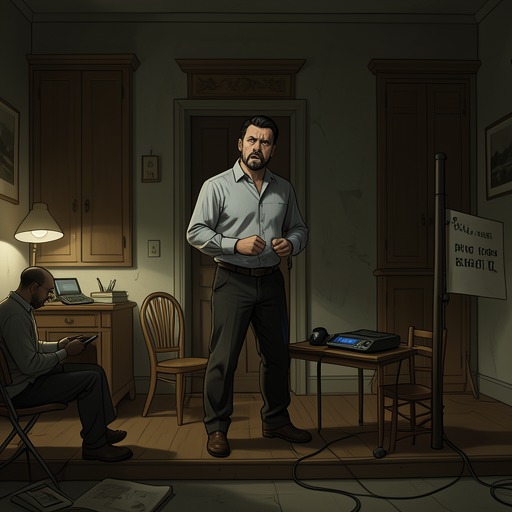
The public story begins before Scott agrees to take part. Marty mentions Scott’s mysterious condition to a fellow member of the Kiwanis, and the information spreads gradually into New York City. Mel Hammer then comes to the apartment with a newspaper offer. When Scott later encounters a copy of the New York Globe-Post on the refrigerator, its title is partly obscured by dust and water damage. That battered paper reconnects him to the moment when his private circumstances were made available for public narration.
Scott refuses the offer despite the family’s need for money. The tests at Columbia Presbyterian Medical Center had been free, but the first examinations still left a substantial bill. The family also owed Marty five hundred dollars and faced accumulated expenses from a difficult winter, including clothing, fuel oil, and additional medical costs after moving from Los Angeles to the East. Public exposure therefore presents itself not as an easy choice between privacy and profit, but as a possible answer to concrete household debts.
Scott’s refusal takes place during what he later calls his period of furies, when his anger at his condition is persistent and mounting. He objects to being exposed to morbid public curiosity and lashes out at Louise Carey when he feels she does not support his decision strongly enough. He recognizes that his anger is misdirected, but fear fuels it. The scene establishes the emotional cost of publicity before the newspaper series begins: even the offer forces Scott to imagine himself as a spectacle, and the financial need makes that unwanted prospect difficult to dismiss.
The Publicity Campaign
Scott eventually signs the contract. The series turns his case into a recurring public account, with photographs and medical examination presented to readers. In the remembered photo session, he is posed in shoes far too large for him, beside Louise, beside his daughter Beth, beside his hanging old clothes, and next to a tape measure marking his former size. The photographer also arranges a picture with Mel Hammer’s large hand pointing to the relevant mark. These images translate a changing body into comparisons that can be quickly understood and circulated.
The newspaper’s treatment extends beyond photographs. The Globe-Post’s appointed doctors examine Scott, and the paper reworks his case history for a million readers. The account does not merely report that he is shrinking: it organizes his life into a public record and makes his body available for repeated inspection. Scott suffers fresh mental distress as the series continues, and at night tells himself that he will break the contract, regardless of the family’s need or Louise’s possible anger. The distinction between choosing publicity and being free to withdraw from it becomes increasingly strained.
The campaign generates offers for radio, television, stage, and nightclub appearances, as well as magazine articles and syndication of the newspaper series. The range of invitations shows how quickly the reported case can be repackaged as entertainment across different venues. Attention also moves beyond formal media: people gather outside the apartment, stare at Scott, and ask for his autograph. Religious advocates send appeals in person and by mail, while unsolicited letters from strangers add another intrusion into the household’s private life. Publicity is thus not confined to what the newspaper prints; it encourages strangers to approach Scott as someone they are entitled to observe or address.
Celebrity and the Search for Privacy
Six weeks before the lake episode, the family moves away from the apartment because Scott feels trapped there. When he goes out, people stare. The first week and a half of the Globe-Post series has already appeared in print and reprint, and Scott has become a national celebrity. Requests for appearances continue, and reporters repeatedly come to the door. The move is an attempt to escape the consequences of exposure, not a sign that the family has become comfortable with it.
The lake does not solve the problem. The family manages to move there without anyone finding out, but Scott discovers that life in the new place is no improvement. The contrast exposes the limits of concealment: the publicity has made his condition widely recognizable, yet physical relocation cannot by itself restore the ordinary privacy that the attention has displaced. The crowd’s curiosity is especially unsettling because it is not limited to reporters or professional entertainers. Scott understands that ordinary onlookers look at him partly to reassure themselves that they are normal. In that exchange, his difference becomes a prop for other people’s sense of security.
Money, Refusal, and the Cost of Visibility
Financial pressure repeatedly brings the publicity choice back into view. Scott considers returning to the Globe-Post, accepting appearance offers, letting sensational magazines tell his story, or allowing a ghostwriter to produce a book about his case. He knows that these routes could provide enough money to ease the insecurity Louise fears. Yet the thought of placing himself before the blatant curiosity of an audience remains repellent to him. His refusal is therefore not a simple rejection of income: it is a continuing conflict between material need and the terms on which that income is offered.
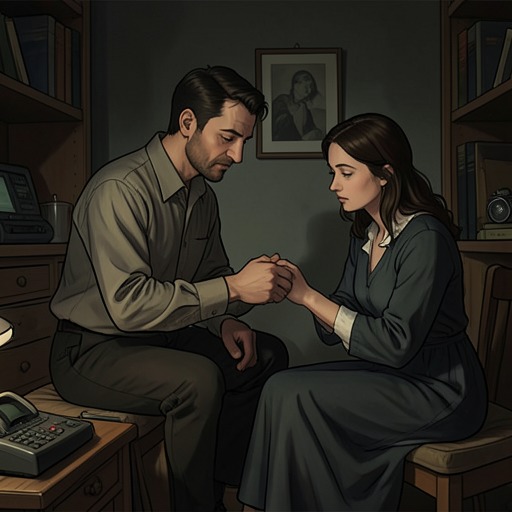
The insecurity becomes sharper when the expected check fails to arrive. Marty tells Scott that he has lost his Fairchild contract and must reduce his operations, so the payments to Scott will stop. Marty gives him a hundred dollars, but makes clear that it is the end of the support. Scott is left with seventy dollars in the bank and the hundred in his wallet, and the possibility of returning to publicity acquires immediate urgency. He nevertheless imagines the newspaper’s photographers, Hammer’s questions, and the headlines that would reduce him to his size, eating habits, clothing, and private life. The imagined coverage makes visible what the contract threatens to do: convert an entire person into a set of marketable diminutions.
The episode presents publicity neither as uncomplicated rescue nor as an attention Scott can simply disregard. It can answer real debts, but the means of earning that money are bound to public access to his body and home. Scott’s story is repeatedly framed for consumption, while he struggles to retain authority over when and how it is told. That conflict makes the spectacle more than a media subplot: it shows how public fascination can turn vulnerability into a commodity and make privacy costly precisely when privacy is most needed.