The Spider as a Symbol of Fear
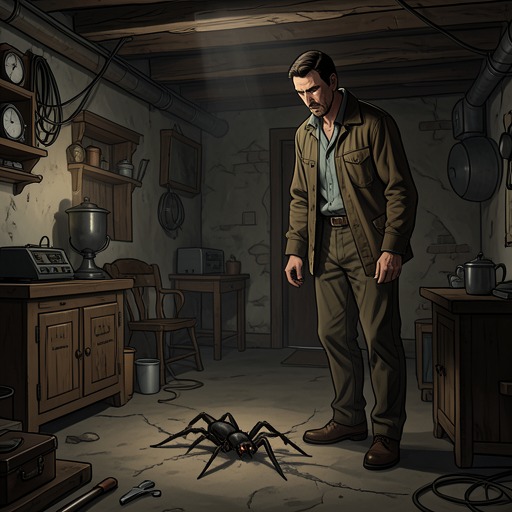
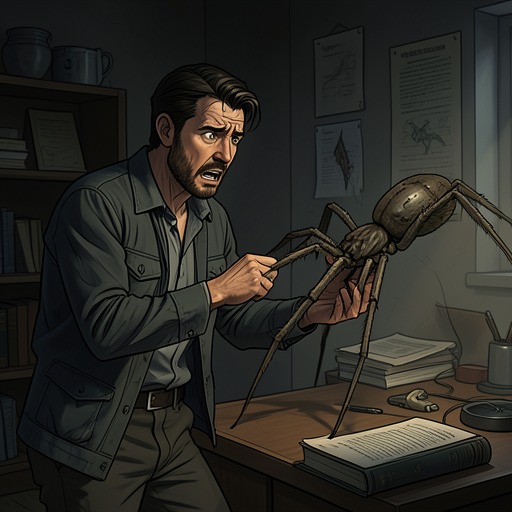
The Shrinking ManThe spider in Scott Carey’s final struggle is at once a physical adversary and an embodiment of fear. Scott sees it as more than an animal: it gathers the unknown terrors, anxieties, and insecurities of his life into a single form. The confrontation consequently carries two stakes. He must face a creature that can threaten him, but he is also acting against the fear that creature has come to represent. Its death brings relief, though not an escape from the dangers of his diminished world.
A Physical Threat and a Mental Emblem
Scott’s understanding of the spider moves beyond ordinary fear of an animal. In a moment when he wonders whether it might already be dead, his initial excitement quickly gives way to disbelief: in his mind, the spider has become nearly impossible to imagine as vulnerable. Its significance has expanded beyond its physical presence, absorbing the unknown terrors and personal anxieties that trouble him. The spider’s form gives those diffuse fears a focus, making them seem concentrated in one opponent.
This symbolism does not make the spider unreal. Scott encounters it as an actual creature, and the physical danger of meeting it shapes his decisions. The image works because the literal and symbolic threats remain joined: the spider can injure him, while its presence also gives a visible form to what he fears. The scene therefore does not resolve the threat by explaining it away as imagination. Instead, Scott must contend with both its material danger and the meaning he has attached to it.
The Climb Reveals His Purpose
After reaching safety, Scott recognizes that getting food was not the only reason he had climbed. He understands that he had also gone up to kill the spider. The realization clarifies the purpose of his dangerous effort: the ascent has led him toward a deliberate confrontation, not simply toward shelter or supplies. His weapon falls from his hand as this truth becomes clear, and he walks out across the sand before sitting down to wait.
That pause matters because Scott does not immediately treat his decision as self-evident. He considers why he is staying and why he is willing to risk the encounter. He identifies the spider as something he hates and cannot coexist with, and connects his willingness to face it with his belief that he is going to die anyway. Yet he also recognizes that this explanation is not complete: he cannot be entirely certain about what will happen to him, and the thought of the spider frightens him. His resolve emerges amid uncertainty rather than from confidence that he will survive.
Choosing Confrontation
Scott finally settles on the present moment as the basis for action. Rather than allowing uncertainty about tomorrow to decide for him, he chooses to pursue the spider even if the attempt costs him his life. The decision gives his fear a practical direction. He does not claim that the danger has disappeared or that victory is assured; he chooses to act while afraid.
When he encounters the spider, the confrontation becomes a pursuit across the sand. Scott calls to it and throws stones, drawing it away from the web; when it follows, he runs while searching for the pit. The sequence turns the symbolic conflict into an immediate test of nerve. Scott’s challenge is not a composed display of mastery: the pursuit brings panic and physical strain. Still, he continues, and the spider’s movement toward him makes his earlier choice unavoidable. He has sought the encounter, and now must meet the danger it entails.
Death and Its Consequence
Scott ultimately kills the spider with the spear. The outcome resolves the immediate conflict, but its importance lies also in what changes for him afterward. Once the creature is dead, he is exhausted and must recover before continuing. He returns to retrieve his hook and makes his way back toward the climb. His response to the result is not triumph over every danger in his life; it is relief that this particular source of terror has ended.
Scott thinks that the nights of horror are over and that he can sleep without the box top, free and at peace. The tired smile that accompanies this thought marks a brief emotional release. The spider’s death has answered the fear concentrated in it, and Scott considers the struggle worth its cost. His relief is real but limited: as he descends, the hook breaks and he falls. The ending immediately places his hard-won calm beside renewed danger, so the symbolic victory does not amount to safety from the precarious world around him.
Symbolic Function
The spider gives Scott’s otherwise diffuse anxieties a single, confrontable object. Because he names it to himself as something he cannot coexist with, the decision to kill it becomes an assertion of agency in circumstances marked by uncertainty. He cannot settle the larger questions about his future, but he can choose what to do in the present. The struggle therefore joins fear to action: fear remains powerful, yet it does not wholly determine his response.
The spider’s death also gives the episode a contained form of emotional closure. Scott’s relief depends on defeating the creature, not on becoming free of all danger; the broken hook immediately distinguishes those outcomes. The symbol is therefore neither a simple metaphor detached from events nor a guarantee that courage brings security. It is a real adversary made to carry the weight of Scott’s fears, and its defeat grants him peace for a moment, even as the next peril exposes the limits of that peace.