There Is No Zero in Nature (Existence Has Infinite Levels)
The Shrinking ManThere Is No Zero in Nature (Existence Has Infinite Levels) is the principle Scott Carey grasps as his shrinking carries him beyond the scale of ordinary human life. A zero on a measuring scale may signify nothing to people, but it does not mark an endpoint in nature: existence continues through further levels of dimension. The idea changes the meaning of Scott’s fate. He will not simply disappear; he must understand himself as persisting in a world whose scale keeps changing.
The Rule and Its Discovery
Scott says that he had known such levels existed without making the connection to his own shrinking. He had continued to think in terms of the human world and its limited dimensions, assuming that nature followed the measures people use. His revised understanding separates human convention from natural existence: the inch belongs to human measurement, while nature has no zero point at which being becomes nothing.
The conclusion is not comforting at first. Scott is frightened by the possibility of continuing endlessly from one dimensional level to another, a prospect he finds alien. The rule therefore resolves one fear—the prospect of vanishing—while replacing it with a more expansive and disturbing vision of unending continuation.
Scale as Lived Experience
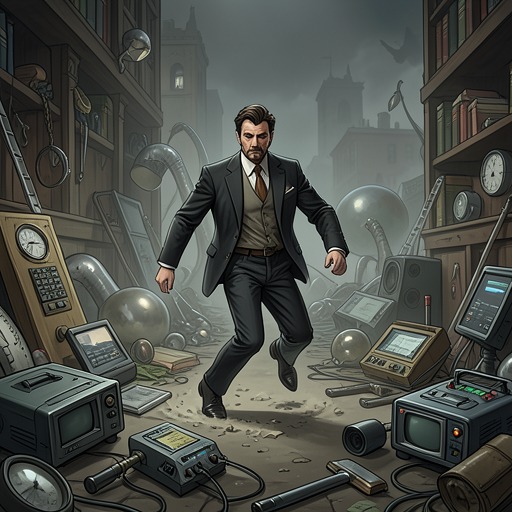
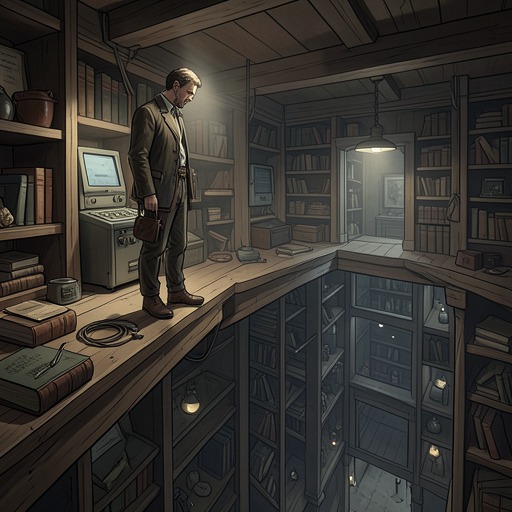
The principle is foreshadowed by the way Scott’s surroundings change as his body shrinks. In Carey's cellar, a step only twelve inches high has become, by his reckoning, equivalent to a 150-foot descent for a normally sized man. He lowers himself by a string ladder attached to a brick, and its rungs are difficult to reach. The measurement has not changed; its meaning has. A familiar domestic feature becomes a massive obstacle because the human scale no longer describes his experience.
The refrigerator presents the same transformation as a problem of routes and equipment. Scott considers several possible approaches to its top: climbing from the fuel-oil tank and across boxes and Louise Carey’s suitcase to a hanging rope, or trying the red cross-legged table or wicker table before making the climb. The refrigerator remains a household object, but at his size it is an attainable summit only through a demanding sequence of intermediate surfaces.
Objects also preserve a measure of continuity amid this altered scale. Looking into the water in a thimble, Scott recognizes the same green eyes, dark-brown hair, nose, jawline, ears, lips, and teeth. His body is a fraction of its former size, yet he sees his features as unchanged line for line. The scene gives the rule a personal dimension: physical scale changes radically, while recognizable identity persists.
Making a World Traversable
Scott’s response to the cellar’s enlarged distances is practical as well as conceptual. When he recognizes that the climb is too difficult without equipment, he reasons that a cliff requires mountaineering tools. Unable to use cleated shoes or an alpenstock, he devises a possible grappling hook: a second pin bent into a semicircle and attached to a long thread, which he could throw into an opening in the lawn chairs and use as a climbing line. His plan treats the altered environment not as an illusion but as a real landscape whose obstacles demand new methods.
Later, he climbs the metal rim of a net and pulls himself onto its broad, curved pole. After reaching a spider’s web, he rests and then climbs its sticky strands, freeing his hands and feet as he moves between them. The web trembles under his weight, and he passes a dead beetle without looking at it. At this scale, a net, its cords, and a web become routes through a landscape; everyday materials acquire new practical functions because Scott’s body and surroundings stand in a different relation.
Consequences and Significance
The rule gives Scott a way to interpret what his shrinking means without pretending that it has stopped. He concludes that there is no point of non-existence in the universe and that he will never disappear. That conclusion does not remove the fear: endless continuation through unfamiliar dimensions remains alien to him. Instead, it changes the terms of the problem from reaching a final zero to living within successive levels of existence.
The physical episodes make that abstraction legible. A twelve-inch step, a refrigerator top, a pin, a net, and a web show how a stable world can become immense without ceasing to be real. The principle unites Scott’s altered measurements with his continued ability to recognize himself and act. Shrinking is not a passage from existence into nothingness, but entry into another scale of existence, where familiar objects become terrain and survival depends on learning its possibilities.