Thread climbing line
The Shrinking ManThe Thread climbing line is an improvised piece of equipment that helps Scott Carey convert the cellar’s oversized furniture and household materials into possible routes. Unrolled from a spool and used under tension, thread can support a precarious climb; later, Scott carries it toward danger and uses it to interrupt a House cat’s pursuit. Its significance lies in this shift from humble material to adaptable survival tool, with each use determined by the scale of the obstacle and the urgency of the moment.
Material and Making
Scott finds the thread while searching for something useful, but first touches a pin and discovers that, at his scale, even that small object has the proportions of a weapon. He then locates the spool and laboriously draws out about eight inches. The work takes a full minute of pulling, jerking, and using his teeth to separate the thread from a spool that seems barrel-sized to him. The contrast makes the thread’s ordinary familiarity deceptive: its supply is abundant, but extracting and handling even a short length requires effort.
That change in proportion governs the line’s usefulness. A few inches of thread can serve as climbing equipment because Scott’s body has become so small, while the spool itself is a bulky object he must work against. The line is not a ready-made tool with a fixed purpose. Scott has to devise ways to anchor it, put it under tension, and make the surrounding furniture carry his weight. Its uses emerge from the encounter between a small, flexible material and a world whose structures now resemble cliffs and towers.
Climbing and Improvised Anchors
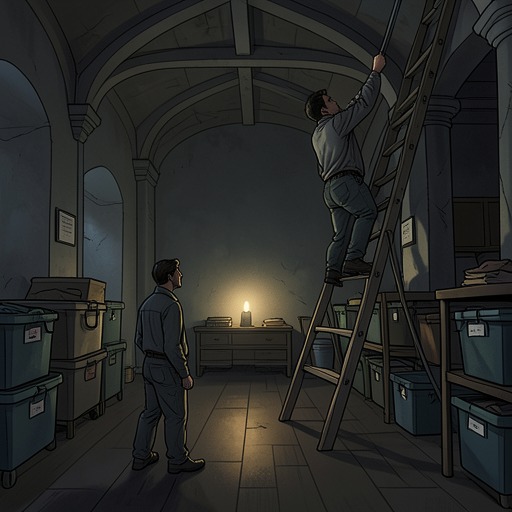
At a table, Scott finds narrow strips twining around one of its legs and angling toward a shelf. He throws a small piece of wood toward the opening between a strip and the leg. After two unsuccessful attempts, the wood passes through and wedges into place. Scott climbs with his feet braced against the leg, his body swinging outward at the end of the taut thread. The line therefore does not function as a ladder by itself: it joins a makeshift anchor, the table’s own construction, and Scott’s climbing effort into one precarious system.
He continues the attempt by urging himself onward and flinging the stick toward the next junction of leg and strip. The repeated effort makes the method feel provisional rather than engineered. Each new hold depends on finding another place where the table’s shape can trap the wood. Thread offers reach and support, but it cannot remove the risks of a weak anchor or the difficult distance between footholds.
The cellar presents other possible routes, but they require different arrangements. Scott considers approaches to the refrigerator that would take him over a fuel-oil tank, cardboard boxes, Louise Carey’s suitcase, or tables, and then up a hanging rope. The passage describes that rope as part of a possible route, not as the spool thread itself. The distinction matters: Scott surveys a landscape of potential paths, while the Thread climbing line represents one specific kind of improvised aid within it.
A Tool Reconsidered Under Threat
Later, Scott retrieves thread from the wicker table and shakes loose a bar from its place. With a House cat nearby, he drags the thick thread toward the step, hoping the materials may give him a chance. In this moment, he is no longer simply planning a climb. The line has become equipment he carries toward a confrontation, though the evidence does not establish exactly what he intends to do with the bar and thread before the encounter develops.
When the House cat pursues him, Scott uses the thread in an immediate, defensive way. As he reaches the step, the coil slips from his shoulder. He grabs it and throws it into the cat’s mouth; the animal recoils, giving him an opening to race away and take refuge in a hole among the stones. The episode changes the line’s role from climbing aid to brief distraction. Its value is not that it can overpower a much larger animal, but that its use buys Scott enough time to escape.
Design, Scale, and Later Possibilities
The thread’s practical meaning changes with its surroundings. At the table, it is a taut climbing line secured through a wedged piece of wood. Near the step, it is something Scott can carry and deploy under pressure. Neither use makes the material powerful on its own: the first depends on the table’s narrow strips, and the second depends on the cat’s momentary reaction. Scott’s resourcefulness lies in recognizing that a commonplace object can acquire a different function when ordinary proportions no longer apply.
Scott later makes a more explicit plan for climbing the stacked lawn chairs. Since the ascent is too difficult without equipment, he considers bending another pin into a semicircular grappling hook and attaching it to a long thread. He intends to throw the hook into openings in the chairs and climb the line. This is a proposed technique, not a recorded completed ascent, but it extends the same principle visible in his earlier climb: a thread becomes useful when he can fasten it to a larger structure.
Other scenes place this ingenuity among a growing range of scale-dependent equipment. Scott uses a pin to help climb the sloping side of a thimble, and later climbs the metal rim and pole of a net before moving onto a spider’s web. These are distinct objects and routes, not further uses of the Thread climbing line. Their contrast underscores the line’s particular function: it is a portable connection between Scott and a surface that otherwise lies beyond his reach. Across its uses, thread makes the cellar’s ordinary materials newly legible as anchors, pathways, or means of escape, while remaining fragile and dependent on Scott’s careful improvisation.