Universe within
The Shrinking ManThe Universe within is the microscopic and submicroscopic realm that Scott Carey recognizes at the novel’s close, when his shrinking forces him to reconsider what counts as a world and whether existence can reach an absolute end. The new landscape appears beyond a light he runs toward, but its importance is more than visual: it overturns his assumption that becoming smaller must eventually mean becoming nothing. The ending gives him no confirmed answer about what lives there or what he will find. Instead, it turns uncertainty into a reason to search.
Recognition and Definition
The idea comes after Scott Carey confronts the possibility that he is less than nothing. Remembering that he had looked up at the universe outside himself the previous night, he draws a parallel: if there is a universe beyond the human world, there may also be a universe within it. He asks himself why he had not made the connection sooner, though he had always known that microscopic and submicroscopic worlds existed. What changes is not the existence of those scales but their meaning to him: he now understands them as possible worlds through which his own shrinking may continue.
Scott’s earlier frame of reference had been human dimensions. He had treated the inch as though it were a measure built into nature, and zero inches as though it meant nothing. His realization separates human measurement from existence itself: the inch is a human concept, not nature’s, and nature has no zero point at which being must stop. In his new understanding, existence continues through endless cycles and levels. The Universe within therefore names both a realm smaller than ordinary perception and the idea that reduction need not terminate in nonexistence.
Appearance and Threshold
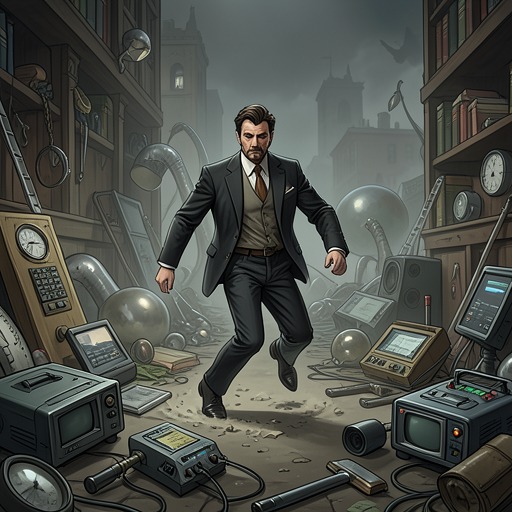
The transition is presented as an act of movement rather than as a measured scientific discovery. Once the possibility takes hold, Scott stands and then suddenly runs toward the light. When he reaches it, he looks out in speechless awe. The world he sees has vivid splashes of vegetation, scintillating hills, towering trees, and a sky whose shifting hues resemble sunlight filtered through moving layers of pastel glass. These details give the newly perceived scale the fullness of a landscape: it is not described as an empty remainder or a blank space at the end of shrinking, but as a place with varied forms and depth.
The scene’s sequence matters. Scott first works through an abstract change in thought, then moves toward the light, and only on reaching it encounters the richly colored world. His first response there is wonder, not a claim that he understands its workings. The landscape is available to perception before it is available to explanation; its vividness establishes that his altered scale has not reduced experience to nothing. The account presents what Scott sees, while leaving the nature and inhabitants of this realm unresolved.
Consequences for Scott
The newly recognized levels initially frighten Scott. The prospect of continuing endlessly through dimensions is alien to him, even as it defeats the conclusion that he must disappear. His next thought opens another possibility: if nature has endless levels, intelligence might also exist at levels beyond his own. He cannot establish that anyone is there, but the prospect matters because it raises the possibility that he will not be alone. Hope returns not as certainty but as a possibility consistent with the world he has begun to imagine.
That change redirects his attention from the question of whether existence ends to the practical demands of continuing within it. Scott recognizes that he must find food, water, clothing, and shelter, and that life itself is the most important unknown. These needs give the new world immediate stakes: it is a place he must search, not merely a conclusion he can contemplate. His questions and ideas multiply alongside his renewed hope, but the narrative does not answer them in advance or assure him of safety.
Ending and Significance
Scott Carey runs into the new world searching. The final action joins the largest conceptual shift to a concrete objective: after imagining existence as continuing beyond human measurements, he begins looking for what survival at this scale will require. The ending does not show him finding food, water, shelter, clothing, or another intelligence; it closes at the threshold of exploration. The landscape’s promise is therefore real as a possibility within the scene, while its future remains open.
The Universe within reverses the apparent meaning of Scott’s shrinking. A process that seemed to carry him toward erasure instead discloses further dimensions, each beyond the scale he had treated as complete. The final movement does not make his predicament easy or settle what awaits him. It changes the terms on which he faces it: zero is no longer the inevitable destination, and the next world, though unfamiliar, gives him something to seek. Scott’s departure into that landscape makes continued existence an ongoing discovery rather than a disappearance already decided.