Universes within universes
The Shrinking ManUniverses within universes is the idea that transforms Scott Carey’s final experience of shrinking from a march toward nothingness into entry into another world. He concludes that human scale is not nature’s limit: existence may continue through dimensions beyond ordinary perception, without arriving at an absolute zero. The thought does not restore his former size or promise rescue. Instead, it gives him a reason to move forward, imagining that life and intelligence may persist at the next level.
The inward universe
The realization begins with a contrast between looking outward and looking inward. The previous night, Scott had contemplated the universe beyond him; now he sees that the same reasoning could apply in the opposite direction. If the universe extends outward, there may also be a universe within, perhaps many. His attention turns to microscopic and submicroscopic worlds, which he had always known existed but had never connected to his own shrinking condition. The decisive shift is not the discovery of a new fact about their existence, but the recognition of what that fact might mean for him.
Scott understands that he has habitually treated the human world and its dimensions as the measure of reality. His familiar scale has shaped what he imagines as large, small, and possible; it has also made shrinking seem like a one-way passage toward erasure. The inward universe unsettles that assumption. What appears negligible from one level may belong to a world from another. The concept thus changes the frame through which Scott interprets his condition, without changing the physical fact that he is still becoming smaller.
Scale and the absence of zero
The argument turns on a distinction between measurement and nature. An inch is a human concept, and zero inches may signify nothing within human measurement, but Scott reasons that nature is not governed by that convention. The end of a scale familiar to people need not be the end of existence. His conclusion is that existence continues through endless cycles or levels, rather than terminating at a final point of nonbeing. In this reasoning, zero is not a destination built into the universe; it is a limit imposed by a human way of measuring.
The insight first frightens Scott. To continue endlessly through one level of dimension after another is alien to him, and the prospect does not immediately feel comforting. That initial fear matters: the idea is not simply an optimistic declaration that everything will be well. It replaces one terrible possibility, disappearance, with another that is difficult to comprehend, unending continuation. Scott’s change comes as he takes in that unfamiliar implication and discovers that it need not mean annihilation. The scale that had made his future seem like a shrinking line ending in nothing becomes a succession without a final zero.
Intelligence and the possibility of company
Scott extends the argument from existence to intelligence. If nature has endless levels, he thinks, intelligence might also exist on more than the familiar human scale. The thought offers no proof that another mind is present, and the scene keeps that possibility open. Its importance lies in changing what Scott can imagine: the unknown beyond his former dimensions might not be empty or wholly alien. He may not have to be alone.
This hope is carefully conditional. Scott does not claim to have found another being, nor does he know what form life might take at the newly perceived scale. Rather, he moves from a limit in his own knowledge to a possibility that gives action meaning. The thought of intelligence accompanies the broader recognition that there may be more to discover than the world available to ordinary human senses. For Scott, the prospect of company is therefore inseparable from the prospect of continued existence: both depend on refusing to mistake the boundaries of human perception for the boundaries of nature.
The new world and the search
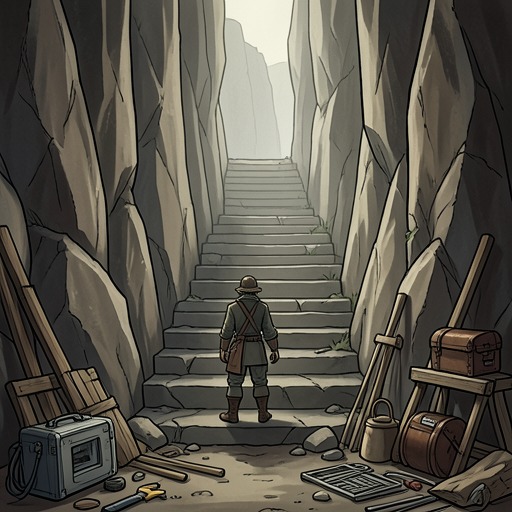
The idea turns almost immediately into movement. Scott runs toward the light, and on reaching it he sees a world marked by vivid vegetation, scintillating hills, towering trees, and a sky of shifting hues. The description makes his new scale perceptible through landscape rather than measurement. What had been an abstract sequence of dimensions becomes a place to look at and enter, beautiful and unfamiliar without being explained away. Scott stands in awe before it; the scene gives visual form to the inward universe he has just conceived.
Awe does not end in passive contemplation. Scott recognizes that there is much to do and think about: he must find food, water, clothing, and shelter. Above all, he must search for life. These practical needs ground the vast idea in immediate survival, while the possibility of life gives that survival a horizon beyond mere endurance. The ending does not confirm that Scott finds other intelligence or learns the nature of the world. It closes instead on his decision to run into it, searching. Universes within universes thus supplies neither a cure nor a final explanation; it changes what the unknown can contain, and lets hope arise from the possibility that existence has further levels still to explore.