Veterans Administration
The Shrinking ManThe Veterans Administration is presented through a single consequential act: a letter informing Scott Carey that his GI loan had been turned down. Rather than receiving an institutional portrait, readers encounter the agency at the point where its decision sharpens the material pressures surrounding Scott’s progressive shrinking and his attempt to keep working.
Institutional Appearance
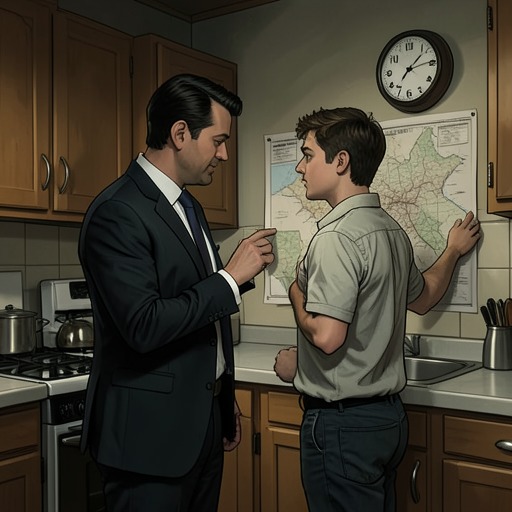
The agency enters the narrative when Scott goes to Marty’s office after Therese sees him trying to climb onto a chair and lifts him onto it. Scott arrives furious, but Marty slides a letter across the desk before he can speak. It is from the Veterans Administration, and its news is brief: the GI loan has been denied. The scene supplies no explanation of the decision, its criteria, or any further contact with the agency; its significance lies in the practical consequence reported by the letter.
The Loan Denial and Its Consequences
The denial comes after Scott has tried to return to work, with Marty reluctantly agreeing to take him on. That effort has not restored his independence: Scott’s shrinking makes an ordinary chair a barrier, and Therese’s act of setting him on it exposes how dramatically his working life has changed. The letter adds a financial setback to that physical and occupational loss, without suggesting that the Veterans Administration caused his condition or knew the circumstances behind it.
Later, Scott recalls the day’s events as he jogs across the cellar floor: after reading the letter, he drove home, suffered a second flat tire half a block from the apartment, and collapsed into hysterical laughter in the car. The narrative describes the laughter as a form of self-defence, a release when pressure has become too tightly wound. The loan decision thus belongs to a sequence of accumulating difficulties rather than standing as an isolated administrative detail.
Narrative Significance
The Veterans Administration’s limited appearance contrasts with the much more public circulation of Scott’s story. Marty’s mention of Scott’s affliction to a fellow Kiwani helps news ripple into the city; the New York Globe-Post later turns Scott’s condition into a story that he experiences as an invasion of his home. At another point, teenage boys recognize him as the shrinking man, while a later newspaper article asks where he is after his disappearance. Against these forms of exposure and public identification, the VA letter is private and spare: it names no spectacle, only a denied loan. Together, the details show how Scott’s shrinking is lived not only as bodily change but through ordinary systems of work, money, recognition, and dependence.