Water heater
The Shrinking ManThe water heater is the center of Scott Carey’s precarious shelter in Carey's cellar: its warmth offers relief from the cold, but its leak threatens the bed and supplies he depends on. As an ordinary household appliance becomes shelter, hazard, and part of an escape opportunity, it also exposes the gulf between Scott Carey’s tiny body and the domestic world that has grown immense around him.
Setting and Physical Form
The heater rests on a cement block in the cellar, its enamel face looming over Scott Carey’s sleeping place. He clambers onto the block and crawls beneath the appliance, using the space under it as protection. The pump nearby can lurch into motion with wheezing, dragon-like sounds, but the heater itself is valued for a more immediate reason: it provides warmth in an otherwise cold environment.
The surroundings acquire their scale through Scott Carey’s altered perspective. The cement block is a platform; the heater above it is a sheltering structure. Later, a giant’s shoes shake the floor, and Scott Carey recognizes the figure as Louise Carey. The appliance that had seemed to define a safe corner now stands amid a landscape in which a person from his former scale can reach down and dismantle it.
Shelter and Daily Routine
Scott Carey makes his bed from a rectangular sponge wrapped in a torn handkerchief and lies beneath the heater, staring at its rust-caked underside. The arrangement is makeshift but essential: he sleeps under its protective warmth, and the block elevates his refuge above the cellar floor. His charcoal-stroke calendar records Monday, March 10, while his thoughts turn to the last week of his life, making the familiar appliance part of a routine shaped by an approaching deadline.
The heater’s warmth matters because Scott Carey is nearly always cold elsewhere. As his original clothes become too cumbersome to move in, he leaves them in dirty heaps beside the appliance and fashions a robe from a piece of cloth, cutting a head hole and tying the ragged edges into knots. When darkness makes the cellar more frightening, he hurries back beneath the heater and drags a box top over his bed. The space is not comfortable in any ordinary sense; it is simply the one place where he can rest and keep warm.
The Leak and Its Immediate Threat
That refuge fails when the heater begins leaking. A rapid thumping sound wakes Scott Carey, who first stands in warm water and struggles to hear himself over the noise. Trying to get out from under the box-top shelter, he slips on the wet surface, strikes his knee and elbow against the cement, and falls again when a drop of water hits his back. Only then does he see the leak.
Water runs across his ankles and spills from the cement block onto the cellar floor. Scott Carey stands indecisive as the warm, wet robe clings to him, confronted by a practical emergency rather than an abstract fear. His attention snaps to the crackers: he lunges back to the box top, carries it away from the bed, and throws himself across the sponge. Water bursts from its pores as he lands. The heater’s malfunction has reached the fragile arrangements around it, putting both shelter and food at risk and forcing him to act despite the slippery floor and his injuries.
Repair and the Chance to Escape
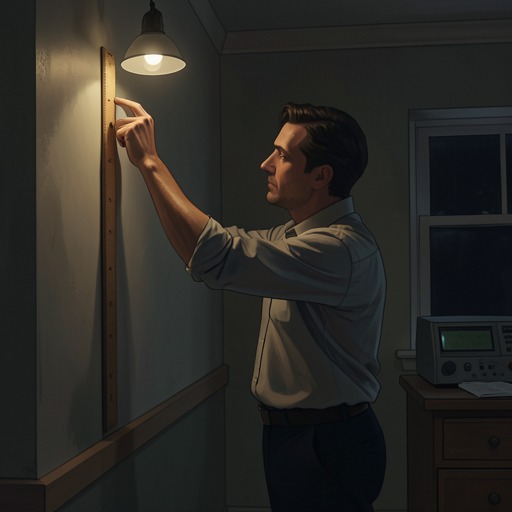
Later, as Scott Carey walks back toward the heater after measuring himself at a ruler, a crash opens a glaring patch of sunlight across the cellar floor. Louise Carey descends the steps, immense from his perspective. Scott Carey freezes at the sight of her shoes and at the recognition that he once occupied the same scale. After he leaps clear of a shoe that lands inches away, he watches Louise Carey crouch beside the appliance.
She takes a screwdriver from her pocket, removes the heater’s side, and probes its interior. In doing so, she picks up Scott Carey’s sponge and tosses it aside, an act that underscores how effortlessly the objects of his shelter can be moved at her scale. Scott Carey is crying as he watches, absorbed in the shock of seeing Louise Carey so completely beyond his reach. Then he notices the cellar door and realizes that her presence at the heater may give him an opportunity to move unseen.
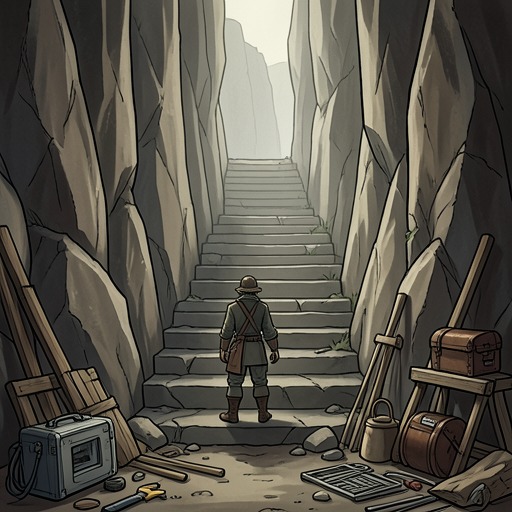
He does not simply dash across the open floor. Fearing that Louise Carey might notice movement and mistake him for an insect, he backs along the cement block, reaches the wall, and runs beneath the fuel tank and tables toward the stairs. The heater is therefore not an escape device, but the focus of Louise Carey’s attention while Scott Carey makes his approach. At the foot of the steps, he finds the first rise towering fifty feet above him and searches for a way up, locating a narrow passage between cement blocks that might be climbed by bracing his body against it.
Narrative Significance
The heater’s role changes without changing its basic form. It begins as a source of warmth and the landmark around which Scott Carey builds a bed, clothing routine, and protected sleeping place. The leak makes that domestic fixture materially unreliable: water, noise, and slippery surfaces turn the shelter into a hazard. Later, repair work transforms the same spot into a point of exposure and opportunity, as Louise Carey’s ordinary maintenance places a giant body beside Scott Carey’s refuge and draws her attention away from his route.
This sequence makes the heater more than background equipment. Its warmth determines where Scott Carey can rest; its failure sets off urgent movements among the box top, sponge, and crackers; and its repair creates the conditions under which he can try to reach the stairs. The appliance’s changing significance follows the instability of Scott Carey’s scale: what once belonged to an ordinary household has become, in turn, a sheltering structure, a source of physical danger, and a point in a perilous route toward escape.