Wooden ruler
The Shrinking ManThe Wooden ruler is Scott Carey’s instrument for recording his shrinking, a plain measuring tool transformed by his hand into a private scale of bodily loss. Its markings make each reduction concrete, but the daily ritual also forces him to confront a change he cannot stop. When the ruler records three-sevenths of an inch, Scott knocks it over, rejecting the practice that had made his shrinking legible to him.
The Ruler as a Daily Measure
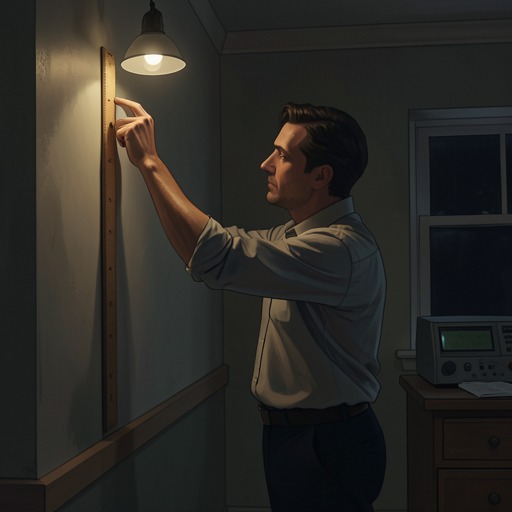
The Wooden ruler stands against the wheels of a huge yellow lawnmower, where Scott has left it. In the rainy cellar, with gray light wavering across the panes, it is the first object he seeks each morning. Before setting out through the cellar or attending to its hazards, he goes to the ruler. The repeated order of this action gives measurement the character of a daily observance: his changing height is not an occasional concern but something he deliberately checks as soon as the day begins.
The ruler is not marked in sevenths. Scott has added those divisions himself, adapting an ordinary instrument to the particular increments by which he tracks his shrinking. He presses close to its calibrated surface, lays his right hand on top of his head, then steps back without moving that hand. The gesture turns his own body into the measure’s movable endpoint. At five-sevenths of an inch, however, the heel of his hand hides the relevant line. The ruler offers precision, but the diminishing space it records makes even the act of reading the scale physically awkward.
That small obstruction sharpens the difference between the ruler’s stable markings and Scott’s unstable body. The instrument stays where he put it; the scale remains available; what changes is the person trying to use it. His measurement is exact enough to register a fraction of an inch, yet it cannot provide a remedy or a reason to continue. The ruler makes the condition visible without making it manageable.
Measurement and Its Limits
After measuring, Scott questions the purpose of repeating the ritual. He knows that he has been shrinking and doubts that injections will begin working at this late point. He considers whether measuring himself is part of an earlier resolution to follow his descent to its end, then recognizes the bleak limitation of that undertaking: no one else would know he had done so. The ruler’s record is therefore private, and its significance depends on Scott continuing to witness it.
This persistence holds together two opposing impulses. Scott has reason to expect no reversal, but he still returns to the instrument and checks the result. Measurement cannot halt his shrinking, yet it gives the change a number and a repeated form. The ruler thus serves both as evidence of helplessness and as a remnant of deliberate attention: each morning, Scott performs the act even while questioning what it can accomplish.
The Final Reading
Later, after nearly three months in the cellar, Scott is mauled and weak. He climbs down to the Thimble expecting water, finds it empty, and sees that the water on the floor has dried or drained into holes in the cement. To reach the other Thimble beneath the water tank, he will have to descend the long Thread climbing line. Before beginning that effort, he shuffles over to the Wooden ruler. The measurement remains embedded in his routine even as thirst and the practical demands of survival press more immediately on him.
The reading is three-sevenths of an inch. This time Scott does not merely question why he measures himself. He pushes the ruler over, and it clatters onto its side. He is tired of measuring himself. The fall reverses the earlier morning procedure: the ruler that he once approached, aligned himself against, and consulted is now deliberately put down. Its markings have not failed; they have recorded exactly what they were meant to record. What changes is Scott’s willingness to submit himself to that record.
A Changed Relationship to the Object
The ruler’s significance lies in this shift from repeated use to refusal. At five-sevenths of an inch, Scott continues the morning check despite knowing that the treatment seems unlikely to work and that nobody else will know about his private resolution. At three-sevenths, he knocks the instrument aside. The two readings preserve a sequence of continued observation followed by rejection, without suggesting that the ruler itself can alter his physical fate.
Afterward, the ruler is no longer the focus of his attention. Scott remembers the missing pin, searches beneath the Sponge and box top, and concludes that the giant may have kicked it away or that it may be embedded in a shoe. He turns away from the distant carton rather than seeking another pin, telling himself that it does not matter, and resumes his movement toward the water pump. The practical crisis continues, but the ruler’s role in it has ended. As a tool, it made Scott’s shrinking countable; as an object he finally pushes aside, it marks his refusal to keep taking that count.