1912
The Silence1912 marks the date of Einstein’s manuscript on special relativity and becomes more than a historical reference: it is a fixed point that characters return to while clocks, schedules, and their own sense of duration grow unreliable. The manuscript’s precise date and material features offer a record to hold onto, even as the present seems to jump, stretch, or lose its bearings.
The manuscript and its date
The year enters the story through the Einstein manuscript that has absorbed Max Stenner. For a year, Diane Lucas has urged the young man to return to earth; instead, he seems only fitfully present, lost in compulsive study of Einstein’s 1912 Manuscript on the Special Theory of Relativity. His fixation turns a date into a persistent object of attention, and a footnote becomes a phrase he repeats: the manuscript calls space and time beautiful and airy. When asked whether he repeats it in English or German, he answers that it depends, making the manuscript’s language itself part of his preoccupation.
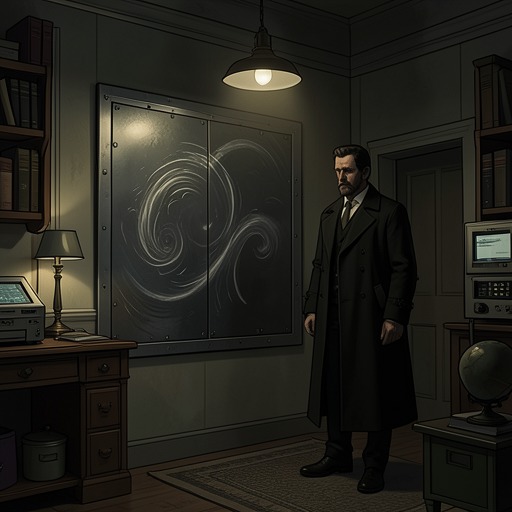
Martin Dekker later gives the date a concrete, archival texture. He identifies the Special Theory manuscript as dating from 1912, then recalls its brown ink and unwatermarked paper, noting that the paper improves and the ink turns black. These details set historical change down in visible materials: the year belongs not only to an abstract theory but to pages and ink that can be imagined changing across the manuscript.
Measured time and the flight
The manuscript’s concern with time is set against the flight’s stream of numerical measures. A passenger watches a screen cycle through altitude, air temperature, speed, and arrival time, trying to sleep but continuing to follow the changing figures. The display gives the journey an orderly scale: an arrival time of 16:32, a speed of 471 miles per hour, and three hours and thirty-four minutes remaining. A separate indication gives the time in New York as 12:55 without specifying a.m. or p.m.; the number is present, but its everyday context is left unstated.
That apparent precision becomes fragile when the plane begins to bounce severely. The passenger keeps reading the screen while noise and physical distress overwhelm the cabin; then the screen goes blank. The change from a sequence of readable measurements to an empty display makes the screen’s ordinary authority visible precisely when it can no longer provide orientation. The year 1912’s theoretical interest in time thus sits beside a much more immediate dependence on clocks, estimates, and functioning instruments.
Dislocated duration
As the crisis continues, measured chronology no longer reliably describes experience. In the living room, Martin notices that time seems to have jumped forward and wonders whether something happened at midnight to intensify the disruption. The question is left unresolved, while his changing voice and coughing interrupt a list about biological weapons. The temporal break is felt before it can be explained.
Diane’s account of her own condition gathers time into accumulated routine: going to bed and getting up, months and years and decades of teaching, and students who listened. She is awake well past midnight, has barely slept or eaten, and questions whether exhaustion helps explain her thinking. Her wish to return to the classroom and teach physics brings the manuscript’s subject into the present as a way of thinking through the crisis, not as an explanation that resolves it.
Jim Kripps likewise finds that recollection alters duration. Recalling the flight, he says it seems a dozen years ago although it happened that day, only hours earlier. His memory returns through particular moments—the turbulence, the unreassuring intercom, the hard landing, his head striking the window, and his hand reaching for Tessa Berens’s wrist—while he admits uncertainty about what he thought or heard at the time. The gap between a short elapsed interval and the event’s remembered weight gives the story’s temporal dislocation an intimate scale.
A historical anchor in the present
Martin places Einstein’s dated manuscript beside the surrounding collapse, which he calls World War III, and recalls Einstein’s prediction that World War IV would be fought with sticks and stones. He holds onto the year, the paper, the ink, and remembered phrases about mass and energy while modern systems of surveillance and verification crowd his thoughts. He imagines walking silently with Einstein across the Princeton campus, a scene of measured companionship set against the present’s fractured signals and uncertain chronology.
The recurrence of 1912 does not make the crisis legible or restore ordinary time. Instead, the manuscript provides a durable reference point against which present experience appears unstable: screen time can be displayed and then disappear, midnight can coincide with a felt leap, and a few hours can become a dozen years in memory. Its significance lies in that contrast between a date preserved on paper and the difficulty of locating oneself in time.