Diane Lucas
The SilenceDiane Lucas is a former college professor whose attention to other people, teaching, and the passage of time persists when the familiar structures around her no longer seem reliable. In scenes with her husband, Max Stenner, and her former student Martin Dekker, she measures a marriage by its long routine, recognizes the unusual closeness between teacher and student, and finally speaks at length about a public crisis she cannot yet comprehend. Her struggle is not simply to explain what has happened, but to recover a way of looking, listening, and teaching.
Identity and Setting
At the Super Bowl LVI gathering in 2022, Diane sits in a rocker five feet from Max, with Martin, her former student, seated between and behind them in a kitchen chair. The arrangement places the three together without making them a simple group: Diane and Max are long-married spouses, while Martin belongs to Diane’s past as a teacher and is now present beside her. The game provides a shared occasion, but the scene’s attention shifts among its spectators, their habits, and what they will say to one another.
The television setting is saturated with commercial interruptions and pregame talk. Max has a history of large sports bets and describes keeping the point spread distinct in his mind from the bet itself. Diane, by contrast, observes what watching does to him: during the succession of commercials, she says, he becomes a consumer who had not intended to buy anything. Her observation turns the televised event into more than background. The screen keeps offering things to watch and consume, while Diane is attentive to the behavior and relationships gathered around it.
Marriage and Routine
Diane names the duration of her marriage directly: “Thirty-seven years.” She qualifies its history as “Not unhappily,” but says the two have lived in “states of dire routine,” so closely clutched together that she can imagine a future in which each forgets the other’s name. The qualification matters: she does not reduce the marriage to misery or present separation as an accomplished fact. Instead, she describes the erosion that can occur within sustained togetherness, where attachment and routine have become difficult to tell apart.
Her account of Max during the broadcast sharpens that contrast. He is accustomed to sitting in his armchair and watching, his reaction to a failed field goal or fumble often visible in his face and in the movement of his hand against his forearm, even when he does not curse aloud. Diane sees his attention held by the game and its wagers, then by the advertisements that follow. Her marriage portrait is therefore made from repeated, ordinary behaviors: the game, the watching, the commercial stream, and the years in which two people remain close while fearing that closeness has hardened into habit.
Martin and the Reversal of Roles
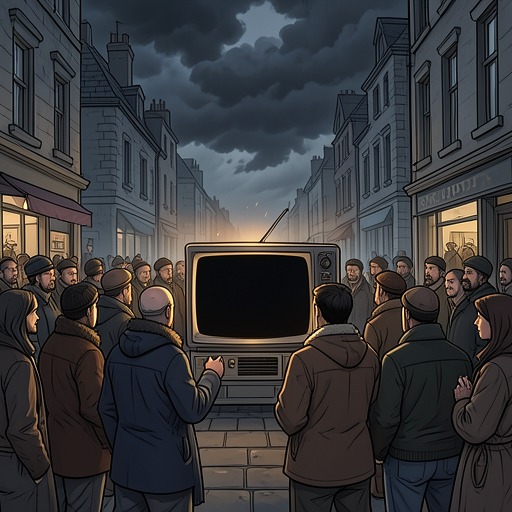
Martin’s presence brings Diane’s former work into the room. He is in his early thirties, and she identifies him as a former student; later, after hearing him repeat his name, she closes her eyes and says it to herself. She wonders whether he will live alone forever, with the blank screen seeming a possible answer. The thought joins an intimate question about Martin’s future to an image that offers no explanation. Diane then turns to look at him, moving from inwardly repeating his name to facing the person who bears it.
She calls their arrangement “Teacher and student in a reverse coupling.” The phrase marks both continuity and change: their connection still carries the history of instruction, but the scene no longer presents Diane simply as the one who speaks and Martin as the one who listens. Her question about his solitude and her effort to retain his full name give the moment personal weight, while the reversal leaves the nature of their present relationship open rather than defining it beyond the evidence. Martin’s presence makes teaching more than a former occupation; it remains a bond that shapes how Diane understands the people beside her.
Crisis, Teaching, and Time
Later, Diane decides to speak although she has no idea what will come out. Her speech gathers details that might otherwise remain separate: staring into space, losing track of time, getting into and out of bed, and decades spent teaching students from different backgrounds. She asks herself what is happening in public squares across Europe, places where she has walked, looked, and listened. She admits feeling simpleminded and calls herself a college professor who quit too soon, then imagines the end-of-the-world movie in which people are stranded in a room. The comparison immediately shifts: they are not stranded, she observes; they can leave whenever they choose.
That distinction exposes the gap between physical possibility and felt disorientation. Diane imagines bedlam in the streets from what Max has seen, yet wonders why she is reluctant to go to the window and look for herself. She considers whether people had been headed toward this condition, naming “No more wonder, no more curiosity” and “Totally impaired orientation” as part of her diagnosis. Her words are not presented as a settled account of the crisis. She also asks whether speaking this way is the result of being far past midnight, sleepless, and barely fed, while the others in the room seem barely to listen. The speech holds interpretation and self-doubt together.
Her clearest wish is to resume teaching and return to her classroom. She wants to speak to students again about physics, moving from particular topics to time itself: “The physics of time. Absolute time. Time’s arrow. Time and space.” The sequence turns her professional longing toward the concepts that might help her think about a world in which orientation has failed. It does not resolve that failure; it shows what intellectual and human work she still wants to do in its presence.
Narrative Role and Ending
Diane’s extended speech contrasts with the brief exchanges and passive television watching that frame the earlier gathering. It ranges across marriage, students, public spaces, exhaustion, physics, and a remembered line from Finnegans Wake, without arriving at a confident explanation. She notes that the line has remained secure in the proper mental slot, an image of memory holding on to a fragment while her sense of the present feels impaired. The movement of her monologue—from outward events to her classroom, then to remembered words—makes thought itself the action of the passage.
At its close, she says the line aloud and gives herself the final instruction, “Shut up, Diane.” The command does not erase the speech that precedes it; it reveals her awareness of having continued despite uncertainty and apparent inattention from the others. Her ending is consequently neither a return to calm nor a declared solution. Diane remains a teacher in desire and in the habits of her attention, but she is also a listener who has not yet made herself look out the window. That unresolved tension between wanting to understand and hesitating to witness gives her reflections their force.