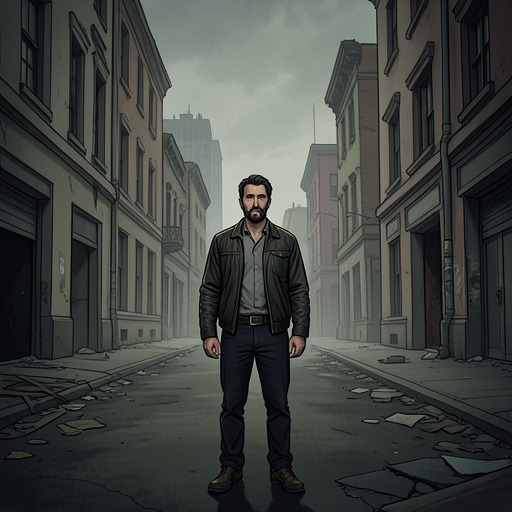
Jim Kripps
The SilenceJim Kripps is introduced through a contradiction: he has a name, but during the flight he follows a personal procedure of treating his seat number as his identity. After the plane comes down and the larger collapse of systems begins to register, that reliance on a fixed label gives way to a more difficult task—recovering what happened and what he felt. His account makes him a witness whose memory is still being assembled as he speaks.
Identity and Background
For the hours of the flight, Jim’s name is his seat number, in keeping with a rooted procedure of his own and the number stamped on his boarding pass. The detail gives his identity a deliberately procedural cast: amid the routines of air travel, he reduces himself to a place assigned to him. Later, when he tries to recall the crash, that same certainty is absent. He cannot initially remember being afraid, and the sequence of the emergency comes back as uncertain recollection rather than settled knowledge.
Jim works as a claims adjuster for an insurance company. After the crash, this ordinary professional identity is reassuring to Tessa Berens, who knows her own name but is struggling to bring events clearly to mind. Jim is present and solid company, though he too is injured and disoriented: a cut on his forehead has left blood on his face, and his phone, like the other passengers’ phones, is dead. His work gives Tessa a concrete fact about the man beside her at a moment when both have lost access to much of the ordinary framework that would make their circumstances intelligible.
The Crash and Its Delayed Recall
When Jim later tries to reconstruct the flight, he begins not with certainty but with the small, ordinary expectation that had occupied him and Tessa Berens: they were seated, half-asleep, waiting for a snack before landing. Then the plane began jumping and making loud banging noises. Jim could not tell whether they were near the airport or landing strip; he looked out of the window and saw nothing, waiting for reassurance from the pilot that did not come. The intercom voices sounded unreassuring, and the plane’s worsening motion made the anticipated landing feel instead like an emergency whose outcome he could not know.
His memory of the moments inside the aircraft is fractured by uncertainty. A pilot spoke French, and Jim recalls that Tessa spoke French too, but cannot tell whether she translated for him; he even wonders whether not translating might have spared him something. He remembers the force of the crash landing, his head striking the window as he was thrown sideways, and blood running into his eye. He reached for Tessa’s hand or wrist while she looked at the blood on his face. Someone shouted about fire, though Jim could not establish whether a wing was burning, and a passenger across the aisle was half-choking and half-shouting. The plane came down hard, then skipped and skidded. His recollection preserves these bodily shocks more firmly than it preserves the explanations around them.
Jim makes clear that, during the landing, he had no way to connect the aircraft’s failure with the collapse of systems beyond it. That connection belongs to later knowledge, not to the experience as it unfolded. He describes this account as his first real opportunity to think about and remember what happened; before it, events had carried him from the van to a clinic and then into the street. The sequence gives his testimony its unsettled character: the crash is both only hours past and, in his telling, seemingly a dozen years distant, while its physical details return before its meaning does.
Relationships and Reunion
In the van after the crash, Jim waits for Tessa Berens to look at him so they can exchange a glance. Around them, the vehicle is crowded with two flight attendants and passengers in markedly different states: one man speaks to himself in French, another shakes and curses his phone, some passengers moan, and others sit quietly trying to recover what happened and who they are. The van carries not only injured survivors but a group whose basic bearings have been shaken. Jim’s wish to meet Tessa’s eyes is a small, deliberate effort to establish contact amid that confusion.
Their connection remains present in the details of the immediate aftermath. Jim has a bloodless laceration on his forehead, and Tessa keeps looking at it, seeming to want to touch him, as if touch, an embrace, or continuous speech might help them remember. Jim, for his part, recalls reaching for Tessa’s wrist during the crash and finding her there beside him afterward. Neither gesture restores a clear account of events, but their physical nearness offers a point of continuity while memory and the surrounding systems fail.
Later, Jim and Tessa arrive at Diane Lucas’s door, where the strain of reaching the apartment is audible: the elevators are not working, and people have had to climb eight flights. Jim answers Diane’s welcome by saying that they have made it only barely. They take off their coats and join Diane, Martin Dekker, and Max Stenner; the greetings include handshakes and half-embraces, while Max raises a clenched fist. Seeing Jim’s bandage, Max throws a few mock punches, turning recognition into a teasing acknowledgment of the injury rather than a solemn inspection.
Once everyone is seated, Jim and Tessa recount the flight, what followed it, and the spectacle of the midtown streets emptied across their grid. The account brings the crash into a shared conversation, but it does not make the experience orderly: Jim’s later recollection remains pieced together from bodily impressions, uncertain details, and the route from plane to van, clinic, street, and finally this gathering. In the company of the others, his experience becomes something he can begin to tell, while the empty streets outside mark how little of the familiar world is available to support that telling.
Memory and Narrative Role
Jim’s recollection emerges as testimony under construction rather than a settled account. Stooped low in his chair, looking down and speaking into the carpet, he moves from the banal expectation of a landing snack to the plane’s violent jolts, then interrupts himself to question whether his thoughts about the many passengers who had died in similar emergencies were present during the flight or had entered the story as he rambled. Even the duration resists measurement: what happened only hours earlier seems to him like a dozen years ago. His account makes the gap between experiencing an event and being able to narrate it part of the event’s meaning.
The form of his telling preserves uncertainty instead of smoothing it away. Jim can recall the bangs, the impact, and his head striking the window, yet he is unsure whether Tessa translated the pilot’s French or whether he saw a wing on fire. He also distinguishes what he knew then from what he learned afterward: during the crash, he could not connect the aircraft’s emergency with the wider collapse of systems. By voicing doubts about his own memory, he presents himself not as an authoritative interpreter of the catastrophe but as a witness trying to recover its sequence from bodily impressions, later knowledge, and the limits of recall.