Martin Dekker
The SilenceMartin Dekker is a high-school physics teacher whose intense absorption in Einstein’s 1912 Manuscript on the Special Theory of Relativity makes him seem only partly present to the people around him. The novel first places him among Diane Lucas and Max Stenner during Super Bowl LVI, then reveals the scale of his inward preoccupation: he carries the manuscript’s details in his head and gives Einstein an imagined English voice. Martin’s importance lies in that uneasy conjunction of a gifted teacher, a solitary observer, and a mind that may be reaching beyond the limits of what can be verified.
Identity and Work
Martin is in his early thirties and lives alone in the Bronx, where he teaches high-school physics at a charter school for gifted students. He is described as neatly dressed and clean-shaven, punctual, and accustomed to moving through city streets without being noticed. In the classroom, he serves as a somewhat eccentric guide to the dense wonders of physics. His teaching therefore depends on making difficult ideas available to others, even as his private pursuit increasingly separates him from shared, everyday attention.
That pursuit is his study of Einstein’s 1912 Manuscript on the Special Theory of Relativity. Diane sees Martin as lost in it, not simply occupied by a scholarly subject: for a year she has urged him to return to earth. He seems to occupy a chair only fitfully and sometimes falls into what the narration calls a pale trance. The question of whether this is sickness or a condition remains open. The text establishes the visible distance between Martin and ordinary company without supplying a diagnosis.
At Diane and Max’s Home
During the 2022 Super Bowl, Martin sits in a kitchen chair, bent slightly forward, behind Diane and five feet from Max. The staging gives him a place within the domestic gathering but also marks his separation from its center. Max is fixed on the game and its wagers; Diane sits in a rocker; Martin is physically present yet seems to Diane only fitfully engaged with the room. Pregame commercials and commentary continue around them, while his attention is associated with the manuscript that has consumed him.
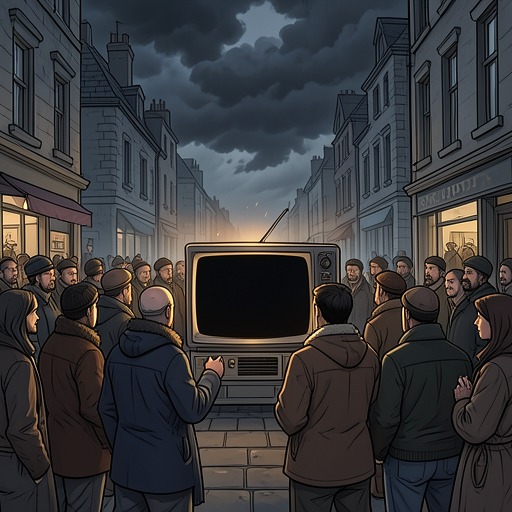
Diane is Martin’s former teacher, and their connection is unsettled by the way their roles begin to shift. At one point she repeats his full name to herself, then wonders whether he will live alone forever. The moment is described as a reverse coupling of teacher and student, suggesting an altered balance between them without resolving what that change means. Her concern is personal as well as intellectual: she is trying to call him back into the world, but the name she silently repeats and the blank screen before her offer no answer.
Einstein’s Voice and the Manuscript
Martin’s relation to Einstein moves beyond close study into performance. Diane realizes that he is using an accent: not merely speaking in a manner unlike his own, but adopting a voice meant to belong to a particular person. It is Martin’s version of Albert Einstein speaking English. This distinction matters because the imagined voice gives his scholarship a dramatic presence, while leaving Diane uncertain about what she is hearing and how much of it Martin understands as fact.
The uncertainty grows when Martin speaks about censored news and people with phones implanted in their bodies. Diane doubts that his account is anything but foolish speculation, yet she also recognizes something in his essential nature that makes the speculation possible. The text does not confirm that Martin has special access to events. Instead, it holds his claims between possible invention and an unexplained reach toward information, allowing Diane’s skepticism and her recognition of his unusual character to coexist.
Crisis, Presence, and Narrative Role
Later, Martin repeatedly stands and moves up and down as he speaks, immersed in what is described as a nowhere stare. His thoughts bind his private subject to the public emergency: he refers to the present conflict as World War III and recalls Einstein’s statement that World War IV would be fought with sticks and stones. He also dwells on the manuscript’s physical and historical particulars, including its date, 1912, its brown ink, its unwatermarked paper, and the later change to black ink. These specifics show how completely the document has become part of what he carries in his head.
His speech also moves between expansive ideas and immediate bodily needs. Alongside Einstein and the coming wars, he recognizes that he needs a shave and wonders whether leaving the living room for the lavatory would mean not coming back. The turn makes his disconnection concrete: even an ordinary movement through the home has become uncertain to him. Martin remains a teacher of physics, but in the novel’s crisis he also becomes a solitary interpreter of history, technology, and time. The others cannot conclusively distinguish insight from exhaustion or imagining; the narrative preserves that uncertainty as part of his character rather than settling it into a diagnosis.