Max Stenner
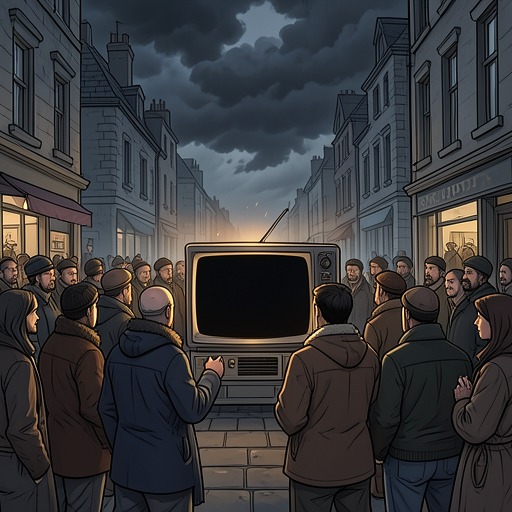
The SilenceMax Stenner is defined by the tension between a life organized around wagers and a manner that conceals how much those wagers matter to him. A habitual bettor who keeps the amount of his losses private, he is introduced watching the season’s final football game with Diane Lucas; when the screen goes blank, his familiar posture and curses persist, but the ordinary structures of spectatorship have failed. Later, the act of climbing home connects the present crisis to an old childhood routine of counting steps.
Identity and Habits
Max is accustomed to being sedentary, settled into his armchair in front of the television. During the final game of the American football season, he watches a field one hundred yards long, with eleven players on each team, while the broadcast moves through commercials, pregame talk, a national anthem sung by a semi-celebrity, and the flight of six U.S. Air Force Thunderbirds over the stadium. The details establish a familiar spectacle around which he has built a recurring habit: watching, waiting, and wagering.
His responses to the game are largely physical rather than spoken. A failed field goal or a fumble may draw a silent curse visible in his narrowed eyes, with the right nearly shut. Depending on the situation and the size of his wager, the tension can spread across his face: lips tightening, chin quivering, and a wrinkle beside his nose lengthening. His right hand then moves to scratch his left forearm, fingers digging into the flesh. The stillness of his posture does not mean indifference; minute changes in his face and hands register the pressure he does not voice.
Gambling and Secrecy
Max describes a split in his relation to betting. The point spread and the money are continually present to him, and he says he consciously keeps the spread in mind regardless of what happens on the field, while separating it from the bet itself. This distinction makes gambling both an acknowledged fixation and something he mentally brackets: he can attend to the terms of the wager without, in his account, attending to the wager as a whole.
Diane makes the secrecy more concrete. The amount Max bets is a number he keeps to himself, a boundary she calls sacred territory. She jokes that she is waiting for him to die before he reveals how much money he has lost over the years of their partnership. Her remark places his private betting inside their marriage, where its financial scale remains undisclosed even as its long duration is familiar. Max’s question to her about how many years shifts the exchange from the hidden sum to the history of their relationship, without answering her complaint.
The narrative names his guiding belief as a gambler’s creed: impulse should determine logic. The phrase gives an organizing principle to the contrast between his conscious attention to point spreads and his concealment of the actual bet. His habits make that principle visible in two registers: the careful mental tracking he describes and the bodily strain that escapes him when the game turns against his wager.
The Blank Screen
After the television goes blank, Max is back in his chair, still cursing the situation and repeatedly looking at the screen. His exclamations invoke Jesus in several forms, but the broadcast does not return within the moment described. Diane watches both him and Martin Dekker from an angled seat and suggests that Max prepare a halftime snack, while allowing that reception might resume in a few minutes. She also makes clear that she does not believe her own reassurance. Max goes to the liquor cabinet instead of the kitchen and pours himself a ten-year-old bourbon, Widow Jane.
The interruption strips his usual activity of its object without immediately changing his posture. He remains in the armchair, eyes barely open, trying to look bored. His repeated curses and fixed attention on the blank screen sit uneasily beside that display of boredom: the game has stopped, but he continues to watch for its return. The scene’s stalled routine makes the failure of reception more than a pause in entertainment. The familiar screen remains physically present, yet it can no longer provide the game, its progress, or the point spread around which his attention has been arranged.
Stairs and the Return Home
A first-person recollection associated with Max turns from the chair to the stairs. He remembers counting seventeen steps as a child in a small town, where his family rented the second floor of a two-story house: nine steps ran alongside the garage, followed by eight more to their apartment. At times the number seemed to change, leaving him uncertain whether he had miscounted or whether the world was shrinking or expanding. The childhood memory is specific and measured, but its uncertainty already unsettles the reliability of counting as a way to secure the world.
As an adult and a father, Max has a job that takes him into luxury towers to inspect basements, stairways, and rooftops for building-code violations. He says that he loves finding violations because they justify his feelings about nearly everything. His professional attention to faults therefore has a personal charge: the built environment offers visible defects against which he can confirm an otherwise broadly stated dissatisfaction.
During the crisis, Max makes his way back through crowds to his street and building, finds his house key, and unlocks the front door. The elevators are not working, so he climbs slowly, looking at each step and counting flight by flight. He initially notices his hand on the handrail, then decides he does not want it there and continues without it. His mind, he recalls, is more or less blank; he does not experience the climb as a deliberate reliving of childhood. The old sequence of steps returns instead as an action suited to the immediate problem. He climbs past the third and fourth floors, continues upward, and finally reaches the hallway, where he retrieves his apartment key from beneath a crumpled handkerchief in his pocket. Counting links childhood and adulthood, but the climb is not a return to a safely remembered past: it is the practical means of reaching home when the building’s ordinary convenience has failed.