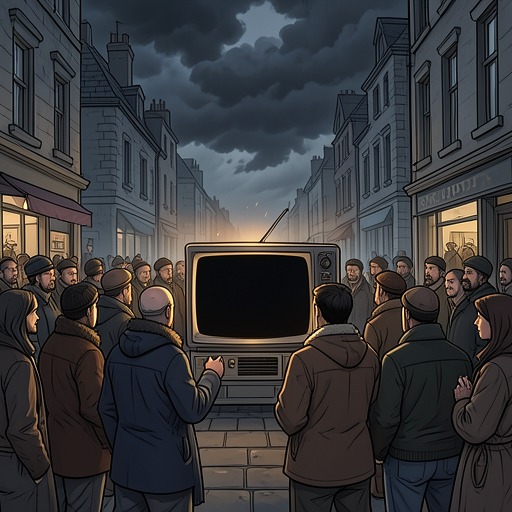
Paralysis of communications and technology systems
The SilenceParalysis of communications and technology systems transforms everyday devices from invisible conveniences into stubborn evidence of dependence. It begins with a television that fractures into abstract pulses and loses its sound, then widens to dead phones, an unusable landline, a lifeless laptop, and screens emptied across the world. The failure reaches beyond communication: clinic lights go out, transport and elevators are reported stalled, and even nuclear weapons become dysfunctional, while the war itself continues. The disruption is not a single broken machine but a cascading crisis in the systems that organize perception, movement, and power.
The First Failures
At Max Stenner and Diane Lucas’s home, a screen initially shows images that shake in a way that seems deeper than ordinary distortion. Rectangles, triangles, and squares form and dissolve in a rhythmic pulse, advancing and retreating. The effect turns the television from a transparent window onto a broadcast into an image with no stable meaning. Max repeatedly presses the remote’s volume button, but there is nothing to hear. Then the screen goes blank. He tries the power button on and off; Diane checks their phones, which are dead. The landline has no dial tone, the laptop is lifeless, and a computer in the next room remains gray when she touches its controls.
The failures arrive through familiar interfaces, one after another, and make the scale of the breakdown legible by subtraction. Television, mobile phones, a landline, and computers each cease to perform a different ordinary function; no replacement device restores access. Diane stands behind Max with her hands on his shoulders, waiting for him to clench his fists and curse. Instead, he calmly asks what is happening to his bet. The mundane question sits beside a breakdown that has already reached across the room, registering how abruptly ordinary concerns persist even as the infrastructure supporting ordinary life disappears.
From Devices to Infrastructure
The crisis becomes more than a household outage when Jim Kripps and Tessa Berens reach a clinic after their plane’s crash landing. A middle-aged staff member points to the blank screen among the devices set into the wall. She says that whatever is happening has crushed technology and questions the usefulness of secure devices, encryption, and the online systems associated with posts, trolls, and bots when the wider digital sphere may be exposed to distortion and theft. Her account links the loss of working equipment to a broader uncertainty about authority and trust: a device can no longer be assumed to provide secure information simply because it was built to do so.
The clinic’s other functions depend on people and physical procedures. The staff member says her work is to direct injured people to examination and treatment, not to explain the crisis. She has seen people arriving with stories of an abandoned subway, stalled elevators, and empty office buildings, alongside barricaded storefronts. These reports are presented as what others have told her, not as a complete inventory of conditions everywhere. Still, they suggest that the outage is disrupting movement and access to workplaces and public spaces, not merely the exchange of messages. Jim’s wound is treated by a young man who applies medication and bandages it; the concrete task of care continues even as the clinic’s digital apparatus fails.
Darkness and Material Dependence
The loss of electricity makes the clinic’s vulnerability immediate. Its overhead lights blink, dim, and go out, and the waiting room falls into silence. The staff member first whispers personal details about her family and background; after a pause, she speaks more intensely about surveillance systems, facial recognition, and image resolution. She asks how people can know who they are when those systems fail, and worries about the practical consequences of leaving: cold, no light or heat at home, public transport and taxis unavailable, and the elevator in her building immobilized. She loves her cubicle but does not want to die in it. Her fears connect the abstract failure of advanced systems to specific needs for warmth, transport, and a route home.
When the lights return dimly, Jim is standing straight and expressionless, resembling a tall white android. The image briefly makes a human body seem as blank and mechanical as the equipment around him. Outside, the wind is fierce and Jim, Tessa, and their companions walk quickly with their heads down. They see a hobbling man pushing a battered cart, who steps away from it to imitate their bent movements before they wave and continue. At a major intersection, the digital traffic warden is frozen with one arm slightly raised. With no functioning signal to direct them, the travelers have nothing to do but keep walking. The scene shows how a small failed control device can leave movement to improvised judgment and physical effort.
A War Without Its Expected Machinery
The breakdown expands into the machinery of war. In the account that opens the book’s second part, unknown groups or agencies are said to be manipulating nuclear launch codes remotely. Nuclear weapons worldwide have become dysfunctional: missiles are not crossing oceans, and bombs are not being dropped from supersonic aircraft. This interruption does not end the conflict. Cyberattacks, digital intrusions, biological aggression, anthrax, smallpox, other pathogens, deaths, disability, starvation, and plague accumulate as its terms. The contrast is decisive: the failure of nuclear delivery systems removes one familiar form of warfare, but violence continues through other means and consequences.
Power grids are also described as collapsing, linking the failure of electricity to the already visible losses of screens and lighting. The scale shifts between global systems and personal perception, which is said to be sinking into quantum dominance. The text raises questions about warming air and rising oceans rather than confirming those changes as measured outcomes. Likewise, it asks whether some people have phones implanted in their bodies and whether such devices could provide warnings through a bodily code or second heartbeat. These are speculations prompted by the global silence, not established explanations or evidence that such people exist.
Significance of the Silence
The system failures recur at different scales: a silent television, dead personal devices, blank screens, dark rooms, frozen transport infrastructure, collapsing grids, and disabled launch systems. Their accumulation makes technological dependence tangible by showing what stops when each layer ceases to work. The outage also unsettles the distinction between information and security. Encryption and surveillance may promise control, yet the clinic worker wonders whether the systems themselves are subject to distortion and theft; the malfunction leaves people unsure not only how to communicate but what can be trusted.
The silence does not create a pause in history. Martin Dekker calls the conflict World War III, while the account of the wider crisis emphasizes that the war rolls on despite the failure of nuclear weapons. At the clinic, people wait through darkness; on the street, the travelers walk past a disabled traffic warden; elsewhere, the text imagines conflict spreading through digital and biological means. The paralysis therefore changes the conditions under which people move, care for injuries, receive information, and understand danger without supplying a single authoritative explanation for the collapse. What remains is a world in which advanced systems have failed, physical needs endure, and the consequences of technological dependence are encountered one darkened room and stalled journey at a time.