Paris
The SilenceParis is presented less as a fully depicted setting than as a place measured, visited, and recorded. A clock on an aircraft screen puts its local time beside London’s; later, landmarks, rain, and a saved ticket stub make the city part of a carefully maintained book of memories. The contrast between passing through time and trying to preserve an experience gives Paris its particular significance in the novel.
Time and Transit
During a flight, a man reclines his seat and watches a small screen beneath the overhead bin as it cycles through changing information: altitude, air temperature, speed, arrival time, words, and numbers. Among its displays are the times in Paris and London. Paris enters first as one point in a system of measurements, its hour set alongside another city’s, while the screen’s changing figures follow the progress of the aircraft.
The man wants to sleep but keeps looking. He calls the woman’s attention to the display; she nods faintly and continues writing in a little blue notebook. He then recites the words and numbers aloud. Merely noticing them, he feels, will not help: without speech, each detail would be lost at once in the combined drone of his mind and the aircraft. Paris’s brief appearance in this scene belongs to that effort to hold on to information as it changes and disappears. The city is named on a screen, but the human response to the screen is already a question of memory.
A Holiday Preserved in Notes
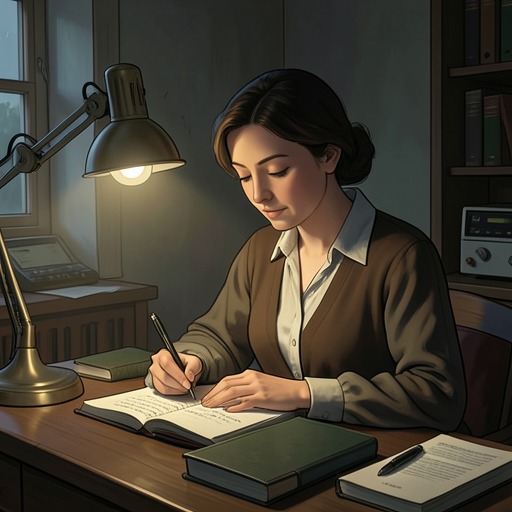
Paris also appears as a city the couple have visited. In conversation, the man reminds the woman of the holiday’s intended record: its high points, vivid moments, long walks, meals, wine bars, and nightlife. He recognizes that this account has become stale even as he speaks. The woman’s notebook, however, is not simply a collection of celebrated highlights. She wants the rainy day included, with enough precision and detail that she can return to the notes years later and see what that day was like.
Her account of the trip names the Jardin du Luxembourg, Ile de la Cité, Notre-Dame, and Centre Pompidou. It also includes a ticket stub she still has. These details give the holiday two kinds of persistence: the notebook describes remembered experience, while the stub is a surviving object from the visit. The record is selective but deliberately attentive to particulars, including a rainy day that does not fit the usual ideal of a holiday remembered only through its best moments.
The exchange makes the difference between the couple’s approaches visible. He recites the conventional inventory of memorable pleasures, then admits to himself that his words have gone stale. She insists on the value of the unexceptional weather and on the accuracy of the record. When he tells her she cannot help herself, she does not want to be cured of the impulse: what she wants is to get home and look at a blank wall. Paris is therefore attached both to the active work of recording and to her desire, after that work, for a space without further demands on her attention.
Return and Recollection
In a later exchange, someone says that Tessa is back from Rome, and Tessa replies that they are back from Paris. The wording places Paris within a conversation about returning from travel, rather than establishing a further scene in the city. It also keeps the account of Paris mediated by recollection and report: the holiday is named again after the journey, just as its details survive in a notebook and a ticket stub.
Across these appearances, Paris connects two forms of keeping time. On the aircraft screen, its hour is one changing figure among measurements of a journey; in the notebook, its streets, landmarks, rain, and remnants become details chosen for future memory. The city is not elaborated through a continuous travel narrative. Instead, the novel lets a few precise references carry the tension between experience as it passes and the attempt to preserve it without reducing it to a list of conventional highlights.