Super Bowl LVI
The SilenceSuper Bowl LVI, played in 2022 as the final game of the American football season, is the televised event around which a domestic gathering becomes a study of habit, attention, and dependence on technology. For Max Stenner, the game is inseparable from gambling: even as the broadcast disappears and the household’s devices stop working, his most urgent question is what has happened to his bet.
The Game and Its Audience
The scene establishes the event through the familiar apparatus of a major football broadcast. Two teams of eleven play on a rectangular, one-hundred-yard field, with goal lines and goal posts at either end. Before the action, the broadcast offers the national anthem, sung by a semi-celebrity, and six U.S. Air Force Thunderbirds streaking over the stadium. Commercials, station breaks, and pregame discussion fill the time before the opening kickoff, which is described as one commercial away. The championship arrives not as uninterrupted play but as a sequence of spectacle, commentary, and advertising.
Diane Lucas sits in a rocker five feet from Max, while Martin Dekker, Diane’s former student, sits behind and between them in a kitchen chair. He is in his early thirties and bends slightly forward. These positions make the viewing arrangement precise: Max faces the screen from his familiar place, Diane watches from nearby, and Martin is physically included while seeming less settled in the room. The game supplies their shared focus, but each is situated differently in relation to it.
Max’s Betting Ritual
Max has a history of placing large bets on sporting events, and the championship gives that habit its most immediate object. He explains that he can keep the point spread distinct from the bet itself, recognizing a split between what happens on the field and the wager he has secured in his mind. The distinction is telling: the game’s outcome and the financial risk are connected, yet he experiences them as separate concerns. His attention is organized not simply around which team wins but around the terms of his bet.
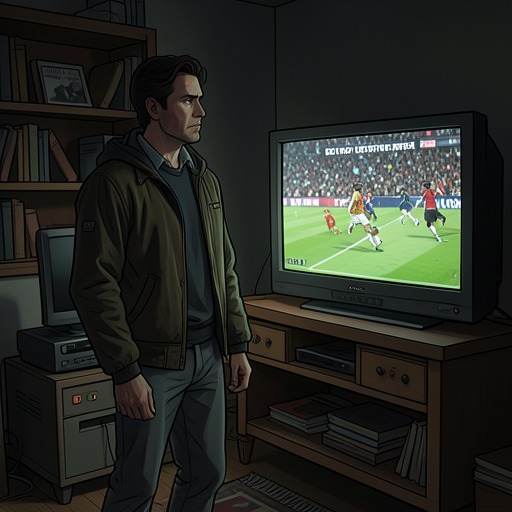
His customary reactions are physical rather than spoken. In his armchair, he watches and silently curses when a field goal fails or a fumble occurs. The curse shows in narrowed eyes, with the right eye nearly shut; depending on the situation and the size of the wager, his expression may tighten into visible regret, his lips drawn in and chin slightly quivering. His right hand scratches at his left forearm, fingers digging into the flesh. The gestures give the private pressure of gambling a bodily form without turning it into a shouted performance.
The broadcast also gives Max an occasion to complain about professional football’s focus on its two quarterbacks. He finds the players easier to deal with than the constantly shifting units of the full teams. That preference sits alongside the game’s scale: eleven players per side, a long field, and a stadium spectacle, yet the commentary narrows attention to two individuals. Before kickoff, Max stands, rotates his upper body as far as he can while keeping his feet planted, then looks straight ahead for about ten seconds. When he sits again, Diane nods, as if the proceedings on screen can continue according to plan.
Interruption and Resumption
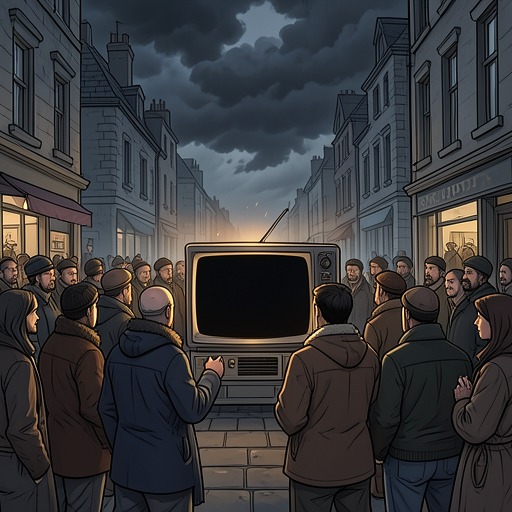
The plan breaks when the screen goes blank. Max presses the power button on and off; he and Diane check their phones, which are dead. Diane tries the landline, a sentimental relic, but there is no dial tone. A laptop is lifeless, and in the next room the computer screen remains gray when she touches its controls. The failure reaches beyond the television: the usual devices through which the household receives information and makes contact are unavailable.
Diane returns to Max and stands behind him with her hands on his shoulders, waiting for the clenched fists and cursing she associates with his response to a bad play. Instead, he asks calmly, “What is happening to my bet?” He looks to Martin for an answer, then stresses that serious money is involved and asks where the bet is. The interruption has removed the visible game but not the wager from his attention. His calmness does not mean the bet has become unimportant; it makes its priority unmistakable.
The account later announces that play resumes in the second quarter, naming the actions and body parts involved in football before calling the championship “Our National Death Wish.” That description shifts the emphasis from the sporting pageantry to the repeated impacts of the game: hands, feet, knees, head, chest, and crotch, with players both hitting and being hit. Diane tells Martin there is no reason they cannot converse because Max has his game and is beyond distraction. The scene thus holds together two versions of the event: a mediated contest that absorbs Max, and a collision-heavy spectacle that can be redescribed as a collective appetite for danger.
Significance in the Scene
Super Bowl LVI is more than a broadcast in the background. Its interruptions expose how firmly Max’s attention is attached to the wager, even when the picture, phones, landline, and computers cease to function. The game’s expected rhythm—pregame talk, kickoff, and continuing play—is disrupted, but his central concern persists. At the same time, the shift from ceremonial anthem and fighter-jet display to the language of blows and bodily targets unsettles the event’s polished presentation. The scene ends without reporting the game’s final result; its decisive outcome is instead a change in what the viewer can see and what Max continues to value.