The blank screen
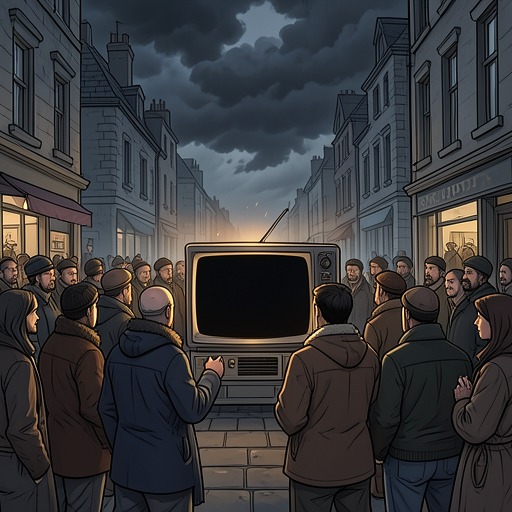
The SilenceThe blank screen is the novel’s recurring image of technological failure and suspended communication. It first appears after moving patterns on the television dissolve; phones, the landline, and computers then prove unusable, while the screen becomes a persistent focus for speculation and attention. Its importance lies not only in what it no longer displays, but in how the people around it continue to look for meaning there.
From Distortion to Failure
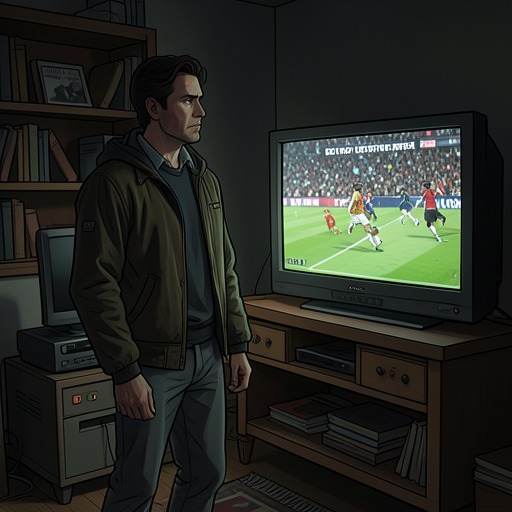
The screen does not go blank immediately. Images first shake in a way that seems deeper than ordinary visual distortion, forming rectangles, triangles, and squares that pulse forward and recede. The shapes suggest an ordered sequence, but offer no explanation. Max and Diane watch and listen; Max repeatedly presses the remote’s volume button, only to find that there is no audio. The failure therefore unfolds across both image and sound before the screen goes blank.
Max tries the power button, switching the set on and off, but the image does not return. The failure is not confined to the television. Max and Diane check their phones, which are dead; Diane crosses to the landline, described as a sentimental relic, and finds no dial tone. The laptop is lifeless, and the computer in the next room stays gray when she touches its controls. These specific, failed attempts make the blank screen part of a larger breakdown in familiar systems. What had been ordinary tools of connection and use instead confront the characters as inert objects.
An Empty Surface That Still Speaks
The screen’s blankness does not settle the question of whether anything can come through it. After it has gone dark, a brief snatch of dialogue seems to issue from it. The characters try to identify the speech as English, Russian, Mandarin, or Cantonese, then wait when it stops. Diane calls it extraterrestrial, while remaining unsure whether she is joking. Her suggestion follows her mention of military jets over the stadium, but neither the speech nor the jets establish an explanation for the failure.
This moment makes the screen’s emptiness active rather than conclusive. There is no visible speaker or image to help interpret what the characters hear, and the sound gives them no confirmed source. They look, listen, and wait for more; the pause itself becomes part of the scene. The screen no longer supplies the usual stream of identifiable images and voices, yet the possibility of communication keeps the characters oriented toward it. Their hypotheses occupy the space left by the missing picture without resolving it.
Watching as Reassurance and Habit
Diane’s attention to the screen takes on a distinctly personal force. At one point she keeps looking straight ahead at it during an exchange about Einstein’s manuscript, even as the conversation turns to the physical beauty of its pages. Later, she repeatedly edges her head around to check that the screen is still blank. She cannot understand why this reassures her. The text supplies no settled reason for that response: the blankness offers no practical security, and the wider devices remain out of order. Its effect is nevertheless clear in her repeated checking and in her own puzzlement at the comfort it provides.
Max’s reactions make the contrast sharper. After Diane waits behind him with her hands on his shoulders, expecting him to clench his fists and curse, he asks calmly what is happening to his bet. Later he performs a television-style field report, raising his head and addressing an imagined camera while the screen remains blank. The gesture recreates the form of a broadcast without a visible audience or functioning image. Diane checks that the surface is still empty; Max supplies an imaginary scene for it. Both remain in relation to the screen, though neither can restore its ordinary function.
Recurrence and Significance
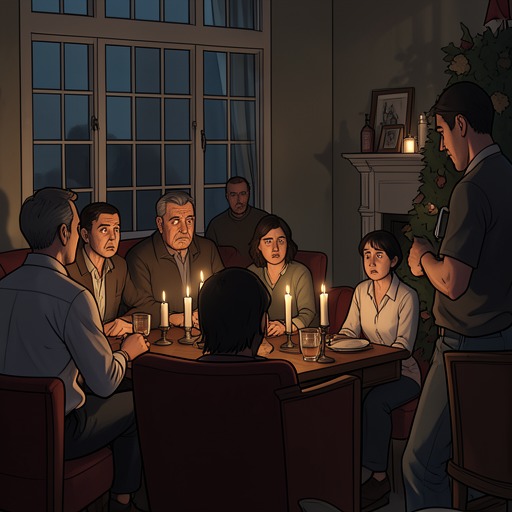
The image persists beyond the first failure and the characters’ attempts to explain it. With the stove and refrigerator dead and the heat beginning to fade into the walls, Diane senses that it is Max’s turn to speak. He looks at the blank screen and suggests eating before the food changes temperature. Nobody moves toward the kitchen. The suggestion meets a pause rather than action, while the screen remains the point before which Max sits. Later, after eating, he puts down his plate, takes bourbon from the floor, pours a drink, and continues to stare at it.
The recurrence gives the screen a role larger than that of a broken television. It remains present while ordinary routines falter, conversation wanders, and decisions fail to produce movement. Near the close, Max sits with his hands folded behind his neck and his elbows jutting, still staring into the blank screen after the assertion that the world is everything and the individual nothing. The screen offers no reply and no image to interpret. Across these scenes, its blankness marks the absence of the systems the characters have relied on, while their continued attention exposes how difficult it is to stop expecting those systems to answer.