Time, space, and temporal dislocation
The SilenceTime, space, and temporal dislocation in the novel move between measured quantities and lived uncertainty. Numbers on an airplane screen promise a dependable route through time and distance; after that screen goes blank, characters reach for Einstein, teaching, and memory to describe a world whose continuity they can no longer trust. Spacetime is both a scientific idea they repeat and a problem they experience: time seems to jump, collapse, or stretch, while remembered events feel strangely remote despite having happened only hours earlier.
Measurement and the Flight
At the start of the flight, Jim Kripps watches a screen beneath the overhead bin rather than sleeping. It cycles through altitude, air temperature, speed, and estimated arrival, supplying a stream of numerical updates as the plane makes its way toward its destination. The display gives the journey an orderly scale: remaining time can be counted, speed can be read, and arrival can be anticipated. Jim even notices that the displayed time in New York City lacks an a.m. or p.m. designation, a small ambiguity within an otherwise authoritative system of figures.
The screen’s details make that reliance concrete. The arrival time is 16:32, the speed is 471 miles per hour, and the estimated time to the destination is three hours and thirty-four minutes. Jim wants to sleep, but the changing words and numbers keep drawing his attention. Time is presented as something externally legible, divided into data that can be checked while the body waits.
That arrangement fails during the turbulence. As the plane bounces, Jim continues reading the screen, while Tessa Berens folds over her notebook; a passenger staggers down the aisle, and announcements come first in French and then in English. A massive knocking sound follows. The display goes blank, and the pilot’s French announcement receives no English follow-up. The measurements that had made the trip seem knowable disappear at the moment when the passengers most want orientation. The blank screen is not merely missing information: it marks the loss of a familiar instrument for locating the plane within a journey.
Einstein, Spacetime, and Repetition
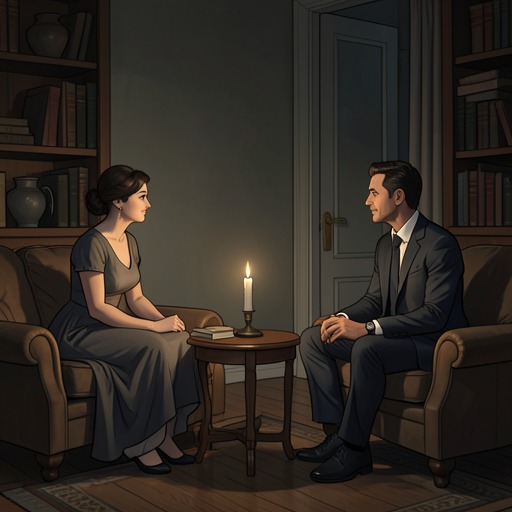
In the conversations that follow, Einstein’s ideas offer language where ordinary technical certainty has failed. A participant recalls a footnote from the Einstein manuscript describing the concepts of space and time as beautiful and airy, then reduces the formulation to the repeated words space and time, and finally to spacetime. The movement from an elevated phrase to a compact term resembles an effort to hold onto a difficult idea by saying it again. The phrase is not offered as a solution to the crisis; its recurrence gives the speakers a shared point of attention.
The manuscript matters not only for its scientific subject but for the visible record of thought it contains. Its crossed-out words and phrases allow a reader to see Einstein thinking, while its handwritten numbers, letters, and expressions preserve the physical marks of that process. Another fragment, four words long, concerns an additional theorem of velocities. The listener asks for it to be repeated, then decides the exchange should stop. The scene is described as a teacher-and-student relationship in reverse, so the language of physics carries the residue of classroom roles even as those roles shift.
References to footnotes extend that connection to teaching. Someone remembers a person quoting footnotes in class and disappearing into the details of Einstein, Heisenberg, Gödel, relativity, uncertainty, and incompleteness. In the changed circumstances, those once-specialized subjects are recalled alongside a sense of abandonment by science, technology, and common sense. Scientific language remains available, but its presence no longer guarantees mastery of the world it describes.
A Jump, a Collapse, or a Distortion
The characters cannot agree on what has happened to time because they cannot establish a reliable measure of the disruption. One account notes that time seems to have jumped forward and wonders whether midnight intensified the breakdown. Tessa poses the competing possibilities directly: perhaps time has leaped, as a young man says, or perhaps it has collapsed. She imagines the further consequences of a population losing its accustomed patterns: people could become flash mobs, running wild and breaking into places across the planet. The scene leaves that possibility as a fear rather than confirming it; no one moves toward the window to check what is happening outside.
Tessa places the crisis against a longer record of disturbances. She recalls power failures, failing technology, storms, wildfires, evacuations, typhoons, tornadoes, drought, dense fog, polluted air, landslides, tsunamis, disappearing rivers, and collapsing buildings. She also names the recent memory of virus and plague, masked faces, airport terminals, and emptied city streets. Her list makes the present feel less like an isolated rupture than an intensification of repeated warnings, while her question about time’s leap or collapse remains unanswered. The dislocation is therefore both immediate and historical: the characters cannot tell whether they have entered a wholly new condition or reached a breaking point in processes they had already witnessed.
Diane Lucas frames the same uncertainty through the language of physics. She wants to return to teaching and speak about absolute time, time’s arrow, and the relation between time and space. Yet her attempt to organize the crisis intellectually is interrupted by her own doubts: she has barely slept or eaten, and she wonders whether exhaustion is shaping what she says. The contrast matters. Scientific terms give her a structure for thinking, but the body’s hunger, sleeplessness, and fatigue make that structure precarious.
Memory and Experienced Duration
Jim’s account of the emergency landing shows how sharply experienced duration can diverge from clock time. He remembers being half-asleep and waiting for a snack before landing when the plane began to shake and bang. He recalls the lack of reassurance from the announcements, the impact that threw his head against the window, blood running into his eye, and his reaching for Tessa’s hand. The plane then came down hard, skipped, and skidded. Only later could he connect the landing to the collapse of systems around them.
Although Jim says the event happened that day, more or less only hours earlier, it seems to him like a dozen years ago. His recollection is vivid but not perfectly settled: he questions whether Tessa translated the French announcement, and even whether some thoughts he attributes to himself were present at the time or have entered the story as he rambles. He identifies this as his first chance to think about and remember the event. The passage thus makes memory an imperfect instrument of temporal measurement. The landing is recent by the clock, yet already remote in feeling; recollection restores its sequence without eliminating uncertainty about what Jim knew as it happened.
The Stakes of Disorientation
The characters’ reflections make temporal dislocation inseparable from dependence on systems of orientation. The flight display had translated movement into readable quantities; once it failed, the passengers were left with noise, bodily danger, and incomplete announcements. Later, ideas from physics and remembered lessons supply other means of ordering experience, but neither can establish exactly what has happened beyond the room or how far the disruption extends. The characters speculate about streets and crowds without going to the window, preserving a gap between what they fear and what they can verify.
Martin Dekker’s recollections sharpen that tension. He carries details of Einstein’s 1912 manuscript in his head: brown ink on unwatermarked paper, followed by improved paper and black ink, as well as the phrase about the dependence of mass on energy. He imagines walking silently with Einstein across the Princeton campus, while also wondering whether leaving the living room to look in a mirror would mean never returning. The movement between precise archival detail and uncertainty about a nearby doorway gives the concept of spacetime a practical and intimate edge. Abstract knowledge persists, but it cannot settle the next moment. Across screens, manuscripts, classrooms, and remembered crashes, the novel presents time and space not as stable guarantees but as coordinates people keep trying to recover when their usual measures no longer hold.