World War IV and sticks-and-stones warfare
The SilenceWorld War IV and sticks-and-stones warfare is the future catastrophe invoked by Albert Einstein’s warning: a later war fought with rudimentary weapons after the destruction of the technological civilization that made modern warfare possible. In the novel, the warning gains force from the contrast between a globally connected conflict whose nuclear weapons no longer function and Martin Dekker’s uncertain recollection of what may come after it.
The warning and its reversal
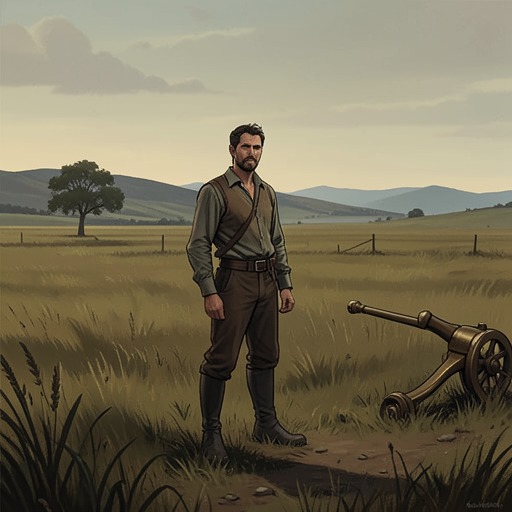
The warning, presented as an epigraph attributed to Albert Einstein, contrasts uncertainty about the weapons of World War III with a stark prediction about World War IV: it will be fought with sticks and stones. Its force lies in the reversal. The next war is imagined not as an advance toward more powerful weapons, but as a return to the most basic implements of violence. The novel does not depict this future war taking place; the phrase remains a prediction against which the unfolding crisis can be measured.
A war that continues without nuclear weapons
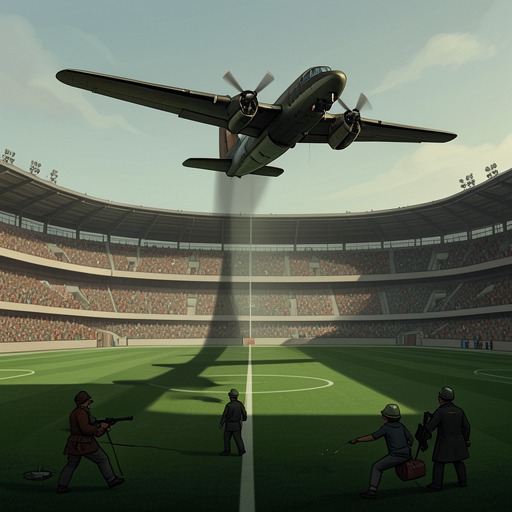
In Part Two, the expected machinery of nuclear conflict has been disabled. Unknown groups or agencies are manipulating launch codes remotely, and nuclear weapons worldwide have become dysfunctional: missiles do not cross oceans, and bombs are not released from supersonic aircraft. Yet the failure of those weapons does not end the war. Instead, the conflict continues and its terms accumulate, shifting attention from spectacular nuclear attack to persistent damage across digital systems, bodies, and basic conditions of life.
The threats named include cyberattacks and digital intrusions alongside biological aggression. Anthrax, smallpox, and other pathogens appear in a catalogue that also includes death, disability, starvation, and plague. Power grids collapse as the war presses beyond conventional military action. The warning about sticks and stones therefore stands beside a present in which sophisticated weapons may be unusable while other forms of violence remain active and consequential.
Biological weapons and Martin’s recollection
Martin Dekker’s account connects the abstract warning to the immediate spread of biological threats. He describes countries that were once forceful advocates of nuclear arms now speaking in the language of living weapons, and recites a compressed inventory of germs, genes, spores, and powders. The change in emphasis echoes the novel’s broader contrast: the nuclear arsenal has failed, but warfare has not become less dangerous; it has taken forms that act through living agents.
Diane Lucas recognizes that Martin is speaking in an adopted accent, his version of Albert Einstein speaking English. His invocation of Einstein is thus also a performance, as though he were giving the warning a voice inside the crisis. Diane is not certain that Martin’s account is pure fiction. She associates his manner and apparent access to world events with censored news reaching him, while the source of that access remains unclear.
Memory, uncertainty, and the future war
Martin places the warning within his own recollection of Einstein and the Special Theory. He says Einstein had no premonition about how the current war would be fought, but had made clear that the next major conflict would be fought with sticks and stones. He also dwells on the physical record of the theory: the manuscript is dated 1912, and he recalls brown ink on unwatermarked paper before the paper improves and the ink turns black. These details make the past a material record that Martin carries in his head even as the present becomes difficult to interpret.
That recollection is not presented as settled prophecy. Martin wonders whether he is imagining the connection because it is late, he has barely slept or eaten, and those around him are not listening. His uncertainty matters: the warning can organize the reader’s view of the crisis without confirming what the future holds. World War IV and sticks-and-stones warfare remains the novel’s image of a possible aftermath, where technological collapse would not abolish conflict but leave violence stripped to its most elemental means.