World War IV will be fought with sticks and stones
The SilenceWorld War IV will be fought with sticks and stones is an Einstein-attributed warning that gives the novel a stark measure of technological and social collapse: even if the weapons of one world war become unusable, conflict does not simply end, and a later war may leave humanity fighting with what remains. The saying recurs as the world’s nuclear systems fail and warfare shifts toward digital and biological threats, while Martin Dekker’s effort to inhabit Einstein’s voice gives the expression an unsettled place between historical warning, present crisis, and anxious speculation.
The Saying and Its Frame
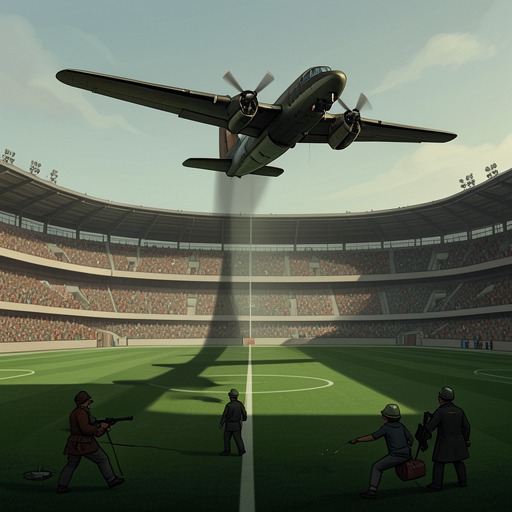
The book first presents the expression as an epigraph attributed to Albert Einstein. Its structure hinges on a sharp contrast: uncertainty about the weapons of World War III gives way to a confident image of World War IV reduced to sticks and stones. The second war is imagined not as a more advanced conflict but as one fought after the means of modern civilization have been lost.
Later, Martin connects the saying to Einstein’s theory of relativity and to Einstein’s 1912 Manuscript on the Special Theory of Relativity. He recalls the manuscript as dated 1912, 110 years earlier, and describes its material details: brown ink on unwatermarked paper, followed by improving paper and black ink. In Martin’s account, the historical document and the remembered warning belong together; both give him a way to think about the present through Einstein.
A War That Changes Its Weapons
The later account complicates the image of a future fought with primitive weapons. Unknown groups or agencies are manipulating nuclear launch codes remotely, and nuclear weapons around the world have become dysfunctional: missiles are not crossing oceans, and bombs are not being dropped from supersonic aircraft. Yet the narrative insists that the war continues and its terms accumulate. The failure of one category of weapons is not peace.
The conflict instead includes cyberattacks, digital intrusions, and biological aggression. Anthrax, smallpox, and other pathogens are associated with death and disability, as well as starvation and plague. Power grids collapse, while personal perception is described as sinking into quantum dominance. The account also raises, without resolving, whether oceans are rising rapidly and the air is warming from hour to hour. This spread of threats gives the expression a concrete setting: the prospect of sticks and stones hangs over a world already being damaged through its systems, infrastructure, and living bodies.
Martin’s Performance of the Warning
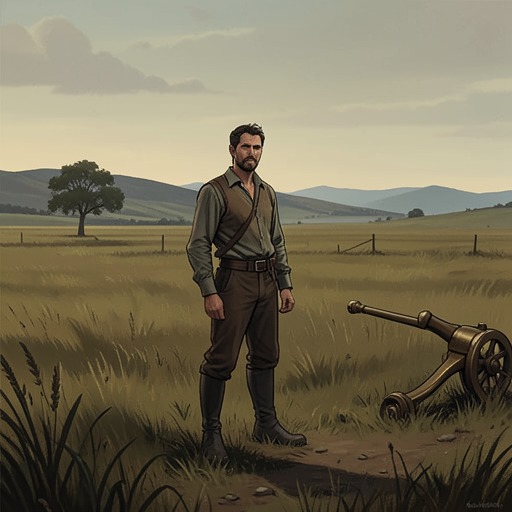
Martin’s relation to the saying is not merely scholarly. While speaking about bioweapons, he lists countries and materials until a coughing fit interrupts him; he wipes his mouth with the back of his hand, examines it, and continues. Diane Lucas realizes that his accent is adopted, not simply a manner of speaking: it is Martin’s version of Albert Einstein speaking English. His performance makes the Einstein connection audible, but it does not establish that Martin’s account of current events is reliable or wholly invented.
Diane is unsure whether his claims are pure fiction. She senses that he may have access to world events, though she cannot tell how, and the possibility of censored news reaching him remains unresolved. Against that uncertainty, Martin recites the warning about World War IV and identifies the war around them as World War III. He also questions whether the association between Einstein’s theory and street riots is something he is imagining because he is tired, has barely slept, and has barely eaten. The saying thus carries authority for him while his circumstances make the certainty of his interpretation difficult to judge.
Collapse, Memory, and the Final Image
Martin’s recollection of Einstein exists alongside his awareness of technological dependence. He invokes surveillance, verification, and tracking, then tries to imagine earlier human traces, such as a flagstone image or cave drawing. Einstein’s language offers him an exhilarating contrast to those fragments of long human memory; he imagines walking silently with Einstein across the Princeton campus. The movement between advanced systems and prehistoric images echoes the saying’s own passage from modern warfare to sticks and stones.
The expression does not resolve the novel’s uncertainties into a prediction with a clear timetable. Instead, it recurs within Martin’s effort to understand a war whose weapons and consequences are changing faster than his explanations can settle. His final insistence that the streets are empty, without needing to look out the window, leaves the warning suspended between a remembered historical statement and a present reality he cannot fully verify.