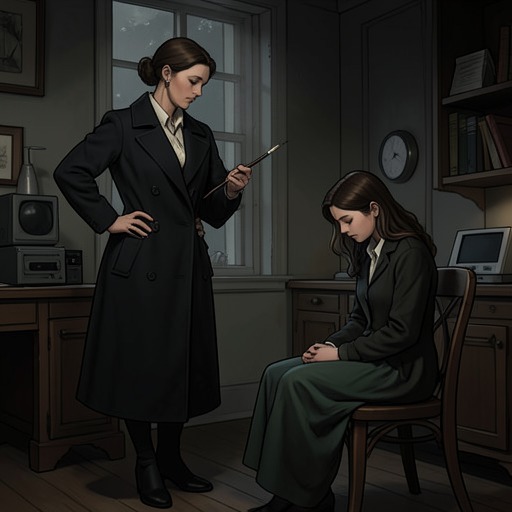
Gram admits she once told Paige never to come back
The Sky Is EverywhereGram admits she once told Paige Walker never to come back in a confession that changes the meaning of Paige’s sixteen-year absence. As Gram recalls the night Paige left, Lennie Walker learns that her grandmother’s familiar silence concealed not indifference but remorse: Gram believes her own words helped drive her daughter away. Lennie’s answer does not undo the departure, but it releases Gram from sole responsibility and lets the two women face their losses together.
The confession within a grieving household
The admission comes after Bailey Walker’s death, when grief has unsettled the household’s ordinary rhythms. At the beginning of the summer, Gram follows Lennie around the house with a full teapot and two mugs, trying to revive their old late-afternoon ritual of tea and conversation. Lennie refuses to talk, and Gram has not yet accepted that withdrawal. The tea becomes a small measure of what grief has interrupted: not only the sisters’ place in the family, but also familiar ways of caring for one another.
Lennie’s inward turmoil complicates that silence. She is bewildered by her sudden, persistent desire for physical closeness and ashamed of having kissed Bailey’s boyfriend, Toby Shaw. She tries to make sense of the impulse by comparing it with the intense passions she had previously encountered in books, while recognizing that she keeps imagining someone she believes she should never kiss again. In another moment of mourning, she wonders whether, if Bailey were alive, she would remain safely content and emotionally enclosed. The possibility that loss has made her more alive frightens her, because any growth seems to carry an unacceptable cost. These episodes establish the emotional conditions around Gram’s confession: grief is not one settled feeling but a strain on relationships, a source of guilt, and a force that alters how Lennie understands herself.
Gram’s memory of Paige’s last night
When Gram begins to recall the night, her posture and voice seem unfamiliar to Lennie. The memory first arrives through precise domestic details: the cold was unseasonable, the kitchen was full of lilacs Gram had placed in vases because Paige was coming, and Paige wore a long green dress that Gram remembers as almost a scarf. Those details give Lennie something she had never been given before: not an abstract account of an absent mother, but a particular woman moving through a particular room.
Paige had come for the weekend so Gram could see her daughters, or so Gram initially believed. Then Paige asked what Gram would do if she left. Gram discovered that Paige had a one-way plane ticket to an unspecified destination and intended to use it. Paige told her mother she did not feel capable of being a mother. Gram answered that Paige could stay with her and that she would help, insisting that Paige had a responsibility to her children and could not simply leave as others in the family had done.
Paige kept asking what Gram would do if she went. Gram remembers trying to hold her by the arms, as she had when Paige was younger and became wound up, but Paige kept slipping from her grasp. The image of Paige as a trapped wind, billowing through the kitchen in her green dress, records both Gram’s fear that her daughter would disappear and her inability to keep her there. The argument turns when Gram, already upset and prone to what she calls the tornado inside her, loses control. She tells Paige that if she leaves, she can never come back and will be dead to her daughters and to the family. Gram then locks herself in her art room for the rest of the night. By morning Paige is gone.
From family silence to shared responsibility
For Lennie, the memory exposes the source of a guilt she had not understood. Gram confirms that she told Paige never to return, and for an instant Lennie sees her grandmother as frighteningly changed: hunched, turned away, and speaking in an unnaturally calm voice. Yet the confession also makes visible the remorse beneath Gram’s account. For sixteen years she has carried the knowledge that she spoke those words, while the family’s accepted story left Paige without blame and hid Gram’s self-accusation.
The green dress continues into the present through Gram’s paintings. Lennie looks at the framed green women in the kitchen and understands them as images of Paige, preserved in the billowing dress between presence and absence. The paintings become evidence of Gram’s continuing attachment, while the story of the argument explains the guilt she had kept behind that attachment. Lennie also remembers overhearing Gram apologize to The Half Mom and recognizes that she had blamed Gram for things even Gram could not control.
Lennie tells Gram that Paige’s decision to leave and not return was Paige’s choice, regardless of what Gram said. The distinction does not excuse Gram’s words; it separates a hurtful outburst from the decision and its long aftermath. Gram exhales as though she has been holding her breath for sixteen years and describes Lennie’s reassurance as opening a window and letting Paige out. The image reverses the earlier memory of Paige as a trapped wind: what Gram could not release in that kitchen, Lennie helps her release in the present.
Consequences and significance
The confession alters the relationship between grandmother and granddaughter from guarded caretaking to mutual recognition. Lennie realizes that Gram has lost two daughters, while also recognizing that her own grief over Bailey does not include the same estrangement from a living mother. She is standing close enough to see the years on Gram’s skin and smell her tea-scented breath. Her thought that Bailey’s search for their mother might have led back to Gram links the sisters’ unanswered longing to the person who has remained with them. Lennie puts a hand on Gram’s arm and tells her that she and Bailey were fortunate to have her; Gram answers that she was the fortunate one. They embrace, and Gram proposes that they drink tea. The ritual that Lennie had rejected at the beginning of the summer returns as an expression of closeness made possible by speaking plainly.
The scene does not restore Paige or settle Lennie’s grief for Bailey. Later, Lennie understands that Bailey will die again and again in memory, and that grief will remain joined to love. She runs toward the cemetery for her first visit to Bailey’s grave, carrying the knowledge that a future without her sister is still hers to live. In that larger movement, Gram’s confession is a family reckoning with an earlier absence: it makes room for compassion without rewriting what happened. Its decisive change is not the recovery of the lost, but the relinquishing of inherited blame so that love can be spoken among those still present.