Gram's grief over Bailey's death
The Sky Is EverywhereGram’s grief over Bailey’s death is both intimate and disorienting: it removes someone at the center of her life and leaves ordinary routines feeling inadequate to the loss. She tries to care for Lennie Walker while concealing her own distress, but eventually names how completely Bailey’s absence has unsettled her. The story does not present grief as a matter of keeping Bailey safely in memory; Gram longs for her granddaughter’s actual presence in the family’s unfinished future.
The household after Bailey’s death
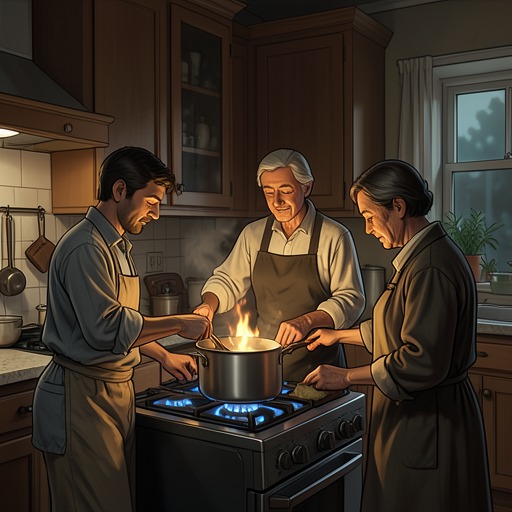
In the first weeks after school ends, Gram, Lennie, and Big move through the house and park in separate directions, a compact picture of a family no longer moving together. Gram follows Lennie with a full teapot and two mugs, trying to revive the late-afternoon tea they used to share at the kitchen table before the others came home. The ritual carries the promise of conversation and closeness, but Lennie does not want to talk, and Gram has not accepted that refusal. Lennie retreats to The Sanctum and pretends to read while Gram remains in the doorway with the tea. The scene makes care visible, but also shows its limits: Gram can offer a familiar gesture without being able to restore the relationship or the household as it was.
Her distress continues out of sight. Gram spends unusually long periods in the shower because she believes she can cry there without Lennie and Big hearing; they hear her anyway. The family’s grief is not confined to one person, but Gram’s attempt to hide it leaves its own quiet trace in the home. The old routine of tea and talk has been interrupted, and even privacy cannot make the loss inaudible.
Bailey’s irreplaceable place
When Lennie and Gram later speak directly about their losses, Gram tells Lennie that she does not know who she is without Bailey either. Her grief is not only sadness for a beloved granddaughter; Bailey had helped define Gram’s sense of herself and of the family. Gram describes her days after Lennie and Big leave as standing before a blank canvas, unable to find a way into painting because every shade of green disgusts, disappoints, or breaks her heart. The blankness is both practical and emotional: a former means of working cannot offer her a usable response to Bailey’s absence.
Gram’s account of the family’s scale of loss is concrete. She sees Bailey, Big, and Lennie as having been her whole life, alongside generations of flowers and her green paintings. In that picture, Bailey is not a symbolic presence that can be substituted by memory. Gram rejects the reassurance that Bailey remains in the hearts of those who loved her. She wants Bailey in the kitchen with her and Lennie, at the river with Toby and the baby Bailey had been expecting, and alive to take on the dramatic roles she loved. Her grief is sharpened by futures that are now impossible: family time, a shared riverbank, and the life Bailey might have continued to inhabit.
Grief shared, but not interchangeable
Lennie’s own bereavement sometimes takes forms Gram cannot see or control. Soon after Bailey’s death, Lennie describes finding herself kissing the air and imagining a person she believes she should not kiss again. The contrast between Gram’s quiet attempts to approach her with tea and Lennie’s confusion about her newly intense feelings shows how differently loss moves through the household. The evidence does not make Lennie’s response Gram’s, but it places Gram’s sorrow within a family whose members struggle to reach one another while grieving.
Music and the prospect of returning to summer band practice offer Lennie a moment of renewed possibility. Elsewhere, she wonders whether Bailey’s death has changed her from a protected, emotionally restrained person into someone more open to the world, and fears that anything good emerging from that change would come at an unacceptable cost. Later, Lennie recognizes that a future without Bailey does not mean she has stopped loving her. These shifts matter beside Gram’s grief: the family begins to find ways of continuing, but continuation cannot make Bailey present or make each person’s mourning identical.
The losses beneath the present one
Gram’s grief over Bailey touches an older family rupture. She had explained Paige Walker’s long absence through the family’s so-called restless gene, describing women who leave and, eventually, return. That account gave Lennie and Bailey a story for their mother’s absence, but it could not erase the fact that Paige had been away for many years. Lennie later finds Gram’s carefully kept letters to Paige, with the recipient’s name and a year on each envelope. Learning that Gram wrote to her daughter every year gives Lennie new, ordinary details about the mother she barely knows, including her love of lilacs and the way she made pesto with walnuts.
The discovery changes Lennie’s understanding of the family’s silences, but Gram’s own account eventually makes the old sorrow more direct. She remembers Paige arriving for a weekend in a long green dress, the kitchen filled with lilacs, and asking what Gram would do if she left. Paige had said she did not feel able to be a mother. Gram recalls insisting that Paige could not leave her daughters, and Lennie comes to understand that Gram had carried blame for what followed. This history does not equate Paige’s absence with Bailey’s death; it shows that the present bereavement opens onto grief and guilt that Gram has held for years.
Naming the loss
When Gram tells Lennie how much she hates the idea of Bailey being confined to someone’s heart, the conversation moves from concealed distress to shared acknowledgment. Lennie places her hand over Gram’s, and Gram quickly covers it with her own. Their physical contact does not repair the loss, but it marks a change from Lennie’s earlier withdrawal: they can sit together with the fact that Bailey is gone without pretending that remembrance is enough.
That frankness also informs Lennie’s later understanding of grief. She recognizes that Bailey’s death will recur in her life and that grief remains bound to love rather than disappearing once life resumes. The final movement through the woods toward Bailey’s grave brings this continuing bond into a specific place: Lennie runs, feels the grip of death loosen for a time, and then sits beside the stone chosen so Bailey could be near the river. Gram is not present in that visit, but the scene clarifies the family’s altered way of living with the loss. Bailey cannot return to the kitchen, the river, or the future Gram wanted for her; love persists without making that absence less real.