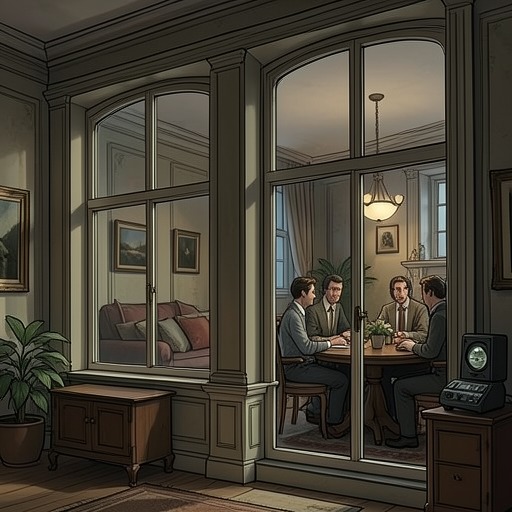
Grief is a house
The Sky Is EverywhereGrief is a house is a recurring poetic image through which Lennie Walker gives form to life after Bailey Walker’s death. Its rooms and familiar supports have become unreliable: the house offers no protection from loss, and even the younger sister’s future carries the painful fact that she will outlive the older one. Yet the image does not mean that grief is only confinement. When Lennie encounters someone who understands the loss, the house becomes less lonely. The metaphor ultimately holds together two truths that the story refuses to separate: Bailey is gone, and Lennie’s love for her continues.
The House After Bailey’s Death
The image appears as Lennie struggles to live in a family home altered by bereavement. Two weeks into the school holidays, Gram, Big, and Lennie are described as moving in different directions, unable to settle together. Gram tries to revive her former late-afternoon routine with Lennie by bringing tea to her room, but Lennie does not want to talk, and Gram has not accepted that withdrawal. Elsewhere, Lennie understands that Gram spends a long time in the shower because she believes she can cry there unheard; the family hears her all the same. These details make grief a condition of the household, not an isolated feeling that Lennie can simply put away.
The poem’s image of chairs that can no longer hold the family translates this changed domestic life into a concrete failure of support. Chairs remain part of a house, but their usual purpose no longer works. In the same way, familiar routines and relationships persist while offering less comfort than before. The metaphor does not suggest that the family has ceased to care for one another; rather, care cannot undo the absence around which the home is now organized.
The poem also registers grief’s unequal chronology. Lennie is the younger sister, but Bailey’s death means Lennie will grow older than her. This reversal turns the ordinary expectation that an older sibling will remain ahead into a lasting measure of what has been lost. The house cannot protect Lennie from that future or make the sisters’ lives continue in parallel. Its emotional force comes partly from placing an irreversible change inside the domestic image of a shared life.
A Metaphor That Changes Across Encounters
Grief is a house does not remain a declaration of abandonment. At Flying Man’s, Toby speaks to Lennie about Bailey’s imagined wedding there: Bailey had wanted to marry by the swimming place and jump into the water with the guests afterward. As Toby describes that unrealized celebration, Lennie pictures Bailey’s happiness and begins to cry. The grief is shared between the two mourners, and they kiss. In the poem that follows, Lennie presents Toby’s presence as company within her house of grief: the wind and emptiness remain, but they are less frightening and lonely than before.
That change is significant without being a cure. Toby can recognize the loss because he also loved Bailey, and that knowledge briefly alters Lennie’s isolation. But their closeness is bound to bereavement, not proof that the loss has passed. The house still stands; another person’s presence changes what it is like to endure being inside it. The image therefore makes room for companionship without claiming that companionship restores the life Bailey’s death interrupted.
The metaphor also sits beside Lennie’s confusion about her responses to loss. She wonders why she is preoccupied with kissing and why her feelings have become so intense, especially when she has recently crossed a boundary with Bailey’s boyfriend. Her grief, desire, and fear occupy the same unsettled period. The house image gives shape to this instability without reducing it to a simple progression from sadness to recovery: Lennie is trying to understand how to live amid feelings that do not arrive in orderly sequence.
Grief, Exposure, and Change
Later, Lennie considers what her life might have been if Bailey were still alive. She imagines that she would have remained in a mild, protected happiness, less exposed to the world and less fully engaged with music and feeling. The possibility troubles her because it seems wrong for anything valuable to emerge from Bailey’s death. She also remembers that Bailey herself lived with an openness and daring Lennie had not shared before. In this reflection, the emotional house is not only a place of injury; it marks the difficult change in Lennie’s way of inhabiting life. That change is not offered as compensation for the death.
This tension clarifies the metaphor’s limits. Grief makes Lennie feel more vulnerable, and she cannot treat that vulnerability as a gift that balances the loss. At the same time, remembering Bailey influences how she chooses to live. Lennie begins to understand that her sister’s example can guide her without making Bailey’s absence acceptable. The house holds both the cost of this transformation and the continuing presence of the person whose life shaped it.
From Temporary Relief to Lifelong Grief
Near the end of the story, Lennie recognizes that Bailey will die again and again in the sense that her absence will recur throughout Lennie’s life. Grief does not disappear; it becomes part of the person who continues living. Lennie describes grief and love as inseparable, and resolves to love Bailey by living with the daring, spirit, and joy she associates with her sister. The house metaphor thus opens onto a lasting relation rather than a completed stage of mourning: life can continue, but it does not require Lennie to stop grieving.
Lennie’s first visit to Bailey’s grave gives this understanding a physical setting. After finishing baking with Gram, she runs through the woods toward the cemetery and feels the hold of death begin to loosen. The release is a moment of happiness and movement forward, not evidence that grief is over. At the grave, she sits beside the stone and rests against it, touching Bailey’s name and the inscription she wrote for the funeral. The sequence brings relief and remembrance together: Lennie can move toward a future while returning to the place that holds Bailey’s memory.
As an expression, Grief is a house links domestic space, sibling loss, and the persistence of love. Its most bleak details insist that neither family nor time can protect Lennie from outliving Bailey. Its more companionable moments show that shared understanding can make grief less isolating, even when it cannot remove the emptiness. The image’s final meaning is therefore neither escape from the house nor permanent imprisonment within it, but a life in which grief remains because love remains.