Joe witnesses Lennie and Toby kissing and breaks up with Lennie
The Sky Is EverywhereJoe Fontaine witnessing Lennie Walker and Toby Shaw kissing turns a private entanglement in grief into an immediate rupture with Lennie’s other love. Joe’s response is not only to leave: he rejects her attempted explanation, gives up the duet he had brought for her, and runs. The scene’s decisive shift is carried by that contrast between a relationship still being offered in music and one that, for Joe, has become impossible to trust.
The Encounter and Its Reversal
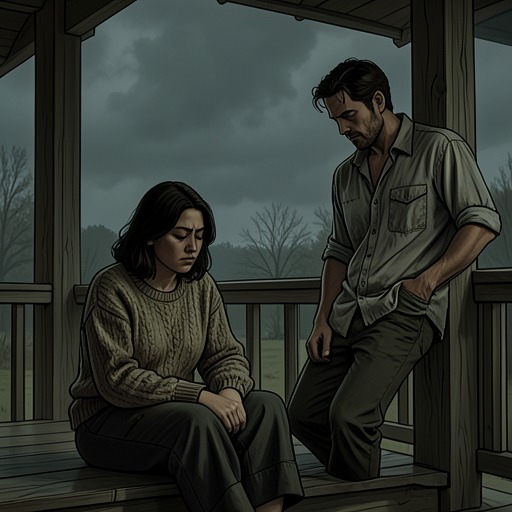
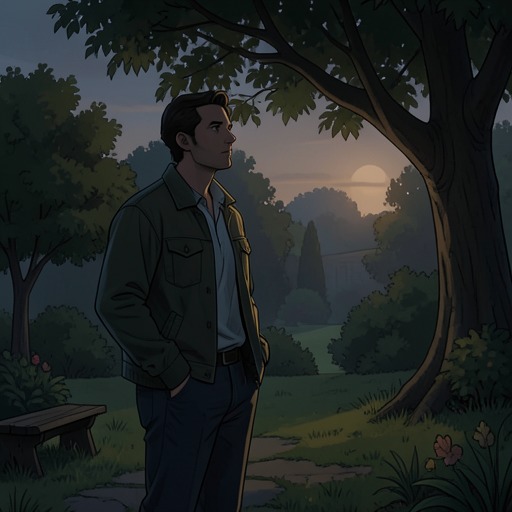
At first Lennie thinks the figure approaching must be Gram, then considers Big; neither is there. Joe stands a few yards away, motionless, watching Lennie and Toby. When he stumbles backward, Lennie jumps out of Toby’s grasp and rushes toward him. Joe turns away and starts to run, but freezes when she calls after him. The sequence makes the sight of the kiss the event’s hinge: before Joe appears, Lennie is physically held by Toby; once she recognizes Joe, she breaks free and pursues him.
The image of Joe paused with his back to Lennie against a sky that seems to be burning gives the separation an outward scale, while Lennie describes herself as tumbling without control. Yet she does force herself forward and take his hand, trying to turn him toward her. Joe tears it away as if her touch disgusts him. When he finally faces her, Lennie sees a lifeless look and a face like stone. His withdrawal is thus both physical and relational: he refuses her touch before he refuses her account of what happened.
Explanation and Breakup
Lennie tries to explain that what happened with Toby was not like her relationship with Joe. She starts to invoke her sister’s pregnancy, then falters, recognizing that this does not explain the betrayal Joe believes he has seen. Her plea that it is not what he thinks is answered by his insistence that it is exactly what he thinks—and exactly what he had thought. The exchange shows the distance between Lennie’s attempt to describe the act through grief and Joe’s understanding of it as a breach of their relationship.
Joe’s response combines rage and hurt; Lennie cries and says he does not understand. He answers that she is right: he does not. The scene does not resolve the mismatch between their interpretations. Lennie is desperate for Joe to grasp that her intimacy with Toby is bound up with her sister’s death, but she cannot make that context undo what he witnessed. Joe, meanwhile, does not ask for a fuller explanation before turning away. The breakup occurs in that gap between the meaning Lennie is trying to convey and the action Joe considers decisive.
The Duet and the Parting
Joe had come to give Lennie a piece of paper. Instead of handing it to her, he pulls it from his pocket, crumples it, and throws it at her before running into the falling night. The paper is headed “Part 2: Duet for aforementioned clarinetist and guitarist.” Its wording identifies the gift as music made for Lennie, and its second part implies a continuation of their musical exchange. In the moment of separation, Joe turns that intended offering into something cast away between them.
Lennie retrieves the crumpled page, smooths it out, folds it carefully, and puts it in her pocket. Her care for the paper contrasts with Joe’s gesture of rejection: the relationship has broken, but the music he brought remains something she keeps. The duet also makes the loss concrete. Joe does not simply leave after seeing her with Toby; he leaves carrying the possibility of a shared musical future no further, while Lennie holds its written trace.
The Aftermath at the Same Place
After Joe runs, Lennie sits on the grass, describing herself as a heap of bones. She realizes she is in exactly the spot where she and Joe kissed in the rain the previous night. The location folds an earlier moment of intimacy into the breakup without making the two encounters equivalent: the same ground that held their kiss now holds Lennie alone with the paper Joe has thrown away.
The sky that seemed to Lennie to be in a wildfire’s fury has lost its intensity, leaving gold wisps being consumed by darkness. She tries to hear the duet’s melody in her head but cannot; instead, Joe’s question—“How could you?”—remains audible to her, followed by her own unanswered “How could I?” The ending leaves her caught between his accusation and her self-reproach. The unwritten future of the duet, the preserved sheet, and the remembered kiss make the breakup more than a departure: Joe’s trust and Lennie’s ability to hear their music have both been interrupted.