Lennie and Gram’s relationship
The Sky Is EverywhereLennie and Gram’s relationship is a central family bond in the aftermath of Bailey Walker’s death: Gram reaches for her granddaughter through caretaking, familiar rituals, and practical concern, while Lennie struggles to accept comfort or speak openly about her grief. Their closeness does not prevent them from hurting one another. Instead, the relationship moves between pursuit and withdrawal, showing how grief can make care feel both necessary and difficult to bear.
A Bond Built on Attention and Family Stories
Gram has watched over Lennie for most of her life, even investing a houseplant with meaning as a reflection of Lennie’s emotional, spiritual, and physical well-being. When the plant develops black spots, Gram’s concern is not simply about its leaves: she sees a sign that Lennie may be suffering. The plant becomes an unusually concrete measure of how closely Gram attends to her granddaughter, and of how much Lennie has come to share Gram’s belief in that connection.
Gram is also one of Lennie’s interpreters of family history. When Lennie is ten, Gram explains the restless gene, a tendency among the women in the Walker family to keep moving from place to place and relationship to relationship. She connects that family story to Lennie’s absent mother, Paige Walker, and to the uncertainty surrounding the girls’ fathers. Gram names other women in the family whom she believes shared this restlessness, and presents leaving and eventually returning as a recurring family pattern. Her explanation gives Lennie a framework for understanding her mother’s absence, even though it cannot undo the absence itself.
After Bailey’s death, familiar gestures carry the weight of their earlier intimacy. On the first day Lennie returns to school, Gram comes out to the porch in a bright, flowered dress, holding a paintbrush—the first time Lennie has seen her with one since the death—and asks how the day went. Lennie approaches her and recognizes the familiar scent of patchouli, paint, and garden dirt. The brief exchange does not open into a larger conversation, but it shows Gram trying to resume contact through a recognizable presence and a simple question.
Care Meets Lennie’s Withdrawal
The summer after the death sharpens the mismatch between Gram’s attempts to help and Lennie’s capacity to receive them. Gram has put her work as a garden consultant on hold and follows Lennie through the house and around town: she appears at Maria’s Deli while Lennie is working, at the library during her shift, and at Flying Man’s while Lennie floats in the water and cries. Her vigilance comes from concern, but Lennie experiences it as pressure. Gram’s presence is most difficult to bear during teatime, a routine they once shared at the kitchen table while they talked before the others came home.
Gram also tries to address Bailey’s untouched belongings. In Lennie’s room, she sees the gum wrappers, hairbrush threaded with Bailey’s hair, dresses left over a chair, a towel on the bedpost, and a laundry basket still filled with dirty clothes. She proposes packing up a few things. Lennie answers that she will do it herself and asks Gram to stop following her and leave her alone. Gram accepts the rebuff and leaves; Lennie immediately wants to run after her, take the teapot, pour a cup, and tell her what she is feeling. She does not. The moment exposes the difference between wanting Gram’s closeness and being able to tolerate it: Lennie’s refusal is followed not by relief, but by an awareness that she has hurt someone she wants to keep near.
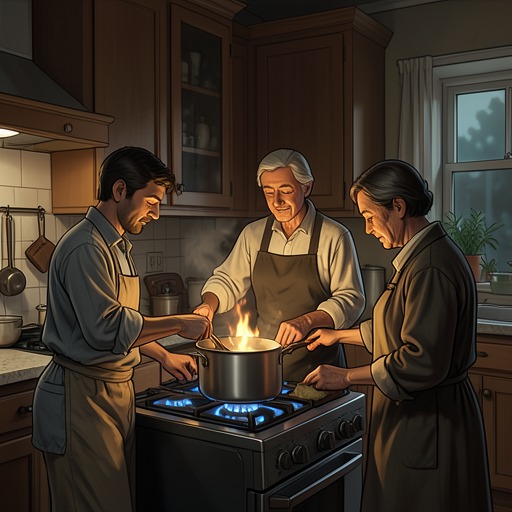
The strain is reciprocal. Lennie hears Gram crying in the shower, where Gram seems to be trying to hide her tears from Lennie and Uncle Big, though they can hear her. Later, while they cook together, Gram pats Lennie’s head or squeezes her arm as they prepare dinner. When Gram says she is worried, Lennie cannot confide in her; she experiences the emotional distance between them as immense despite their physical proximity. The narration conveys Gram’s heartbreak alongside Lennie’s inability to bridge that distance, making their silence a shared pain rather than evidence of indifference.
Small Repairs and Unfinished Conversation
Their relationship begins to recover through time spent doing ordinary things together, rather than through a single decisive talk. After cooking, Lennie smiles when Gram remarks that it is nice to be cooking together again. The warmth is real, but not complete: Gram’s worried attention returns, and Lennie drops her eyes rather than meet her disappointment. Their ease can reappear in a shared task even while the deeper conversation remains beyond Lennie’s reach.
The next morning, Lennie sits beside Gram at the kitchen table and apologizes for the previous night, when Gram had wanted a ritual for Bailey and for the family. Gram takes Lennie’s hand and rubs it, tells her they will have a ritual, and reassures her that there is time. She also says she thinks she has worked out what was causing the bad luck. The scene gives physical form to a repair that words alone have not accomplished: Lennie acknowledges the hurt, Gram responds by holding her hand, and the ritual remains something they can still do together.
Gram’s history as a letter writer also becomes part of the bond Lennie carries forward. She has written to Paige over the sixteen years of her absence. Lennie transcribes those letters into a small notebook and, at Bailey’s grave, places it in the stone’s little cabinet so Bailey can have those words too. The act connects the generations without resolving their absences: Gram’s correspondence preserves her continuing address to Paige, while Lennie makes sure Bailey remains part of the family story.
Grief, Separation, and Continuing Connection
Lennie’s grief repeatedly disrupts her connection with Gram. She can turn away from Gram’s efforts to talk while privately longing to return to their old closeness; she can participate in cooking and still feel unable to answer a worried question. The relationship therefore changes by fits and starts. Care is offered, resisted, regretted, and offered again, with neither member able to make the other’s grief disappear.
By the end, Lennie’s movement toward life does not mean that Bailey has become less important or that sorrow has ended. She understands that grief will remain part of her because her love will remain, and she runs toward the next stretch of her future carrying that knowledge. At Bailey’s grave, she leaves the notebook of Gram’s letters and later takes the old houseplant to the edge above the falls and lets it go. Since Gram had long treated the plant as a reflection of Lennie’s well-being, its final disposal marks a change in the image through which their relationship has registered her state; it does not establish that their bond, or their grief, has been neatly settled.
The relationship’s significance lies in this unfinished, recurring effort to stay connected. Gram cannot make Lennie talk before Lennie is ready, and Lennie cannot always accept the care she wants. Yet their shared routines return, a hand is held after an apology, and Gram’s letters are carried into the memorial Lennie makes for Bailey. The family’s continuing ties are shown not as a cure for loss, but as a way of keeping love present while each person learns to live with what cannot be repaired.