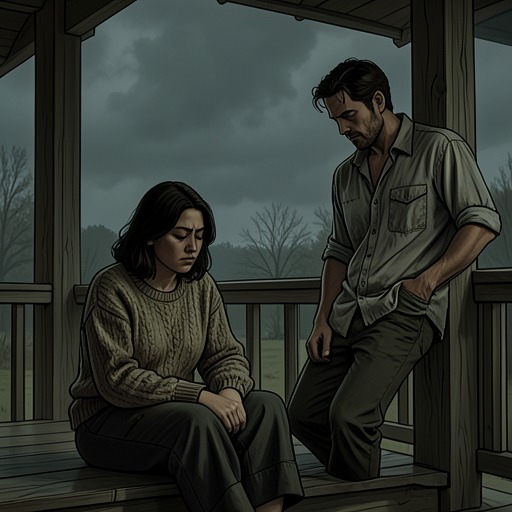
Lennie and Joe’s first kiss
The Sky Is EverywhereLennie and Joe’s first kiss transforms a walk to work into the moment their playful closeness becomes unmistakable romantic intimacy. Against the immediate backdrop of the Walker household’s grief, the scene lets a fanciful plan to escape into a shared future gather enough force to become a kiss. Its central change is not that Lennie’s sorrow vanishes, but that she can briefly imagine a life opening beyond it.
Setting and Circumstances
The encounter follows a morning when Lennie feels responsible for disturbing the household’s fragile progress toward healing. At breakfast, Joe and Big keep up a lively conversation about resurrecting bugs and exploding cakes, while Lennie avoids Gram’s suspicious gaze. The contrast matters: the family is together, but Lennie feels out of step with the mood around her, as if her grief and actions have derailed the path to recovery.
Lennie says she must get to work early because the Dwyers’ party is being catered that evening. Gram has agreed to oversee its flower arrangements, an unusual choice because she hates cut flowers and normally refuses such requests. The work provides the practical occasion for Lennie to leave the house; Joe offers to walk with her, saying that he needs to go to the music store. His family has converted a barn into a workshop where his father makes specialty guitars, and the Fontaine boys are supposedly working for their parents during the summer. Lennie suspects they spend much of that time making songs for their band, Dive.
The walk is only seven blocks, yet Joe repeatedly stops whenever he has something to say—which, as Lennie observes, is every few seconds. The small delay becomes part of their intimacy: conversation takes precedence over getting anywhere quickly. When Lennie asks whether he can walk and talk at the same time, he stops, answers, “Nope,” and tries to continue in silence. He lasts about a minute before stopping again.
Paris as Shared Possibility
Joe’s next interruption turns the walk into a miniature escape plan. He takes Lennie’s arm and insists that she should go to Paris with him. In his imagined future, the two of them play music in the metro, earn plenty of money, eat chocolate croissants, drink red wine, and stay awake all night because, in his version of Paris, nobody sleeps. The proposal is playful, but its effect on Lennie is serious: for a moment, leaving her sad life behind feels not merely imaginable but immediately possible.
Lennie tests that possibility against the details she already has. She has money saved and a beret; she knows how to say Je t’aime, loves coffee, chocolate, and Baudelaire, and has watched Bailey closely enough to learn how to wrap a scarf. These particulars make the fantasy feel less like a distant daydream and more like a life she could choose. She imagines that she and Joe could board a plane that very day. Her excitement is so physical that she tells him she might catapult into the air.
Joe answers by taking her hand and raising his other arm in a Superman pose. His gesture extends the flight fantasy into their bodies: Lennie imagines being lifted, and Joe performs the image beside her. He tells her, “You see, I was right,” smiling so broadly that Lennie compares the smile’s power to the electricity of the entire state of California. The scene’s playfulness is mutual, but Lennie’s response also reveals how deeply she wants to believe in the escape they have invented together.
From Confession to Kiss
The emotional turn comes when Lennie blurts out that Joe is gorgeous. The words escape before she can reconsider them; she immediately wants to disappear, and Joe seems equally unable to believe he has heard them. His smile grows so wide that he cannot get words past it. The exchange makes the attraction explicit without either character having planned a declaration. Their teasing has crossed into candor, and Joe’s delighted silence answers Lennie more plainly than a composed reply could.
Then Joe stops once more. Lennie expects him to continue talking about Paris, but instead sees that his face has become serious, as it was the previous night in the woods. He whispers her name. Lennie looks into his sorrowless eyes and feels a door in her heart blow open. When they kiss, she sees sky on the other side. The transition from travel fantasy to kiss is abrupt but prepared: the imagined departure has already given shape to a desire for another life, and the kiss brings that possibility into the present.
Significance
The first kiss marks a shift in Lennie and Joe’s relationship and in the emotional register of the scene. Before it, their connection moves through jokes, stops in the road, a theatrical superhero pose, and a shared picture of Paris. After Lennie’s unguarded compliment, the same encounter becomes quiet and serious. Joe does not answer her confession with more elaborate fantasy; he stops, says her name, and meets her in the present. The kiss completes the movement from imagining a future together to acting on their attraction.
The scene does not present romance as proof that Lennie has recovered from Bailey’s death. Its force comes from the coexistence of grief and possibility: the household’s strained morning remains part of the context, while the kiss opens an image of sky beyond the sadness Lennie has been inhabiting. Paris is never reached in this moment. Instead, the imagined escape changes the meaning of the walk itself. Lennie does not need to board a plane for the scene to register a departure; in kissing Joe, she encounters a new possibility without claiming that the losses behind her have disappeared.