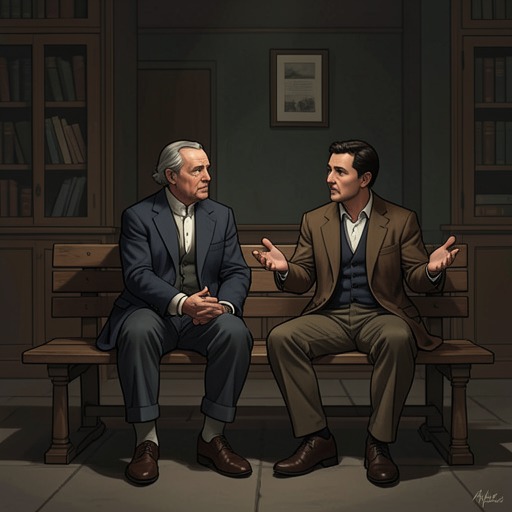
Lennie and Sarah repair their friendship
The Sky Is EverywhereLennie and Sarah repair their friendship through a conversation that turns a difficult confession into an acknowledgment of shared grief. Lennie admits that Joe Fontaine saw her kissing Toby, and Sarah responds not with condemnation but with a sincere question about why it happened. As Lennie struggles to explain the connection to Bailey Walker’s death, the conversation reveals that Sarah has been grieving too. Laughter and an embrace let the friends cross some of the distance between them, even as Sarah’s final questions leave Lennie’s entanglement with Toby unresolved.
The Confession and Sarah’s Response
The conversation opens with Sarah asking Lennie not to expect moral judgment and securing a promise that Lennie will tell her what happened. Lennie admits that Joe saw her and Toby kissing the previous night. The admission makes visible a breach that Sarah had already suspected: her earlier bad feeling proves well-founded, but she does not turn that suspicion into a reprimand. Instead, she asks why Lennie would do it and observes that Lennie does not love Toby and is deeply attached to Joe.
That distinction matters to the scene. Sarah is trying to understand a choice she finds difficult to explain, not to reduce Lennie to it. Lennie, meanwhile, does not defend the kiss as an expression of love for Toby. She says she thinks it has to do with how much she and Toby both love Bailey. Her explanation places the encounter within their bereavement, without making it less troubling: Bailey would have objected, and Lennie knows that. The sisters’ absence is therefore present in the conversation as both the shared loss that draws Lennie and Toby together and the judgment Lennie imagines Bailey would have made.
Anger Turns to Laughter
When Sarah says Bailey would have been furious, Lennie agrees. She then insists that Bailey is dead and that she and Toby do not know how to cope. The grief beneath her explanation emerges as anger: she raises her voice and mockingly proposes elaborate acts of penance, from mortifying herself to wearing a hair shirt. The exaggerated list shows her distress without resolving it; she is furious at Sarah for naming a truth that she already recognizes.
Sarah first plays along with the proposed punishment, escalating it into an absurdly complete hair outfit and calling Lennie a saint. Her response changes the scene’s emotional direction. The joke gives both friends room to laugh at the impossible demand that Lennie somehow punish away her grief and the kiss. Their laughter becomes shared rather than adversarial: the anger that had threatened to divide them gives way to an ease they can experience together. Lennie apologizes between gasps, a small acknowledgment that the outburst has affected Sarah even as their laughter makes renewed contact possible.
Naming the Distance Between Them
The scene’s reconciliation depends on more than humor. After weeks of things left unsaid, Lennie tells Sarah that she thought Sarah could no longer understand her. Lennie had felt changed by grief while Sarah seemed unchanged, and she connects that perception to how Bailey may have felt about Lennie. The comparison complicates Lennie’s self-understanding: she can recognize that the distance she felt from Sarah may echo a distance she herself had once created with Bailey.
Sarah does not claim that she understood Lennie’s experience. She admits that she felt useless and found grief books formulaic and unhelpful. Lennie thanks her for reading them, but then realizes Sarah may have read them for herself as well. Sarah says that she misses Bailey too. Until that admission, Lennie had not fully considered that Sarah’s reverence for Bailey also meant Sarah had her own loss to bear. The recognition changes their positions in the conversation: Sarah is not simply the friend looking in from outside Lennie’s grief, and Lennie is not the only one who has been left with Bailey’s absence.
Lennie reaches across the bench and hugs Sarah tightly. The gesture answers what Lennie cannot yet put into words and acknowledges that, by withdrawing into her own private grief, she had left Sarah to mourn alone. Their renewed closeness is also interrupted by a car full of students from Clover High, whose honking breaks the moment. Sarah waves her feminist book at them, and Lennie laughs. The brief interruption does not undo the reconciliation; instead, their shared amusement shows that the friends can again respond to the same moment together.
A Repair, Not a Resolution
Sarah returns to the subject of Toby, asking whether Lennie and Bailey had been competitive as sisters. Her question follows the admission that Lennie and Toby’s closeness is bound up with their love for Bailey, but it remains a question rather than an established explanation. The available conversation does not show Lennie answering it or Sarah reaching a settled judgment about the kiss. Their friendship is repaired through honesty about hurt and grief, not through a final account of Lennie’s conduct.
The scene’s change is therefore limited but consequential. At its start, Sarah’s suspicion and Lennie’s confession expose the strain between them; at its center, the friends discover that both have been grieving while each misread the other’s position. Laughter, Sarah’s admission, and Lennie’s embrace restore a measure of intimacy. Yet the conversation leaves its hardest subject—what Lennie and Toby’s grief-driven closeness means—open. Sarah’s continued willingness to ask about it suggests that renewed friendship includes not only comfort but also the difficult questions the two had avoided.