Lennie's mourning for Bailey
The Sky Is EverywhereLennie's mourning for Bailey begins as a struggle to bear the sister's absence and develops into a continuing relationship with her through memory, music, words, and ritual. It does not follow a straight path from pain to recovery: daily life can briefly resume, but an ordinary object or remembered future returns Bailey's death to the present. By the end, Lennie can imagine a future without treating that future as proof that she has stopped loving her sister.
The First Months: Avoidance and Intrusion
Two weeks into summer vacation, Lennie describes herself, Gram, and Big as scattered and unsettled, each moving in a different direction. Gram tries to revive an old pattern of closeness by following Lennie with tea, but Lennie does not want to talk. The ritual that once connected them now emphasizes the distance grief has opened: Gram still offers company, while Lennie cannot accept it. Her withdrawal is not a lack of attachment, but one of the ways loss reorganizes ordinary family life.
Grief also intrudes through the body and through impulses Lennie does not understand. She finds herself kissing a pillow and imagining forbidden intimacy with Toby, Bailey's boyfriend, then judges herself for wanting closeness amid bereavement. Her new desire frightens her partly because it is entangled with the person she has promised not to kiss again. Mourning thus coexists with emotional and sexual awakening, making Lennie feel less in control rather than neatly comforted by change.
At Bailey's desk, the physical traces of the life she will no longer lead can make even touching a drawer feel unbearable. Lennie imagines Bailey enclosed in an airless box and forces the image away. Yet she returns to the desk and to the objects associated with her sister. When she discovers Bailey's phone account is still active, she calls the number repeatedly to hear the greeting. Bailey's playful message, performed as Juliet, gives Lennie a voice to approach and then lose again: at first she hangs up at the tone, but eventually stays on the line. The calls do not undo the death; they make the distance audible.
Guilt, Change, and the Unlived Future
Lennie is troubled by the possibility that Bailey's death has changed her in ways that feel alive as well as devastating. Lying on the forest floor, she imagines that, had Bailey survived, she herself might have remained content in a mild, protected version of happiness. Now she feels exposed and intensely responsive to the world, and wonders whether that new intensity is something she prefers. The thought immediately becomes a source of guilt: any good that seems to emerge from Bailey's death feels morally wrong. Remembering that Bailey herself lived with daring, and had urged Lennie to do likewise, offers a different way to understand the change. Lennie can learn from Bailey's life without claiming that the loss was worth its cost.
That tension sharpens when shame over Lennie's lies and half-truths to Joe leaves her alone with the grief she had been avoiding. Without the comfort of Toby's arms or the distraction of Joe's, she confronts the future that Bailey will not live: holding Bailey's baby, teaching the child clarinet, and simply growing older together. These unrealized experiences arrive as physical nausea and a breakdown. Lennie screams into her pillow, her pain registering not as an abstract idea but as the rupture of a shared life that had seemed to extend ahead of them.
Returning to Music and the World
Mourning does not prevent Lennie from finding brief passages back into ordinary activity. After two hours practicing Cavallini's Adagio and Tarantella, she describes the music as making the air seem to turn into colors. The experience recalls Mr. James's musical advice and helps her consider returning to summer band practice. She also reaches out to Sarah. Their phone call begins with Sarah's anger and quickly opens into the summer news Lennie has missed; they arrange to meet at Flying Man's. These moments do not resolve Lennie's loss. They show her moving, for a time, toward music and friendship while Bailey remains central to her inner life.
Later, Lennie recognizes the future as both a privilege and a burden: she has one, and Bailey does not. She does not interpret this as an escape from grief. Instead, she understands that Bailey's death will recur throughout her life because her love will recur too. Grief becomes something carried alongside each new step, not a condition that vanishes once Lennie resumes living. Her decision to emulate Bailey by meeting the world with daring, spirit, and joy holds the two truths together: the loss remains, and life continues.
The Grave, the Letters, and a Continuing Bond
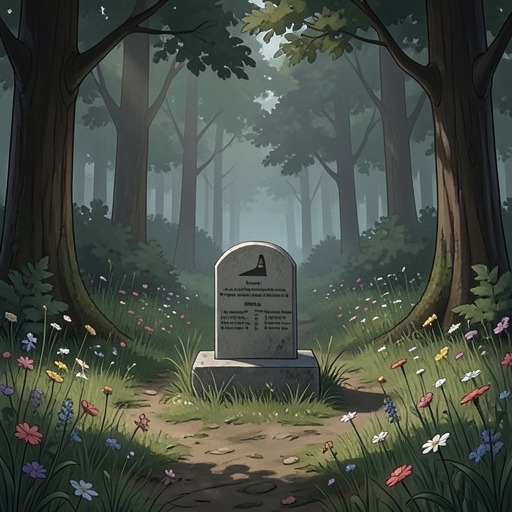
Lennie's eventual visit to Bailey's grave joins movement with remembrance. After running through alternating patches of sunlight and shade, she feels the fabric of death that has clung to her for months loosen. The brief exhilaration does not cancel the loss; she still walks to the grave and recalls that the family chose a site where Bailey could be near the river. The gravestone's small cabinet, with a bird engraved on its metal door, makes remembrance concrete and intimate. Lennie touches Bailey's name and the words she once gave Gram for the funeral, The Color of Extraordinary.
She places in the cabinet a notebook containing the letters Gram wrote to Paige Walker over sixteen years, wanting Bailey to have those words and remain part of the family's story. In the same cabinet she finds an orange-topaz ring that Toby must have had made for Bailey. Its discovery makes the lost announcements—the marriage and the baby—newly tangible: Lennie imagines Bailey showing the ring when the couple told the family. She kisses it and returns it beside the notebook, preserving both the relationship and the future that never arrived.
Finally, Lennie takes her nearly dead houseplant to the edge of the falls, removes it from its pot, and throws it forward. The gesture follows her private act of placing letters and the ring with Bailey, but it has a different direction: the plant, reduced to a few blackened leaves, is released into the landscape rather than kept in the memorial cabinet. The sequence gives no promise that grief is finished. Instead, Lennie's mourning reaches a form capable of holding remembrance, pain, and motion at once: Bailey remains part of her story, while Lennie steps toward the next day.