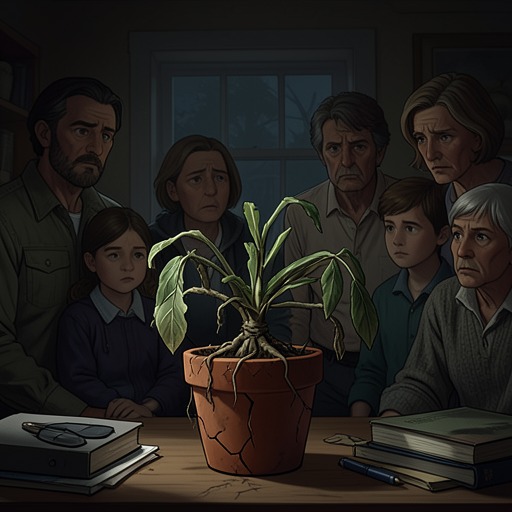
Lennie’s grief erupts through her clarinet
The Sky Is EverywhereLennie’s grief erupts through her clarinet when an attempt to play music with Joe opens the way to the feelings she has been unable to say aloud since Bailey died. The performance begins as an invitation and becomes a rupture: the sound carries years of memory, guilt, anger, and longing out of Lennie before she can control it. Joe’s astonished presence makes him the first witness to this unguarded expression, while the scene turns music from something Lennie is trying to resume into a language for grief.
Background and Immediate Pressure
School has been out for two weeks, and the household is unsettled by Bailey’s absence. Lennie describes herself, Gram, and Big as moving in different directions. Gram follows Lennie with a full teapot, trying to revive the late-afternoon ritual they once shared before the others came home. Lennie does not want to talk, and Gram has not accepted her withdrawal. Even in the shower, Gram tries to conceal her crying from Lennie and Big, though Lennie knows they can hear it. Grief has altered familiar routines without making the loss any less present.
Lennie’s distress also appears in confusion about desire. Alone in bed, she catches herself kissing her pillow and condemning her own impulses: she has kissed boys at funerals, made out with Bailey’s boyfriend Toby, and now keeps imagining someone she has promised her sister she will not kiss again. She recalls that earlier sexual encounters left her feeling detached, unlike the intense passion she had imagined through novels. The contrast helps explain why the feelings now crowding her are frightening: Lennie cannot separate her desire for closeness from her bereavement, guilt, and need for comfort.
Just before the music scene, Toby’s name appears on Lennie’s phone. She lets the call go to voicemail; seeing it brings back the previous night and makes her feel like the worst person in the world. When everyone looks at her, she leaves the kitchen rather than answer. Her invitation to Joe follows this moment of evasion, but the music does not let her simply set aside what the call has stirred up.
The Clarinet Outburst
Lennie asks Joe to play and goes upstairs for her clarinet. After an exclamation from Joe and apologies to Gram and Big, the two return to the porch. Lennie tells him to start and says she will follow. Joe begins with soft chords in G minor, but gentleness cannot settle her. She remains caught in Toby’s call and kisses, and in the household objects that have become reminders of absence: cardboard boxes, unused perfume, unmoved bookmarks, and St. Anthony statues that seem to move.
One image breaks through the confusion. Lennie remembers that, at eleven, Bailey did not include herself in a drawing of their family. The drawing makes Bailey’s absence feel older and stranger than the immediate loss; even a picture of family had held an exclusion Lennie did not know how to understand. From there, Lennie turns toward everything she has not said since Bailey died. Words held deep in her heart begin to move through her like a river, gathering sorrow, fury, devastation, and guilt into a force she can no longer keep inside.
She draws in as much air as she can and blasts it through the clarinet in a single, wild, bleating note. The sound is not a measured performance of Joe’s gentle accompaniment. Lennie forgets that she is playing and even forgets that Joe is beside her. As the note continues, her imagination breaks through walls and burns through the past: memories of Bailey and Lennie in the river and ocean, in their room and the backs of cars, in bathtubs, and running through trees. These shared places and repeated scenes give the outburst its shape. Rather than recounting one memory neatly, the music lets years of sisterhood arrive together.
Witness and Aftermath
The force of the imagined release carries Lennie toward destruction as well as expression. She pictures breaking windows, pushing Toby away, and hurling her houseplant into the sea. The plant, like the other objects she names, belongs to the material world through which her distress has been accumulating; in the outburst it becomes something she wants to throw off. The scene does not present these acts as a literal sequence of damage. They belong to the emotional surge unleashed by the clarinet, as grief and anger momentarily exceed the boundaries of ordinary behavior.
When Lennie opens her eyes, Joe is staring at her, astonished, and dogs next door are barking. His reaction confirms that the sound has broken out of the private space where she had kept her feelings: another person has heard it. Joe responds by saying he thinks he will follow next time. The comment acknowledges the force of what he has witnessed without reducing it to a polished musical performance. Lennie has not explained her grief to him in orderly words, but he has been present while it becomes audible.
The episode belongs to a wider change in Lennie’s relationship with music. After practicing Cavallini’s Adagio and Tarantella for two hours, she later describes the experience as turning the air into colors and considers attending summer band practice after all. Mr. James’s repeated lesson that music cannot come out of a horn unless a person has lived gives that renewed practice a particular resonance. The clarinet outburst is not itself a composed achievement; its importance lies in the feeling that breaks through it and in Lennie’s growing willingness to play again.
Grief, Change, and Narrative Significance
The episode also anticipates Lennie’s later understanding that her life cannot be divided into loving Bailey and grieving her. She recognizes that she would probably have remained mildly happy and protected within her shell if Bailey were alive, and fears that she has begun to prefer the heightened, exposed state that followed her sister’s death. That fear does not make Bailey’s death a benefit. Rather, Lennie comes to understand her changed openness through Bailey’s example: Bailey had urged her to come out of herself, and Lennie can learn from her sister’s life rather than treating the death as the source of that lesson.
Later, Lennie runs through the woods toward the cemetery and feels the fabric of death loosen from her as she moves into a future Bailey cannot share. At Bailey’s grave, she remembers the care taken to place it where Bailey could see and hear the river, and touches the inscription she wrote for her sister. These later moments give the clarinet scene its place in Lennie’s mourning: a sudden expression does not end grief or erase the guilt accompanying it. It begins to make room for movement, music, and a future in which loss remains present. Lennie eventually understands grief and love as inseparable, and the earlier blast of sound is a first embodied form of that recognition: the pain cannot be spoken cleanly, but it can pass through her and be heard.