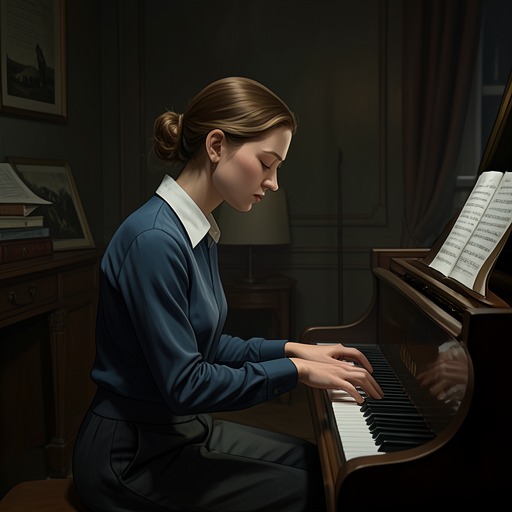
Lennie’s musical inhibition
The Sky Is EverywhereLennie’s musical inhibition is the gap between her considerable technical ability and her difficulty making music feel emotionally alive. She can play with speed, range, and control, yet withdraws from solos and even sabotages her chance at first chair. Music becomes both a measure of what she cannot express and, eventually, the means by which grief and connection force their way into sound.
Ability and the First Signs of Inhibition
As a freshman, Lennie and Bailey Walker both make honor band. During a lesson in musical openness, Mr. James leads the students out of the classroom and into the forest beside the rushing river. He urges them to listen and make music, then conducts the river, wind, and birds before the students join in with their instruments. Lennie is among the first to play. The episode establishes that she once could enter music spontaneously, among other musicians and the sounds of the natural world, rather than treating performance as a test of correctness.
Back in the classroom, Mr. James gives Lennie the card of Marguerite St. Denis and tells her to call. The recommendation marks her as a promising clarinetist, but later achievement does not guarantee ease of expression. When Joe Fontaine hears her play, he recognizes her command of the instrument: her fingering is quick, her tonguing fast, and her range of tones broad. What troubles him is that the skill seems to stop at technique. He describes her playing as sleep-playing, a judgment that lands with the force of exposure because Lennie already knows what he means. Rather than welcoming his attention, she feels caught and retreats inward.
The contrast between that assessment and her potential becomes especially sharp when Lennie thinks of Joe’s virtuoso performance. She can feel the music in her own fingers, but balls them into fists. Joe, she realizes, possesses the abandon, passion, innovation, or courage Mr. James had tried to draw from the students in the forest. Lennie, by contrast, thinks of herself as occupying second chair. The comparison is not simply about ranking: it names the distance between hearing what expressive playing can be and allowing herself to risk it.
Avoidance and the Shape of the Block
Lennie eventually tells Joe that she deliberately blew the chair audition. She had not wanted first chair or the solos, and she had sabotaged her chance rather than take on that exposure. Saying this aloud is itself a release: until then, she has not admitted the choice to anyone. She explains her fear through an image of jumping from rock to rock in the river in thick fog, alone, with every step uncertain. For her, a solo is not merely a technical challenge. It makes each movement feel like a risk taken without a clear view of where it will lead.
Joe answers by treating the fear as recognizable rather than disqualifying, comparing musicians’ apprehension to the possibility of face-planting. But Lennie knows her difficulty exceeds performance nerves. Marguerite St. Denis had understood the problem as nervousness and thought that was why Lennie quit; Lennie now insists to herself that something deeper is happening. For more than a year, she has felt cramped and frightened inside herself when she plays, like a jack-in-the-box without a spring. The image captures both pressure and paralysis: something is held inside, but the expected mechanism for release will not work.
Joe’s response is practical as well as sympathetic. He turns toward playing together, suggesting a clarinet-and-guitar duet and looking through handwritten sheet music. His invitation offers a different condition from a solo: Lennie would not have to produce music alone or know in advance exactly where it would go. Yet she initially feels that he has not understood the magnitude of her confession. The offer matters nonetheless because it makes musical recovery a shared activity rather than a test she must pass by herself.
Grief Breaks Through the Instrument
The most forceful release arrives after Lennie has let a call from Toby Shaw go unanswered. The call brings back their kisses and her distress about what has happened between them. She asks Joe to play and goes upstairs for her clarinet; back on the porch, she tells him to begin and says she will follow. Joe starts soft chords in G minor, but the music does not keep her in the calm the arrangement seems to promise. Thoughts of Toby, the boxes and perfume associated with absence, unmoving bookmarks, a St. Anthony statue, and a childhood family drawing in which Bailey had left herself out crowd into the moment.
Then Lennie’s attention turns to all the words she has not spoken since Bailey Walker died: words trapped by sadness, rage, devastation, and guilt. She draws in an enormous breath and releases it through the clarinet as one harsh, uncontrolled note. The playing gathers memories of the sisters in the river and ocean, in their room, in cars and bathtubs, and running through the trees and through years spent without their mother. The sequence gives musical form to experience that speech has failed to hold. Rather than a polished solo, the sound is an eruption in which the instrument carries the force of what Lennie cannot say directly.
The outburst is not a neat cure. Lennie’s imagined destruction—breaking windows, bursting through walls, burning up the past, pushing Toby away, and hurling Lennie’s houseplant into the sea—expresses the scale and unruliness of the feelings moving through her. When she opens her eyes, Joe is staring at her in astonishment and the dogs next door are barking. The immediate consequence is not a performance judged by musical standards but a witnessed event: Joe has heard an unguarded sound emerge where Lennie had been holding herself shut.
Renewed Playing and Continuing Vulnerability
Lennie’s return to playing remains uneven. At a later rehearsal for the River Festival, she finds her fingers moving through the pieces Mr. James has chosen. Despite Rachel Brazile repeatedly turning the stand so Lennie cannot see it, Lennie loses herself in the music and feels as though she is playing alone with Joe, improvising and welcoming the uncertainty of each note. That freedom briefly reverses the old fear of not knowing what comes next: uncertainty becomes part of the pleasure rather than a threat.
The change does not last without interruption. Mid-song, Lennie is overtaken by dread about Toby, his departure, and what he said in The Sanctum. She forces the panic aside but spends the rest of rehearsal painfully alert, following the arrangement without deviation. The movement from improvisation to strict adherence shows how quickly emotional conflict can narrow her playing again. Musical inhibition, then, is not simply overcome by a single dramatic release; it returns when grief, guilt, and intimacy press on her attention.
At Joe’s home, while Lennie is distracted by what she has noticed in a notebook and avoids asking him a more difficult question, he returns carrying two clarinets, a B-flat and a bass. She reaches for the soprano clarinet she is accustomed to playing. As Joe begins his tuning ritual, the surrounding world recedes for her into him and a handful of chords. The moment echoes the earlier invitation to play together: music can create a space of concentrated connection, even when Lennie remains unable to speak openly about what troubles her.
The arc of Lennie’s inhibition is therefore defined by a recurring tension between control and exposure. Technique lets her perform, but it cannot by itself make the music feel truthful; fear drives her to abandon a solo, while grief eventually makes the clarinet speak in a sound she cannot regulate. Playing with Joe offers companionship and the possibility of improvisation, yet Toby’s presence in her thoughts can send her back to rigidly following the arrangement. Music becomes not a simple cure for grief but a changing form of relation—to Bailey’s memory, to other musicians, and to feelings Lennie has not yet found words for.