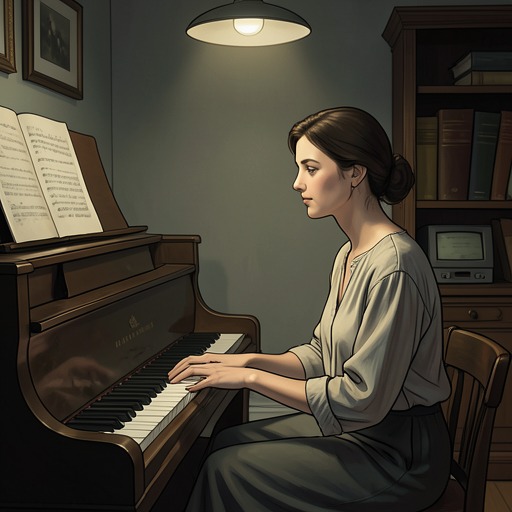
Marguerite St. Denis
The Sky Is EverywhereMarguerite St. Denis is a clarinet teacher whose confidence in Lennie Walker’s musicianship points her toward a future beyond school band. An old friend of Joe Fontaine’s family, she has also taught Joe at a conservatory in France. Through lessons, professional connections, and the ambitions she voices for her students, Marguerite helps connect Lennie and Joe’s musical lives even before their playing becomes a shared form of expression.
Identity and Introduction
Marguerite enters Lennie’s story through a practical gesture: after Lennie and her friend make honor band during freshman year, their frustrated band director, Mr. James, hands Lennie Marguerite’s card and tells her to call immediately. The introduction places Marguerite outside the school’s ordinary instruction, as someone Mr. James believes can offer Lennie a more serious musical opportunity.
By the following summer, Marguerite has become Lennie’s clarinet teacher. Lennie later recalls quitting those lessons while spending time with Bailey Walker and Toby Shaw at Flying Man’s. Marguerite’s influence persists after the lessons end: Lennie remembers that she had begun urging her to consider a performing arts conservatory in New York City, as well as auditions and higher levels of competition.
Teaching and Musical Ambition
Marguerite treats Lennie’s ability as something worth developing beyond participation in an ensemble. Her encouragement encompasses playing first chair, auditioning for All-State, competing nationally, and seriously considering conservatory study. The breadth of those possibilities contrasts with Lennie’s own self-image. After Toby describes the companion ponies that stay beside Thoroughbred racehorses, Lennie identifies herself with the pony and concludes that such a role does not include soloing. Marguerite’s ambitions for her therefore exceed what Lennie is willing to imagine for herself.
That difference makes Lennie’s decision to stop lessons significant without establishing that she lacks skill or interest. Marguerite has already recognized a capacity for more demanding musical work; Lennie, by contrast, frames herself as a supporting player rather than a potential soloist. The tension between the teacher’s confidence and the student’s self-limitation remains part of Lennie’s musical history after their lessons have ended.
Connection to Joe Fontaine
Joe describes Marguerite as an old friend of his family and jokes that she is the person he blames for his being in Clover. He imitates her expressive hand gesture while recalling her praise of Lennie’s clarinet playing, then explains that Marguerite taught at a conservatory in France during most summers. Joe had assumed he was her only student who played exceptionally well; learning that she had praised Lennie unsettles that assumption and gives him a personal reason to take an interest in her musicianship.
Marguerite’s former students later meet through music. Lennie invites Joe to play, and he brings two clarinets, a B-flat and a bass, while she reaches for the soprano clarinet she knows. At a later rehearsal for the River Festival, Lennie becomes absorbed in the music and imagines playing with Joe alone, improvising rather than following each note as a fixed plan. These scenes show a musical connection developing between the students Marguerite once taught, although the evidence does not make her present at their playing or attribute their later intimacy to her.
Influence and Narrative Role
Marguerite’s influence is chiefly conveyed through recollection and consequence rather than through an onstage appearance. The card from Mr. James opens access to her teaching; her conservatory recommendation exposes the distance between Lennie’s ability and her modest expectations for herself; and Joe’s account links her teaching to a musical history that includes both of them.
Lennie’s later music also acquires meanings beyond technical accomplishment. After Bailey’s death, Lennie plays a sustained, uncontrolled clarinet note that releases feelings and memories she has been unable to express in words. At the River Festival rehearsal, she again experiences music as an absorbing, collaborative possibility before anxiety about Toby pulls her attention back to the conflict in her life. The supplied scenes do not show Marguerite guiding these moments, but they make her earlier insistence on Lennie’s musical potential part of the contrast between the role Lennie once accepted and the expressive possibilities she begins to inhabit.