The restless gene
The Sky Is EverywhereThe restless gene is the Walker family’s inherited name for a tendency to keep moving, leave home, and pursue life elsewhere. It shapes how Lennie Walker understands her absent mother, Paige Walker, and how Gram explains the women who have departed and later returned. The idea is neither established as a medical diagnosis nor simply dismissed as fiction. Instead, it functions as family lore: a way to recognize a recurring pattern, give absence a comprehensible shape, and, as Gram eventually admits, avoid confronting her own part in the family’s story.
Family Lore and Its Pattern
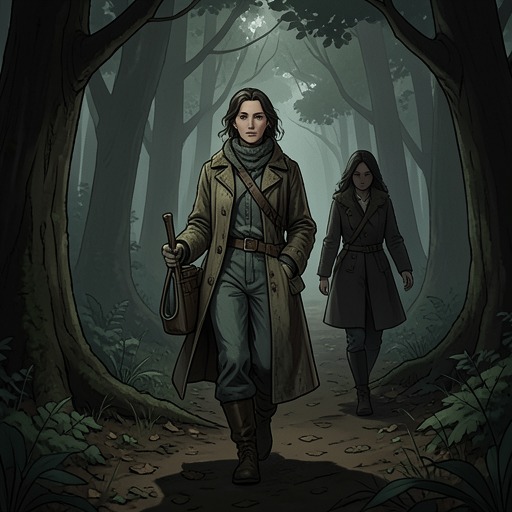
Gram describes restlessness as something that has run through the Walker family for generations, mostly among women. Those she considers afflicted move from town to town, across continents and between relationships; after years away, some eventually return. She names her aunt Sylvie and a distant cousin, Virginia, among the relatives who traveled widely and came back. Sylvie’s return after twenty years, in a battered yellow Cadillac, gives the family account a concrete precedent, while Gram’s insistence that leaving and returning are both part of the pattern turns individual lives into a kind of inherited cycle.
In Gram’s version, the idea also helps explain Paige’s itinerant life and why her daughters did not know who their fathers were. She presents Paige as someone who had been running from the beginning, but distinguishes running toward something from running away. That distinction matters to Lennie: it gives her a way to imagine her mother’s movement as pursuit rather than rejection. Yet it cannot answer the questions the phrase invites. Lennie wonders what Paige was running toward, and whether Bailey Walker or Lennie herself might share the same impulse.
The family name can sound biological, but the evidence remains familial and interpretive rather than diagnostic. Gram speaks of a condition and an inherited tendency; Big later treats the language more loosely, calling it a way of classifying a pattern that seems to recur in the family. Gram likewise acknowledges that a doctor might give the tendency a name, but maintains that a label would not change what the family has experienced. The phrase therefore works less as a verified explanation than as a shared account of repeated departures.
Gender, Departure, and Paige
When Lennie asks whether boys can inherit the tendency too, Gram says they can, but argues that men’s restlessness attracts less notice. In her account, men may become astronauts, pilots, cartographers, criminals, or poets without their movement being treated in the same way as a mother leaving her children. For women, she says, the consequences are more complicated. Her example is Paige, who has been gone for sixteen years and has not returned to see her daughters. The family expression thus describes a pattern, but Gram’s own explanation also exposes how gender and family responsibility shape the meaning attached to it.
Paige’s departure is not only a family legend. In Gram’s later recollection, Paige came for a weekend visit and disclosed that she had a one-way plane ticket to an unknown destination. She said she did not feel she had what it took to be a mother. Gram answered that Paige was responsible for her daughters and urged her to stay, offering to help raise them. Paige left nonetheless. The remembered conversation makes the limit of the inherited explanation plain: even if restlessness helps describe Paige’s history, her decision remains consequential, and Lennie and Bailey were left without their mother.
The unfinished portrait of Paige in the family home gives the idea a visible counterpart. Gram had been painting her daughter before Paige left, but never completed the face; the portrait remained on display as an incomplete maternal image. Gram also repeatedly told the girls that Paige would return, so they waited for a phone call, a visitor, or a letter. The expectation of return softened the finality of her absence, but it also kept the family suspended between hope and the fact that Paige had not come back.
Bailey, Lennie, and the Limits of Inheritance
After Bailey’s death, Lennie begins to wonder whether her sister had the restless gene. Bailey had searched for their mother, and Lennie connects that search to the possibility that becoming a mother herself made the question newly urgent. She also remembers Bailey’s energy in cross-country and her changing personas onstage as signs of a lifelong restlessness. At the same time, Lennie recognizes that she had not wanted Bailey to find Paige: she feared that their mother might offer Bailey a route out of their shared life. This is Lennie’s reading of Bailey, not a settled fact about what motivated every choice Bailey made.
Big challenges that interpretation. He recalls Bailey as relieved when she was rejected from a school in New York City and says he never saw her as someone eager to leave. His response prevents the family theory from becoming a simple hereditary explanation that can be applied with certainty to every Walker. When Lennie asks whether he believes in the gene, Big first treats the idea skeptically, then allows that a tendency, whatever its cause, seems to run through the family. His uncertainty leaves room for patterns without turning them into proof.
Big initially places the strongest example elsewhere: he thinks Gram herself may once have had the tendency, even though she rarely leaves the neighborhood. He imagines that she contained it by spending long stretches in her art room and transferring it onto her canvases. This possibility broadens the meaning of restlessness beyond literal travel. In Big’s account, an impulse to depart may be redirected into creative work rather than visibly acted out. Gram later acknowledges that she, too, used the family explanation to understand the departures around her.
Gram’s Revised Account
Lennie’s discovery of Gram’s sealed letters to Paige complicates the distant, wandering figure she has been taught to imagine. The letters contain ordinary details about Paige, including her love of lilacs, her habit of sleeping in the garden during spring, and her way of making pesto with walnuts. These glimpses do not cancel the years of absence. Instead, they make Paige more particular and more recognizably human, intensifying Lennie’s longing for a mother who existed in daily life as well as in the family story of an explorer.
When Lennie confronts Gram, Gram admits that she had focused on Paige’s restlessness because she hoped the explanation would keep the girls from feeling abandoned or blaming themselves. She had wanted them to admire their mother. But she also recognizes that the story protected her: it was easier to attribute Paige’s departure to destiny or inherited tendencies than to reckon with Gram’s own actions. Her confession does not retract the family’s history of restless relatives. It reveals that a story can contain truth and still be used to conceal responsibility.
Gram recalls the night Paige announced her plan to leave. She remembers Paige in a long green dress and the flowers in the kitchen, then remembers her pacing and saying she could not be a mother. Gram had told her to stay and take responsibility. After hearing this, Lennie tells Gram that Paige’s leaving and failure to return were Paige’s choices, not Gram’s fault. Gram responds with relief, describing the moment as if Lennie had opened a window and let Paige out. The exchange separates two truths the family lore had blurred: the impulse to leave may recur, but it does not make one person responsible for another’s decision.
Narrative Significance
The restless gene gives the family a language for absence, but the novel repeatedly tests what that language can and cannot explain. It lets Gram place Paige among earlier relatives who left and returned; it lets Lennie imagine movement as a possible inheritance; and it gives Big a flexible category for a tendency he cannot verify. Yet the phrase can also make a painful choice sound inevitable. Gram’s admission that she used the story to protect herself exposes that risk without reducing the family’s account to a lie.
Lennie’s understanding changes as she encounters different kinds of evidence: the portrait that preserves Paige as an unfinished image, Gram’s letters that disclose everyday habits, Big’s doubts about who in the family was truly restless, and Gram’s recollection of the night Paige left. At Bailey’s grave, Lennie places a notebook containing transcriptions of Gram’s letters so Bailey can be part of what Lennie has learned about their mother. This act carries the family story forward in revised form. The tendency to leave remains part of how the Walkers understand themselves, but it no longer has to stand in for the whole truth about Paige, Gram, or the daughters left behind.