Childlike Innocence and Faith
The Snow QueenChildlike Innocence and Faith is the story’s answer to the question of what can overcome the Snow Queen’s hold on Kay: not borrowed physical strength, but Gerda’s own purity, persistence, and faith. The Finland woman names this quality as the power Gerda already possesses. At the end, the principle gains a spiritual frame when the Grandmother reads from the Bible and Gerda and Kay understand anew a song they knew as children. Their return does not erase the journey; it reveals what has carried them through it.
The Power the Finland Woman Recognizes
When the Reindeer asks whether Gerda can be given the strength of twelve men, the Finland woman rejects the measure implied by his request. Such force, she says, would be of little use. Her answer redirects the question from how much power Gerda can acquire to what kind of power she already has. The Reindeer has brought Gerda to seek help against the Snow Queen, but the Finland woman will not equip her with a weapon or an external advantage.
Instead, she explains that Gerda’s power consists in her “own purity and innocence of heart.” She points to what Gerda has already managed: people and animals have been obliged to serve her, and she has made her way through the world barefoot. The detail makes innocence an active quality, not a sheltered condition. Gerda’s vulnerability has not prevented her from travelling; her journey itself is evidence of a strength that cannot be supplied by another person.
The Finland woman also sets a limit on what assistance can accomplish. She can send Gerda toward the Snow Queen’s garden, but she cannot grant her a greater power or remove the glass fragments from Kay’s heart and eye. Gerda must gain access to him herself. The distinction matters: guidance and transport can bring her to the threshold, but the decisive act cannot be delegated. The story’s account of innocence is therefore joined to action and responsibility rather than passive goodness.
What Kay’s Enchantment Requires
The Finland woman’s counsel is grounded in her account of Kay’s condition. Kay is with the Snow Queen, and everything there seems so pleasing to him that he believes it to be the finest place in the world. The apparent attraction is not presented as a clear-eyed choice: a broken piece of glass in his heart and another in his eye have altered his feelings and perception. Unless both fragments are removed, he will not become a human being again, and the Snow Queen will retain her power over him.
This explanation sharpens the contrast between Kay and Gerda. Kay’s judgment has been distorted so that coldness appears desirable; Gerda’s innocence, by contrast, sustains her attachment and purpose despite hardship. Her task is not to overpower the Snow Queen on equal terms but to reach Kay and undo the damage that has changed how he sees and feels. The Finland woman’s refusal to offer strength for a contest thus follows from the nature of the problem: force would not correct Kay’s perception or restore his humanity.
Gerda’s faith is also given a concrete form before she reaches the Snow Queen. When living snowflakes gather around her on the cold, clear night, she repeats the Lord’s Prayer. The episode places a spoken act of religious trust beside the physical danger of the living guards. It does not turn faith into a weapon handed to her by the Finland woman; rather, it shows Gerda continuing to act from within the conviction that has sustained her journey.
Innocence as Both Means and Limit
The Finland woman’s description does not promise that Gerda can command events at will. Her power has carried her through the world, but the Snow Queen’s garden still lies ahead, and Gerda must reach Kay without a magical increase in strength. Innocence is powerful in this account precisely because it is not domination. It enables Gerda to persist, to elicit help, and to approach the person whom distortion has made inaccessible, while leaving the danger and the work of rescue real.
The Reindeer’s appeal and the Finland woman’s response also distinguish adult measures of strength from the story’s moral measure. The Reindeer imagines an extraordinary force that could defeat an enemy; the Finland woman recognizes a quality already visible in Gerda’s conduct. Her barefoot passage through the world and the help she has received from people and animals are not separate from that quality. They are the circumstances through which its practical force becomes legible.
Return, Scripture, and the Children at Heart
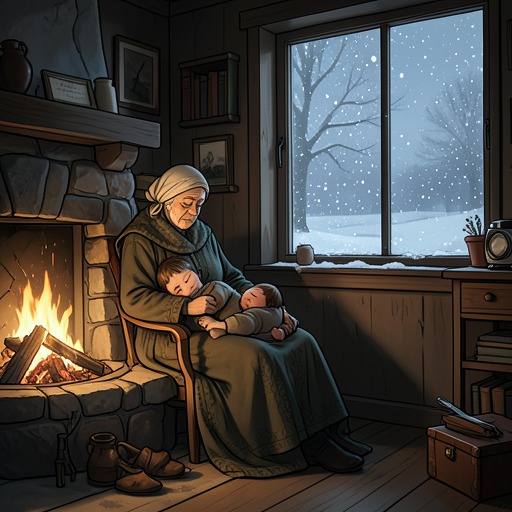
At home, the principle that guided the journey is stated openly. The Grandmother reads from the Bible: “Except ye become as little children, ye shall in no wise enter into the kingdom of God.” Gerda and Kay look into each other’s eyes and understand the words of their old song, including its promise, “But we shall the Christ-child see.” Their response joins childhood, faith, and recognition: what they understood through experience on the journey becomes newly intelligible in the familiar room.
The return is marked by precise continuities and changes. The old clock still ticks; the little chairs remain; the roses bloom at the window. Gerda and Kay sit in their own childhood places and hold hands, yet they have grown into a woman and a man. The Snow Queen’s cold, empty palace recedes from memory like a painful dream, but the ending does not describe them as simply children again. They are grown, yet children at heart, and the story closes in summer. Innocence here is not a refusal of time or experience: it is a faith and tenderness that survive them.
The Concept’s Narrative Significance
The story gives Childlike Innocence and Faith a double function. Before the rescue, it explains why Gerda can continue where an appeal to superior strength would fail; at home, it provides the language through which she and Kay understand the journey’s spiritual significance. The parallel between the Finland woman’s counsel and the Grandmother’s reading makes the ending a confirmation of the principle rather than a new solution introduced after the adventure.
That confirmation also reframes the return. The pair’s childhood chairs and the roses call back to their former life, while their adult bodies register the time that has passed. Their final condition holds both facts together: experience has changed them, but it has not extinguished the childlike faith the story presents as essential. The resolution rests not on the Snow Queen’s world being explained away, but on Gerda and Kay recovering a shared way of seeing in which love, memory, and belief can again be understood.