Forest crow
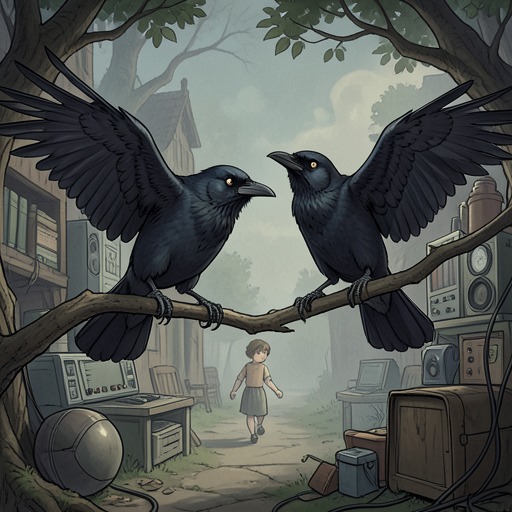
The Snow QueenForest crow is an articulate animal ally who helps Gerda move from searching blindly to pursuing a specific lead about Kay. He cannot reunite them: the boy she finds in the palace is a prince, not Kay. But Forest crow’s knowledge, access, and willingness to help make the night search possible, and his brief journey with Gerda marks both the value and the limits of his assistance.
Encounter and First Clue
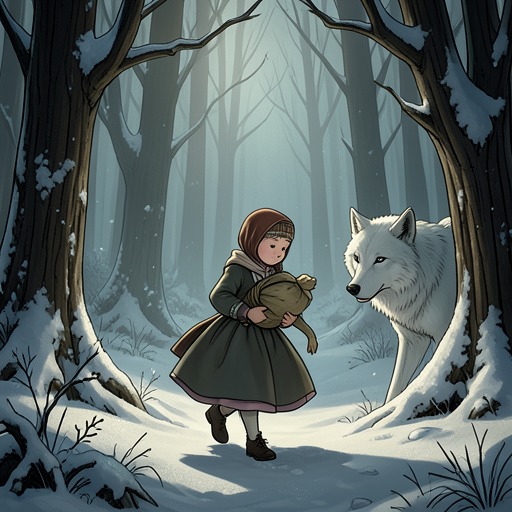
Gerda meets Forest crow when she has been forced to rest during her journey. Autumn has arrived; her feet are sore, the leaves have yellowed and fallen, and the landscape feels cold and bleak. He approaches across the snow, watches her, and greets her as kindly as he can in human speech. His first question—where she is going alone in the wide world—allows Gerda to tell him the story of her travels and ask whether he has seen Kay.
Forest crow answers cautiously. He says that he may have seen Kay, then qualifies the possibility: the boy may have forgotten Gerda by now because of the Princess. This is not reliable confirmation, but it gives the exhausted traveler a reason to hope and a destination to pursue. The qualification also sets up a difficult distinction between resemblance and identity: Forest crow’s report points Gerda toward a boy who might be Kay, without establishing that he is.
Knowledge and Palace Access
Forest crow’s information comes through his tame sweetheart, who moves freely about the palace. He explains that the Princess is exceptionally clever and has decided to marry a man who can answer her when spoken to, rather than one who merely looks grand. The Princess’s requirements offer a plausible explanation for why a young man might be at court, but Forest crow’s account remains second-hand; he makes clear that his sweetheart is the source of what he has heard.
When Gerda asks how she can find the boy, Forest crow recognizes the practical obstacle: a little girl will not easily be admitted to the palace. Gerda insists that Kay will come out to fetch her if he learns she is there. Forest crow does not simply accept that expectation as a plan. He asks her to wait by the palings while he consults his sweetheart, turning his palace knowledge into an attempt to secure actual entry.
He returns late with food taken from the kitchen and a route around the guarded front entrance. Silver-uniformed guards and servants in gold livery would stop Gerda, he explains, but his sweetheart knows a back staircase leading to the sleeping apartments and knows where its key can be found. Forest crow then leads Gerda through the garden and in by a back door. His help is practical and specific: he provides for her immediate hunger, identifies why the obvious entrance will fail, and guides her toward the place where she can test his report for herself.
The Night Search and Its Limits
Inside the palace, Gerda follows Forest crow through increasingly splendid halls to the bedroom. She sees a brown neck in the red lily-shaped bed and calls out, believing the sleeping boy is Kay. He wakes, but he is the Prince, who only resembles Kay in the neck. The Princess also wakes, and Gerda explains her journey and the crows’ assistance. The palace visit therefore corrects the hope Forest crow helped create: his clue was enough to bring Gerda to a possible Kay, but the resemblance does not amount to recognition.
Forest crow’s assistance nevertheless has consequences. The Prince gives up his bed so Gerda can rest, and the following day the Prince and Princess provide her with clothing and a golden coach for the continuing search. The two crows ask for a fixed appointment, thinking of provision for their old age; their request is granted. The story thus shows their service becoming an acknowledged connection to the court, rather than leaving them as anonymous helpers who vanish after the nighttime adventure.
Departure and Narrative Role
Forest crow accompanies Gerda for the first three miles of her departure. He rides beside her because he cannot bear to travel backward, a small practical detail that gives the farewell its own character. His tame sweetheart remains behind, unable to travel because she has been suffering from a headache since receiving her new appointment. The coach carries food as well as Gerda, and the Prince and Princess bid her farewell; after a few miles Forest crow also takes leave.
The parting is emotionally marked on both sides: Gerda weeps, Forest crow weeps, and he flies to a tree to watch the golden coach glitter away in the sunshine. His aid is temporary, but it is not merely informational. He listens to Gerda’s account, risks guiding her into a guarded palace, helps her find rest and a new means of travel, and then accompanies her as far as he can. In the larger search, he functions as a messenger and guide whose knowledge opens one threshold, while the mistaken identification of the Prince makes clear that the journey must continue beyond it.